SMMA Client Acquisition: Referrals vs DMs vs Cold Email
Referrals win the most SMMA clients, cold email is the only channel that scales from zero, and Instagram DMs work only when sent by hand. Here is the ranking.

Referrals from existing and past clients bring in the most agency clients, cold email comes second because it is the only channel a zero-client SMMA can scale legally, and Instagram DMs come third: useful when written by hand to prospects you already know, a breach of Instagram's terms and a ban risk when automated. That is the short answer to SMMA client acquisition in 2026. The main caveat is stage: with zero clients nobody can refer you, so the ranking flips and you start with outbound, then turn your first clients into referrers.
The ranking comes from agency-side survey data, not from a tool vendor. In SparkToro's latest agency survey, "by far the biggest driver of new business remains referrals from existing and past clients", unchanged from the year before (SparkToro, State of Digital Agencies 2025). The survey covers digital agencies broadly, not SMMAs only, so treat it as the closest independent evidence rather than an SMMA census.
SMMA client acquisition channels ranked for 2026
Most pages ranking for this question are written by companies that sell one channel: a cold email sender, a lead list or a DM setter service. Each one puts its own channel first. The table below compares the five realistic options on the factors that decide which one you should run now. It is qualitative on purpose: no public dataset gives SMMA-specific win rates per channel.
| Rank | Channel | Best stage | Speed to first client | Scales? | Policy risk | Main cost |
|---|---|---|---|---|---|---|
| 1 | Client referrals | 1+ happy clients | Fast once you have results | Limited by client count | None | Time: asking at the right moment |
| 2 | Partner referrals (non-competing providers) | Any, easier with a case study | Medium: partners need trust first | Medium | None | Time: relationship building |
| 3 | Cold email | 0 clients and up | Weeks, see the math below | Yes, with list quality and deliverability | Low if CAN-SPAM compliant | Money: tools, domains, data |
| 4 | Manual Instagram DMs | 0 to 5 clients | Medium for warm accounts | No: capped by your hours | Low when genuinely manual | Time: research per message |
| 5 | Automated Instagram DMs | Not recommended | Unpredictable | Until the account is restricted | Breaks Instagram terms | Money plus account loss |
Do referrals really bring the most agency clients?
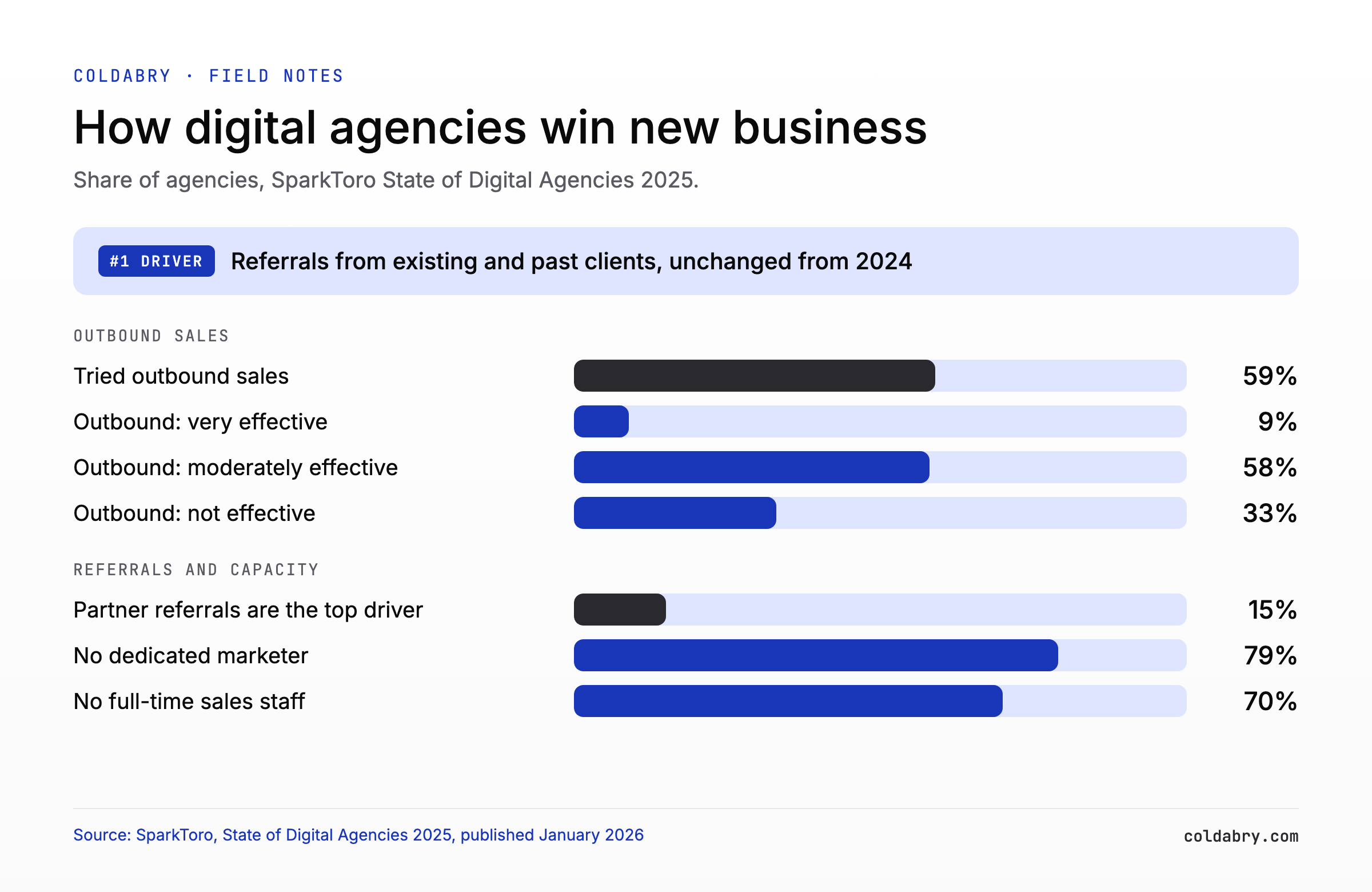
Yes, on the agency side. SparkToro reports that referrals from existing and past clients are the top new-business driver for digital agencies, and that "15% of agencies did say that referrals from partner companies were the top driver" (SparkToro). Outbound is common but rarely a standout: 59% of agencies have tried outbound sales, only 9% call it very effective, 58% moderately effective and 33% not effective at all.
The same survey explains why most agencies lean on referrals by default: 79% have nobody dedicated to their own marketing and 70% have no full-time sales staff. Referrals are what happens when nobody owns new business. They are strong because trust transfers with the introduction, but they are also passive.
The counterpoint comes from the client side. RSW/US, an agency new-business firm, found that in 2022, 73% of clients learned about new firms through networking, 67% through past relationships and 60% through friends or co-workers. By 2025 those figures were 58%, 48% and 35% (RSW/US 2026 Outlook via Agility PR). The report adds that marketers increasingly find agencies "through AI platforms, search, content, and direct outreach".
These are two different measurements. SparkToro asks agencies where their new business came from; RSW/US asks clients how they discover agencies. Both can be true at once: referrals still close the most deals, but fewer buyers start their search there. RSW/US also sells proactive new-business services, so it has a stake in that conclusion. The practical takeaway: keep referrals as your best channel, and stop treating them as something that happens on its own.
Referral ask script (send after the first measurable result)
Ask when the client has just seen a number they like: a record month for reach, a first batch of leads from a campaign, a booked-out week. Not at onboarding, not at renewal.
Email version:
Subject: Quick favor after this month's numbers
Hi {first name}, glad the {result, e.g. "booking requests from Reels"} landed this month. We are taking on {one or two} more {niche} businesses this quarter. Is there one owner you know who would want the same kind of result? If you introduce us by email, I will keep it short and will not chase them. Either way, thanks for trusting us with the account.
In-call version (last two minutes of the monthly review):
Script: "Before we wrap: the {result} this month is the kind of thing we want more of. Do you know one other {niche} owner who is stuck where you were three months ago? If so, I would value an intro. No pressure if nobody comes to mind, I will ask again after the next good month."
Partner-referral pitch (to a non-competing provider)
Pick a provider who serves the same niche but sells something you do not: a web designer, a bookkeeper, a photographer, a booking-software consultant.
Pitch: "Hi {name}, I run social for {niche} businesses and keep meeting owners who need {their service}. I would like to send them your way when it fits. If you meet clients who ask about social media, I would appreciate the same. No commission needed on my side; happy to share a one-page summary of what we do so you know when to mention us."
How to get SMMA clients with cold email (and how many emails it takes)
Cold email is the channel you control from day one: you choose the niche, the list and the volume. The honest question is how much volume one client takes. No public dataset tracks SMMA cold email specifically, so here is a worked example built from two public sources. Treat it as a calculation with assumptions, not a benchmark.
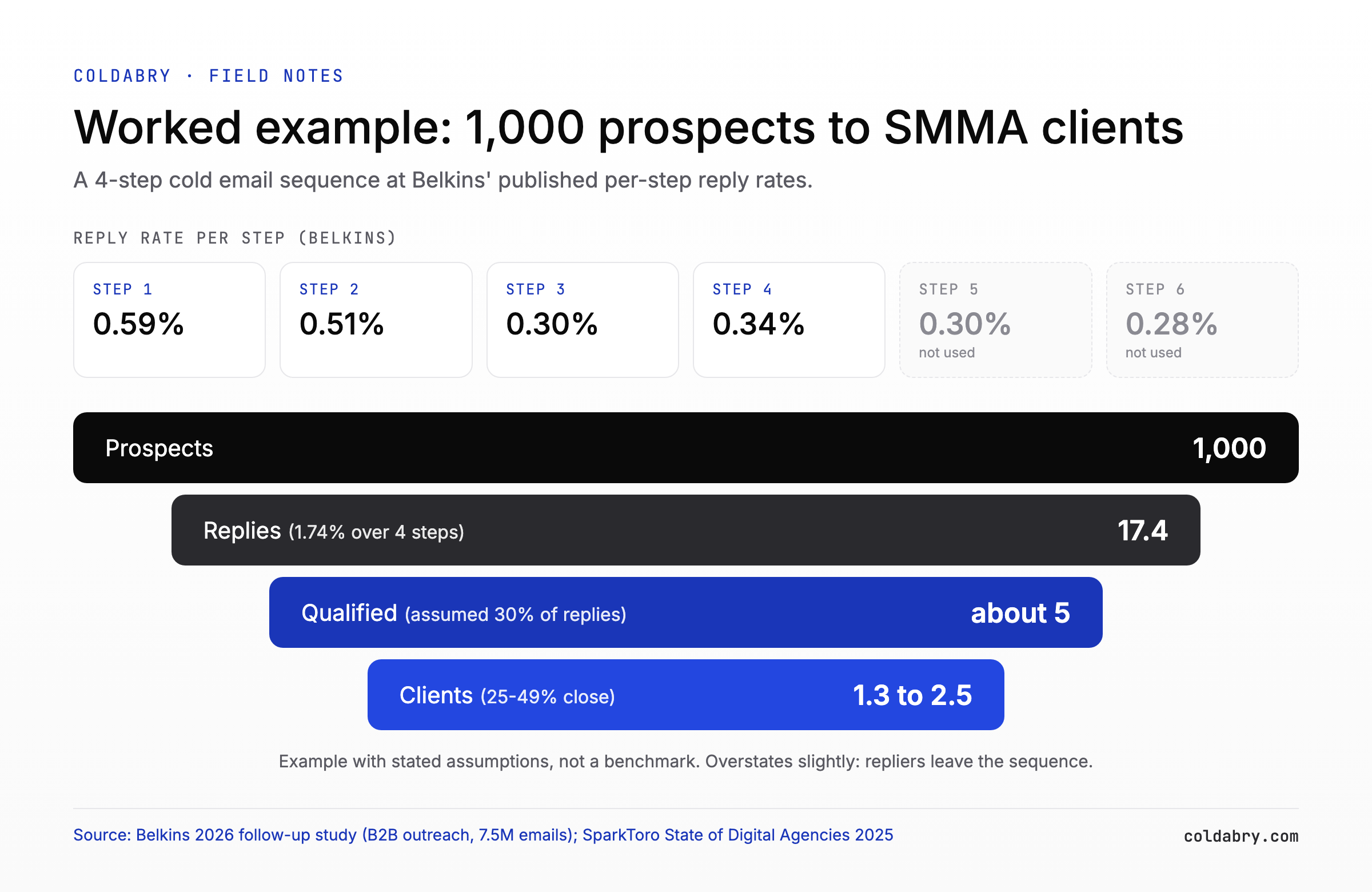
Belkins analyzed 7,530,489 sent emails from its managed B2B outreach in 2025 and published per-step reply rates: 0.59% for step 1, 0.51% for step 2, 0.30% for step 3, 0.34% for step 4, 0.30% for step 5 and 0.28% for step 6 (Belkins 2026 follow-up study). Follow-ups produced 58.6% of all replies. This is B2B lead generation by a specialist firm, not an SMMA campaign, so your numbers will differ.
Worked example: 1,000 prospects, 4-step sequence
- Replies: 1,000 x (0.59% + 0.51% + 0.30% + 0.34%) = 1,000 x 1.74% = 17.4, so about 17 replies. This applies each step's rate to all 1,000 prospects, which slightly overstates the total because people who reply drop out of later steps.
- Qualified leads: assume 30% of replies are real prospects with budget and need (our assumption, not a sourced figure). 17.4 x 30% = about 5 qualified conversations.
- Clients: SparkToro's most common close rate is 25-49% of qualified leads, reported by 39% of agencies (SparkToro). 5.2 x 25% = 1.3 and 5.2 x 49% = 2.5.
Result: roughly 1 to 2.5 new clients per 1,000 well-targeted prospects, under these assumptions. SparkToro also reports that around 55% of agencies take 1-6 weeks to turn a lead into a client, so a campaign launched today pays off weeks later, not tomorrow.
Two levers move this math more than volume. First, list quality: a niche you understand raises the share of replies that are qualified. Second, the follow-up steps, which is where most replies arrive; we cover cadence in how many cold email follow-ups to send, so we will not repeat it here.
Rules: US law covers business email too. The FTC says CAN-SPAM "makes no exception for business-to-business email", opt-outs must be honored "within 10 business days", and each violating email can cost "up to $53,088" (FTC CAN-SPAM guide). EU and UK rules differ and can be stricter, so check them before mailing those markets. Advice to send thousands of emails a day ignores both the law and deliverability.
Do Instagram DMs work for SMMA clients?
Manual DMs can work for an SMMA, because Instagram is where your prospects already show their content and you can reference it specifically. Automated cold DMs are a different thing, and Instagram's terms are explicit about them.
Policy: Instagram's Terms of Use say: "You can't attempt to create accounts or access or collect information in unauthorized ways. This includes creating accounts or accessing or collecting information in an automated way without our express permission, regardless of whether such automated access or collection is undertaken while logged-in to an Instagram account." (Instagram Terms of Use, effective 1 January 2025). Meta's account integrity standard also lists "creating or using an account or other entity through automated means, such as scripting" unless it runs through authorized routes (Meta Community Standards).
That gives three distinct ways to use Instagram for client acquisition:
- Manual, researched DMs. You follow the account, engage with a few posts, then write one message that references something specific. Allowed, slow, does not scale past your own hours. Best for 0 to 5 clients. For wording, see our graded cold DM templates.
- Automated cold DM tools. Scripts or tools that send DMs from your account at volume. This breaks the terms quoted above and puts the account at risk; some DM vendors sell this as the core of SMMA outreach without mentioning it. See how long automated Instagram accounts survive for the ban side.
- Click-to-DM ads. Paid ads that open a conversation through Meta's official tools. Fully allowed, costs ad spend. We compared what Instagram DM ads cost compared with cold DMs separately.
We do not give a reply rate for SMMA DMs here: we found no public, verifiable dataset for it, and the figures quoted around the web trace back to vendors.
How to get your first SMMA client with zero referrals
With no clients, the referral channel is empty, so the first month is outbound plus one offer that lowers the buyer's risk. Several SMMA guides suggest a pay-per-lead or results-based pilot instead of a full retainer (Instantly argues that "most business owners are skeptical of monthly retainers"). The plan below combines that with the channels above.
| Week | Focus | Concrete tasks | Done when |
|---|---|---|---|
| 1 | Niche and list | Pick one niche and one city or region. Build a list of businesses with active but weak Instagram accounts. Note one specific observation per account. | List of a few hundred named prospects with an observation each |
| 2 | Cold email live | Set up a separate sending domain, write a 4-step sequence that references the observation, add a working unsubscribe line and your postal address. | Sequence running to the first batch, opt-outs handled |
| 3 | Manual DMs and pilot offer | Engage with prospects' posts, then send a short daily batch of DMs written by hand. Offer one paid or results-based pilot with a clear end date and one metric. | First conversations booked, pilot terms written down |
| 4 | Deliver and ask | Run the pilot, report the metric weekly. After the first measurable result, send the referral ask script and pitch two non-competing providers. | One pilot client, one referral ask sent, two partner pitches sent |
Should you work for free? Our opinion: a short paid or results-based pilot beats free work. Free work attracts clients who value it at zero, gives you no proof that anyone will pay, and makes the move to a retainer awkward. A small paid pilot with one agreed metric gives you a case study and a client who has already said yes to paying once.
Referrals vs cold email vs DMs: which to pick at your stage
The right mix depends on how many clients you already have. The decision flow below turns the ranking into a choice per stage.
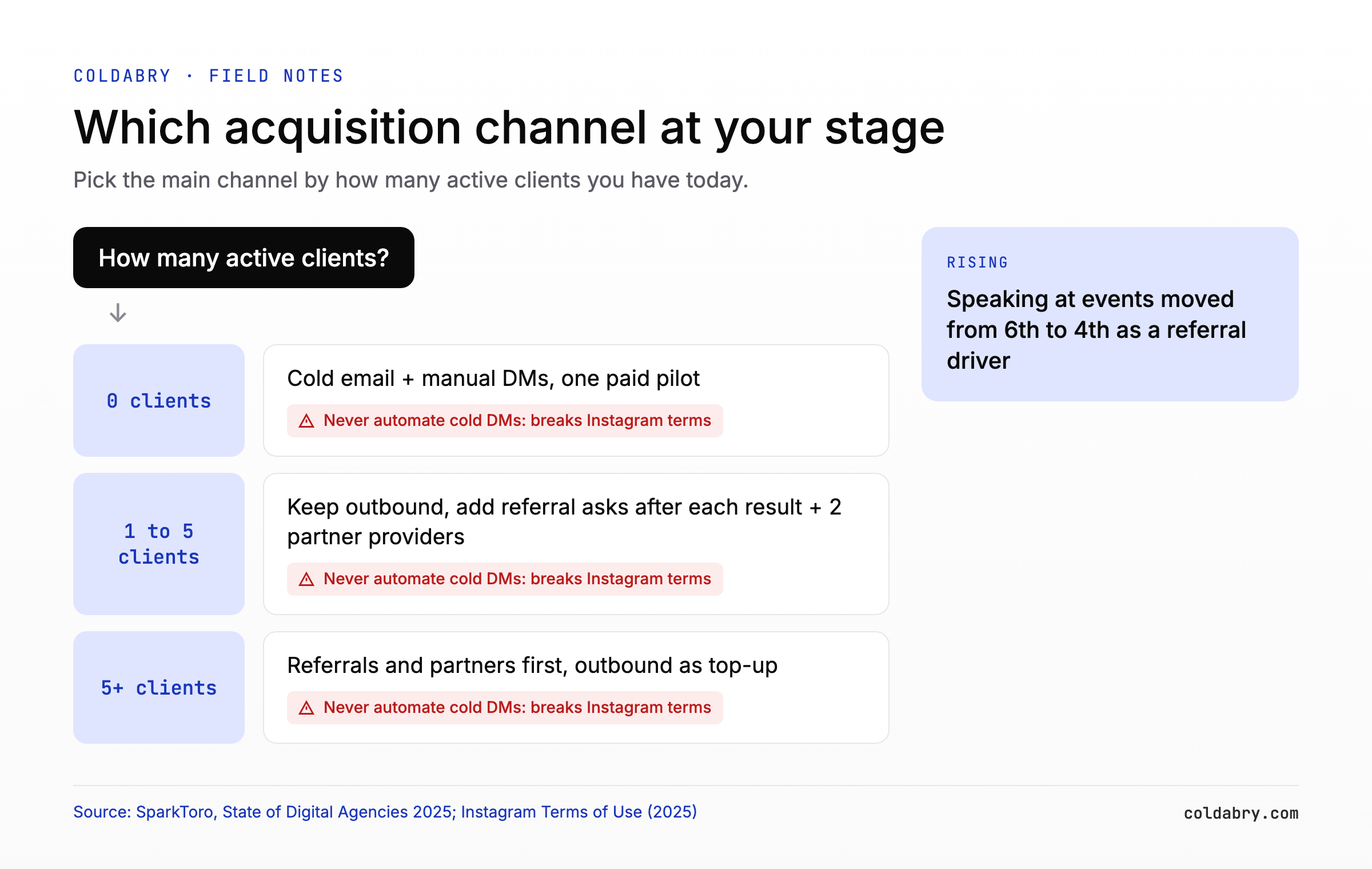
- 0 clients: cold email plus manual DMs, one pilot offer. Your goal is one result you can point to.
- 1 to 5 clients: keep outbound running, but add a referral ask after every measurable result and recruit two partner providers.
- 5+ clients: referrals and partners first, outbound as a top-up when the pipeline thins. SparkToro notes that only 14% of agencies feel their pipeline is healthy, so a steady outbound baseline is still worth keeping.
Visibility channels are also moving. SparkToro reports that "speaking at events and conferences jumped up two places from 6th to 4th", overtaking outbound sales and social media platforms as a referral driver (SparkToro). For an SMMA, a talk at a local business group in your niche can feed referrals better than another hundred DMs.
Automation is useful in this stack, just not for sending cold DMs. The safe places are behind the scenes: keeping the CRM clean, routing replies from email and Instagram to the right person, and generating the monthly client report that triggers the referral ask. That is the kind of work AI automation for reply routing and reporting covers, and agencies that want clients to see results in one place sometimes build a custom client portal or reporting app instead of sending PDFs. If your leads start in Instagram, syncing Instagram leads into a CRM keeps every conversation tied to one record.
Coldabry builds custom AI apps and automations like these; you can see builds we have shipped.
FAQ
What is the best way to get SMMA clients in 2026?
Referrals from existing and past clients remain the strongest source of new business for digital agencies, according to SparkToro's 2025 agency survey. They only work once you have clients with results, though. For a new SMMA, cold email is the best scalable channel because you control the list and volume and it is legal when you follow CAN-SPAM. Manual, researched Instagram DMs work as a supporting channel for small batches. Automated cold DMs break Instagram's terms and are not a sound foundation. The best approach is staged: outbound first, then turn every early result into a referral ask and add partner referrals from non-competing providers in your niche.
How do I get my first SMMA client with no portfolio?
Pick one niche, build a list of businesses whose Instagram is active but weak, and write outreach that references something specific on each account. Run a short cold email sequence alongside a small daily batch of hand-written DMs. Instead of a portfolio, offer a paid or results-based pilot with one metric and a fixed end date, so the buyer takes little risk. When the pilot produces a measurable result, that becomes your first case study and the moment to ask for a referral.
Is cold email or cold DM better for an SMMA?
Cold email is better as the main channel because it scales legally: you can grow the list, test subject lines and follow up on a schedule while complying with CAN-SPAM. Cold DMs are better for depth, since you can reference a prospect's own posts on the platform you will manage. The catch is scale. Manual DMs are capped by your hours, and automating them breaks Instagram's Terms of Use, which prohibit accessing or collecting information in an automated way without permission. Most new SMMAs do best running cold email as the engine and manual DMs as a smaller, more personal layer for warm prospects.
Is it against Instagram's rules to automate cold DMs?
Yes. Instagram's Terms of Use state that you can't access or collect information "in an automated way without our express permission", and Meta's account integrity standard lists using an account through automated means such as scripting, unless done through authorized routes. Tools that send cold DMs from your account at volume fall outside those authorized routes. The consequence is the risk of restrictions or losing the account, which for an SMMA is also its portfolio. Official options exist: Meta's click-to-DM ads and its messaging tools for replying to people who contact you first. Sending by hand remains allowed.
How many cold emails does it take to land one SMMA client?
As a worked example, not a benchmark: Belkins' 2026 study of B2B outreach reports reply rates of 0.59%, 0.51%, 0.30% and 0.34% for the first four steps. On 1,000 prospects that gives about 17 replies. If 30% are qualified (our assumption), that is about 5 conversations. With SparkToro's most common agency close rate of 25-49% of qualified leads, the result is roughly 1 to 2.5 clients per 1,000 prospects. Your numbers depend heavily on niche fit and list quality, and the example slightly overstates replies because people who answer leave the sequence.
Should I offer free work to get SMMA clients?
In our view, no. Free work tends to attract clients who value the service at zero and gives you no evidence that anyone will pay. A short paid or results-based pilot does the job better: the client takes limited risk, you agree on one metric and an end date, and the result becomes a case study you can use in outreach. It also makes the move to a monthly retainer a natural next step rather than a renegotiation.