Wholesale Outreach on Instagram: Recruit Stockists via DM
Instagram DMs can land stockists if the first message is short and your terms sheet is ready. Here are the scripts, terms and math to test it.
Wholesale outreach on Instagram can land stockists for a product brand, but only as a short, personal first message backed by a terms sheet you can send the moment a boutique replies. There is no audited public reply rate for this, so treat it as a test: send to 50 to 100 well-chosen boutiques, count the replies, then decide whether to scale. This playbook is for brands that already sell direct and want shelf space in independent shops. It is a playbook, not a guarantee.
The rest of this post gives you the prospect filter, the terms to have ready, three DM templates, the reply script, a follow-up schedule and a worked example of the math.
What is wholesale outreach on Instagram, and does it work?
It is the practice of messaging boutique owners and buyers directly on Instagram to ask whether they would carry your product, then moving interested shops to a line sheet and a first order. It can work because small shops are reachable there: Shopify's wholesale guide notes that "In many cases, small boutique owners manage their own social media" and suggests engaging with prospects on Instagram and Facebook before pitching.
The hard part is standing out. JOOR says buyers are "inundated with brand pitches daily, so generic outreach simply won't cut through the noise" (April 2026). That is why the templates below are short and specific.
Honest limit: Vendors publish response claims, for example The Folklore says its tool helps brands "reach 3x more qualified retail leads", but none of them give a reply rate we can verify. Use your own first 100 sends as the benchmark.
How do I find boutiques worth DMing?
Start with shops that already sell brands like yours, then filter hard before you write a single message. Good sources are the stockist pages of comparable brands, Instagram search by city and hashtag, and the tagged-photo pages of competitors. Qualification matters more than volume, because a mismatched pitch is the fastest way to be ignored.
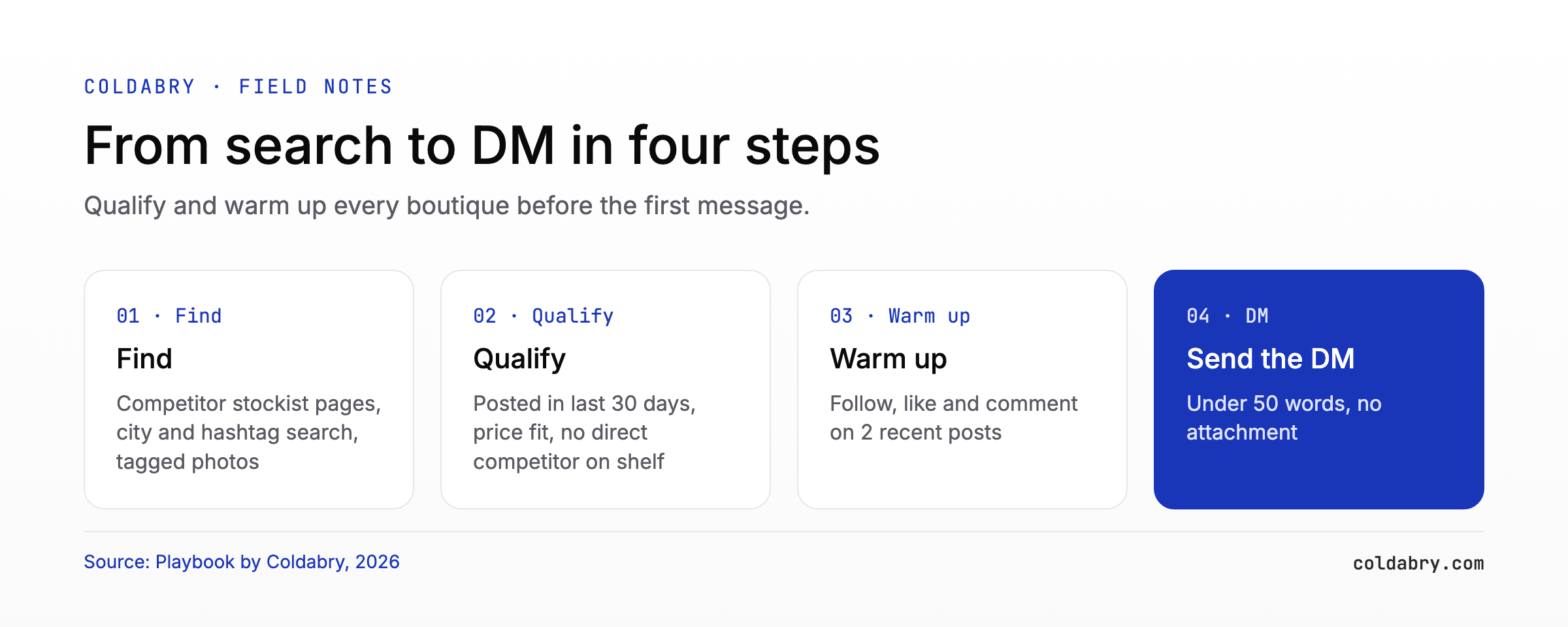
Use this checklist to decide who gets a DM:
| Check | Pass if | Why it matters |
|---|---|---|
| Active account | Posted in the last 30 days | Owners of small shops run their own account, so a dormant one is rarely read |
| Price fit | Their current products sit near your retail price | Your keystone wholesale price must fit their margin and shelf |
| No direct competitor | They do not already stock a near-identical item | Avoids a quick "we already have this" |
| Right location | Not next door to an existing stockist of yours | Protects the stockists you already won |
| Reachable | DMs open, or a visible owner name | Lets you open with a real name |
Once a shop passes, warm it up before the DM. This is our suggestion, not a sourced rule: follow the account, then like and comment on a few recent posts over a couple of days, with comments that say something real about the product. The goal is that your name is familiar when the message request arrives. Do not start the DM sequence until you have done this for that shop.
What terms should I have ready before sending a DM?
Have wholesale price, first-order minimum, payment terms, lead time and a line sheet decided before the first message goes out. The moment a boutique says "send details", you want to answer in one message, not draft policy on the spot.
Faire describes keystone pricing as "the standard way to price for wholesale", setting the wholesale price at 50% of retail, and, in the same guide, recommends first-order minimums of $100 to $150 depending on your average product price, with the option to waive them. The $250 used in this post is only an example. Shopify cautions that keystone "doesn't account for factors like competition, demand, or perceived value", so check it against your own margins.
A line sheet is a one- or two-page PDF or link listing your products, photos, wholesale and retail prices and order minimums. Net 30 means the shop pays within 30 days of the invoice.
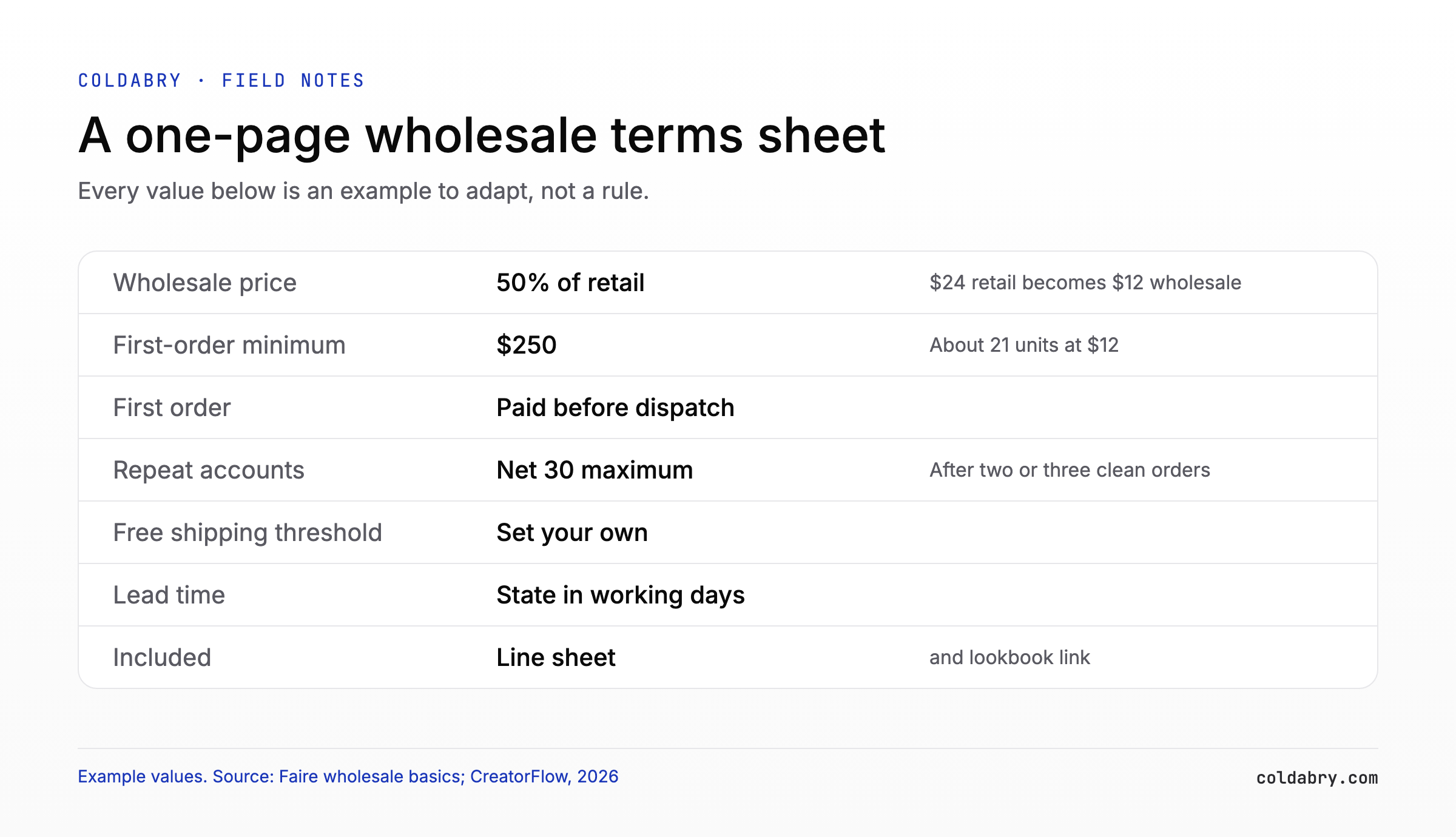
CreatorFlow's example reply uses the same structure: "Wholesale is 50% of RRP, minimum first order £300, and we dispatch within 5 working days" with first orders paid up front and repeat accounts on 30 days. It advises moving an account to invoice terms only after two or three orders without incident, and capping terms at thirty days. Treat all of these numbers as examples to adapt, not rules.
What do I write in the first DM?
Write under about 50 words, name one specific thing you noticed about their shop, ask one easy question and attach nothing. Shopify's sample opener is a good model for the tone: "I've been following you for a while and love your product assortment", followed by an offer to send line sheets. In a DM, hold the line sheet back until they say yes.
These are templates to adapt. Replace the bracketed parts with real details; if you cannot fill them in honestly, skip that shop.
| Template | Message | Why it works |
|---|---|---|
| 1. Cold intro | Hi [Name], I love how [Shop] styles [specific category or display]. I make [product] in [city/country], and I think it would sit well next to [brand they stock]. Would you be open to seeing our wholesale terms? | Names a real detail, links to a brand they already trust, asks for a small yes |
| 2. Warm, after engaging | Hi [Name], thanks for the like on our [product] post. We are opening a few stockist spots in [region] this season and [Shop] is the kind of store we had in mind. Want me to send the wholesale details? | Anchors on a signal they already gave you, gives a reason for the timing |
| 3. Follow-up | Hi [Name], quick follow-up: we just added [new item or seasonal color], which I think fits [Shop] well. Happy to send our wholesale terms if useful, and no problem if the timing is off. | Adds a new detail instead of repeating the ask, leaves an easy exit |
How do Instagram DMs work for a shop that does not follow you?
Messages from accounts a shop does not follow usually land in a message requests folder, so the owner may see yours only when they check it. Three habits help:
- Use a business profile with a clear name, logo, product photos and a link, so the owner can verify you in one glance.
- Send one short message, then wait. A second message before a reply reads as pressure.
- Switch to email only when the buyer asks for it or needs to send a purchase order.
If you want more on message length and structure, see the cold DM scripts we graded and how DM length affects replies.
How do I handle a "yes, send details" reply?
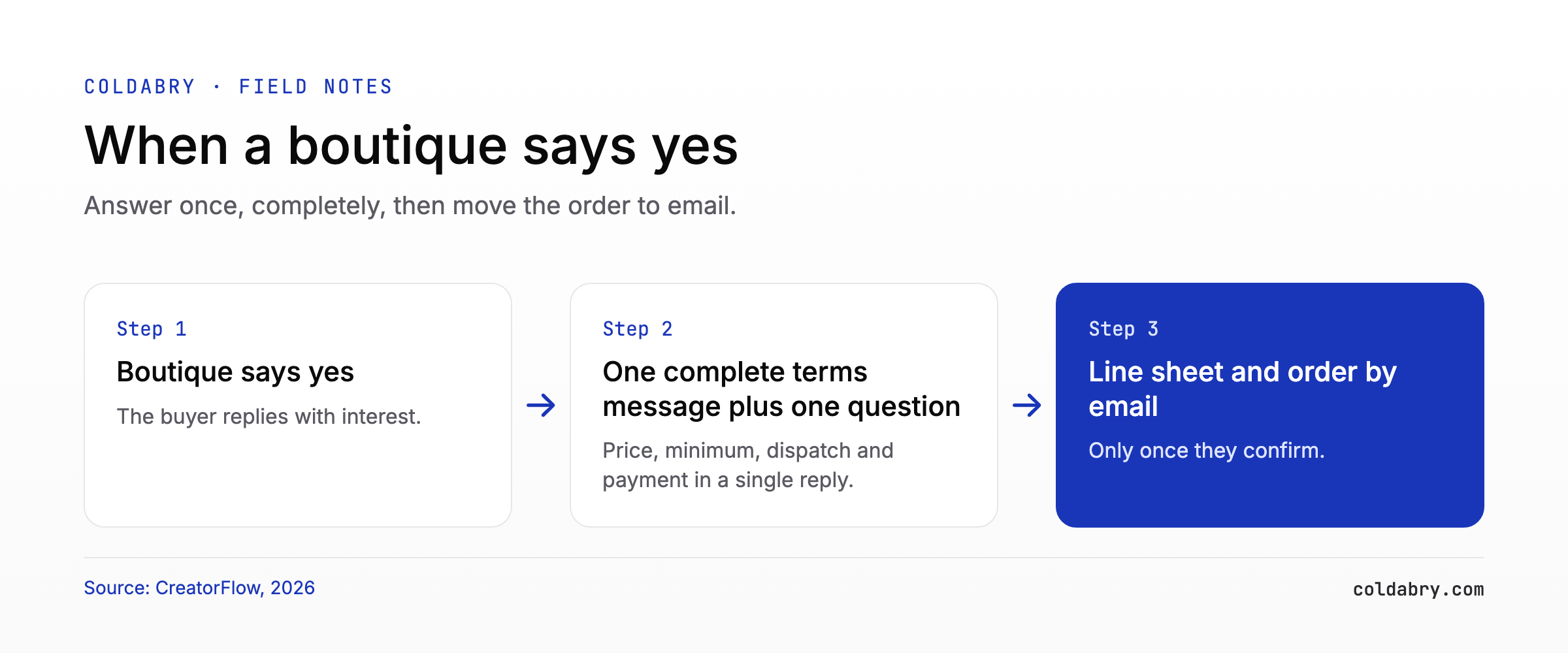
Answer with one complete message that contains everything a buyer needs to decide, plus one question. CreatorFlow recommends that the first reply carry the line sheet, minimum order, lead time, payment terms and shipping, and that it end with a single qualifying question such as which shop they run and where it is. CreatorFlow also says that when brands reply "email us", about a third of enquirers stop there; it gives no data for this, so treat it as a vendor claim, though the logic of keeping the thread in one place holds.
Reply template (example): Thanks [Name], great to hear. Here are our wholesale terms: wholesale is 50% of retail, first order minimum is $250, first orders are paid before we ship, and we ship within [X] business days. Line sheet: [link]. One question so I send the right range: which shop is this for, and where is it based?
Keep three things human even if you automate the rest: qualifying the shop, protecting territory around existing stockists, and any credit decision. Move to email only after the buyer shows real interest and asks for it, for example to send a purchase order.
How many follow-ups should I send, and what do I do with a "no"?
Send up to two or three follow-ups, each adding something new, then stop. Shopify's advice is that "the most powerful tool in your wholesale strategy is persistence" and that if a buyer is not interested right away, it "doesn't mean they won't be interested in the future". In a DM, persistence has to be lighter than in email, so each nudge needs a reason to exist.
| Day | Message | What is new |
|---|---|---|
| 0 | Cold intro (template 1 or 2) | The ask |
| 4 | Short follow-up (template 3) | New item, season or a stockist in a nearby city (only if true) |
| 10 | Last note | A simple "I'll leave this with you, the offer stands" |
Example last note: "Hi [Name], I will leave this with you. If [Shop] ever wants to see our wholesale terms, just reply here."
If the answer is "not now", thank them, note the date in your tracker and reconnect around the next season or collection. Never push after a clear no. For the wider picture of how people now read unsolicited DMs, see the 2026 cold DM debate.
Can I automate wholesale DMs?
Automating the sending of DMs is risky, while automating the tracking and drafting around them is not. Automated cold DMs go against Instagram's rules in practice, and account restrictions are common. We cover the evidence in how long automation accounts last and the 2026 ban wave. Check Instagram's current terms before choosing any tool.
The safest order is manual first. Send your first 50 to 100 by hand from a real, established account, learn what gets replies, and only then automate the parts that do not touch Instagram's sending.
| Mode | What it covers | Risk |
|---|---|---|
| Manual | You find, write and send every message; a spreadsheet tracks status | Lowest. Slow, but you learn the most |
| Assisted | Tools help find prospects, draft messages and log replies; you press send | Low to moderate. Sending stays human |
| Full auto | A tool sends and follows up for you | Highest. Account restrictions are a real possibility |
Where automation does pay off is the back office: a prospect list, reply logging and reminders for day 4 and day 10. Syncing DM leads to a CRM shows the pattern, and custom AI automation for outreach tracking or AI agents that draft and log replies are the kind of builds that fit it.
How many DMs does it take to land a stockist?
Under the assumptions below, about 56 DMs per new stockist, but those rates are assumptions, not benchmarks. Replace each with your own numbers after your first batch.
Illustrative example. Assumptions: you send 100 DMs; 15% reply; 30% of repliers qualify (right shop, right location, serious); 40% of qualified shops place a first order; the first order is the $250 minimum on a $24 item sold at $12 wholesale.
| Step | Calculation | Result |
|---|---|---|
| DMs sent | Assumption | 100 |
| Replies | 100 × 15% | 15 |
| Qualified | 15 × 30% | 4.5 |
| First orders | 4.5 × 40% | 1.8 stockists |
| Units per first order | $250 / $12 = 20.8, round up | 21 units ($252) |
| First-order revenue | 1.8 × $252 | about $454 |
| DMs per stockist | 100 / 1.8 | about 56 |
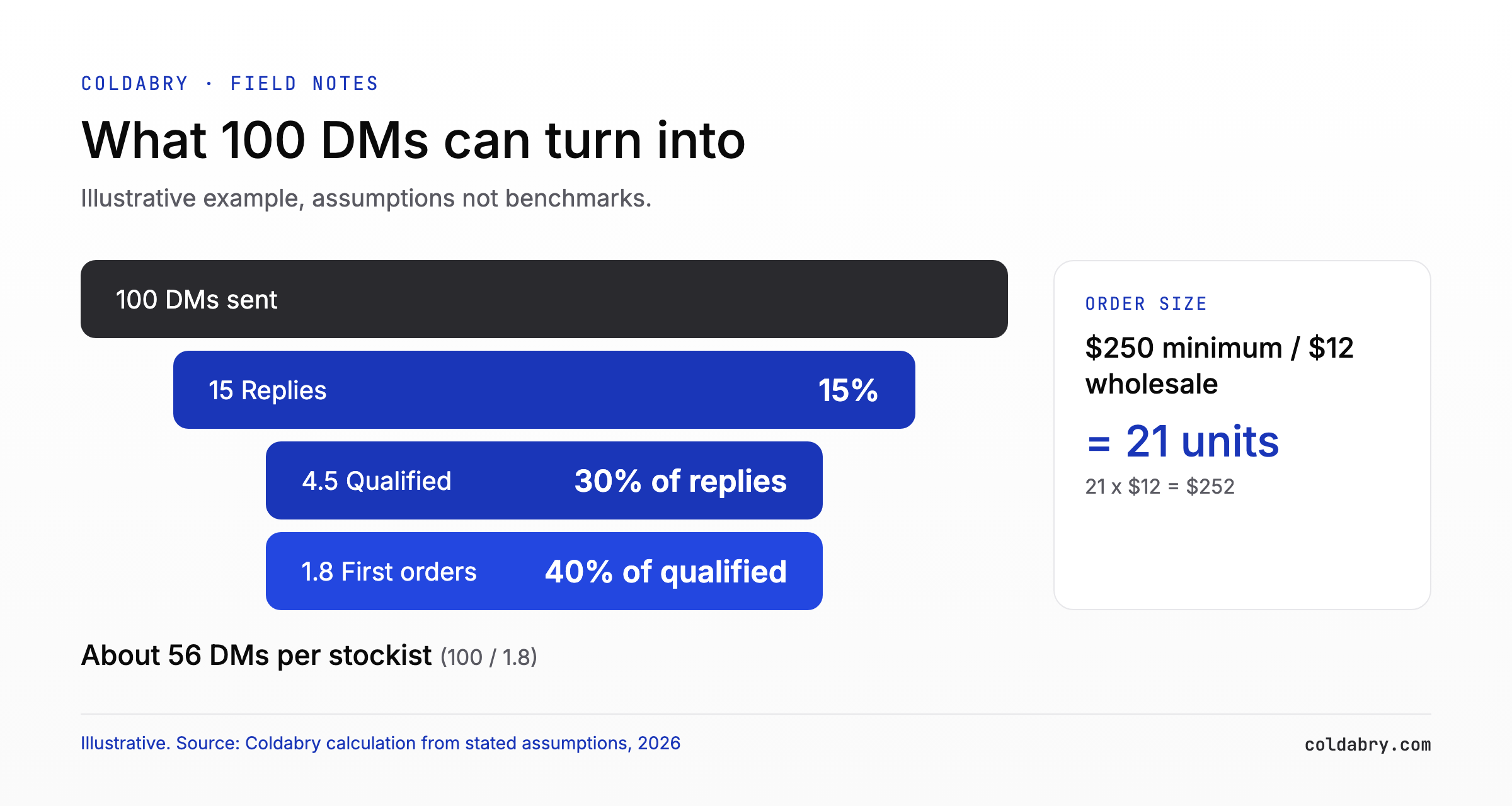
The point of the exercise is the lever it shows: raising the qualified share through better prospect filtering moves the result as much as sending more messages. If your first 100 sends produce no replies at all, fix the targeting and the opener before you scale.
FAQ
How do I find stockists for my brand?
Look at where comparable brands are sold: their stockist pages list real shops that already buy products like yours. Add Instagram search by city and hashtag, and the tagged-photo pages of competitors. Then qualify each shop before messaging: active in the last 30 days, similar price points, no near-identical item on the shelf, and not next door to an existing stockist. A short, filtered list of 50 to 100 shops beats a long, loose one.
Can you DM boutiques on Instagram?
Yes, boutique owners often run their own accounts, as Shopify's wholesale guide notes, so a direct message can reach the decision maker. Keep it short, personal and free of attachments. Sending large volumes through automation tools carries account risk, so start by hand from an established account and check Instagram's current terms before using any tool.
What minimum order should I set?
Set it high enough to cover the cost of handling an order and to let the shop display your range properly, but low enough that a new stockist can say yes. Faire recommends first-order minimums of $100 to $150, depending on your average product price, while CreatorFlow's example uses £300. Work out your own number from your margins and shipping costs, and consider waiving it for a strategic first shop.
What is keystone pricing?
Keystone pricing sets the wholesale price at 50% of the retail price, so a $24 item sells to a shop for $12. Faire calls it the standard way to price for wholesale. It is a starting point only: Shopify notes it does not account for competition, demand or perceived value, so test it against your own cost of goods and what comparable brands charge.
How many follow-ups should I send?
Two or three, spaced a few days apart, each with something new such as a new item, a seasonal color or a relevant stockist nearby. A schedule of day 0, day 4 and day 10 is a sensible starting point. After that, stop and note the shop for the next season. If someone says no, thank them and leave it; "not now" can still become a yes later.
Do I need a line sheet before the first DM?
You need it ready, but you should not attach it to the first DM. Hold it until the boutique says yes, then send it with your terms in one message. A first message with a file attached looks like mass mailing and gives the owner more to read before they have shown interest. Have the line sheet, prices, minimum and lead time finished before you send anything.
We build custom AI apps and agents that clients own, and outreach tracking like the lists and reminders above is the kind of work our AI automation service covers.