Cold DM Script That Works: 7 Public Templates Graded
We found no controlled proof behind any public cold DM script. We graded 7 templates against published reply rates: aim for 2-5% when messaging cold.

The cold DM script that works best on paper gives one specific reason for writing, one short insight and one easy question, but none of the seven public templates we graded has controlled proof behind it. Two score highest on craft, and a fair bar for messages to strangers is a 2-5% reply rate. This applies to creators, coaches and experts looking for the first buyers of a product. The main caveat: that bar comes from LinkedIn figures published by Valley and cold email figures published by Saleshandy, because we found no sourced Instagram benchmark.
Everything below uses public pages only. We ran no sends and no test of our own, so the grades are editorial judgment and every rate is someone else's claim.
Is there a cold DM script that works?
Yes in the sense that some scripts are clearly better written. No in the sense that anyone has shown one beats another: we found no controlled DM data at all. The closest thing, Fuzzy AI's review of 10,000 LinkedIn messages, describes itself as "not a controlled experiment."
So each template gets two grades instead of one. Craft asks how well the message is written. Evidence asks how much proof stands behind it.
- Craft rubric: a reason for this person now, one easy question, no pitch in message one, and a premise that is true and not insulting.
- Evidence C: a self-reported rate with no split of the sends.
- Evidence D: a rate with no source, and no split by script.
- Evidence A or B: needs a controlled comparison. Nothing we read qualifies.
| Script | Source | Words | Craft | Evidence |
|---|---|---|---|---|
| A. Just shipped | DEV | 46 | B+ | C |
| B. Stuck founder | DEV | 54 | C | C |
| C. Context, bridge, question | Typpout | 51 | B+ | D |
| D. Soft opener | BeLikeNative | 41 | C- | D |
| E. Ultra-short | BeLikeNative | 7 | B- | D |
| F. Limited-time offer | BeLikeNative | 22 | F | D |
| G. Free resource | BeLikeNative | 28 | B | D |
Pages were checked on November 6, 2026. Word counts are ours, with each placeholder counted as one word. The reasons for each grade follow in the script table below.
What is a good cold DM reply rate?
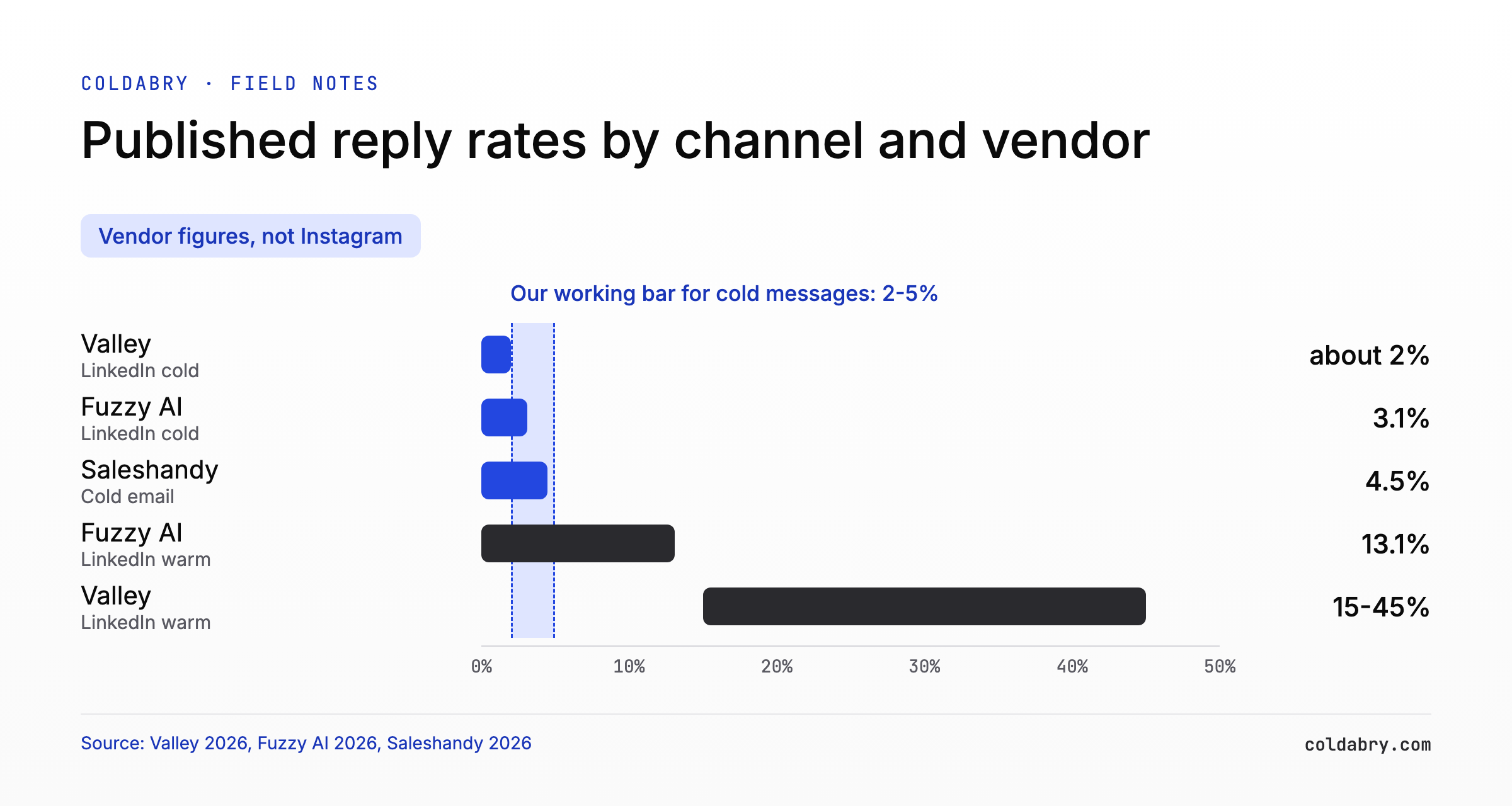
A good cold DM reply rate is 2-5%, or 20 to 50 replies per 1,000 sends. That range is our reading of neighboring channels, not a measurement of Instagram or any other DM inbox. Each figure below comes from a vendor that sells outreach software.
- Valley, cold LinkedIn: about 2%, or 20 replies per 1,000. Valley calls this a "category average" and shows no dataset for it. Its 30M+ message sample supports the warm band, not clearly this number.
- Fuzzy AI, cold LinkedIn: 3.1%, or 31 per 1,000.
- Saleshandy, cold email: 4.5% average, or 45 per 1,000.
- Fuzzy AI, warm LinkedIn: 13.1% after commenting on or reacting to the prospect's content, or 131 per 1,000.
- Valley, warm LinkedIn: 15-45% on signal-based campaigns, or 150 to 450 per 1,000.
The top of our bar comes from Valley too: "On cold outreach, anything above 5% is strong."
The useful pattern is the gap between cold and warm. Before rewriting a script, try engaging with a person's public posts first. Fuzzy's numbers are observational and from LinkedIn, so treat that as a cheap experiment, not a law. Fuzzy and Valley both sell warm-first outreach, so they benefit from this gap.
We looked for the X posts behind two circulating reply-rate claims, could not retrieve them, and left the figures out.
Which cold DM templates get replies?
No page we read shows which template gets replies, but the better scripts share a trait: a specific reason to write to this person. The texts below are verbatim from the sources, with punctuation adjusted so dashes read as commas. Scripts A and B come from a DEV post on cold DM angles, C from Typpout's guide, and D to G from BeLikeNative's Instagram script page.
A. Just shipped
hey [name], just saw you shipped [product]. congrats. real question: who's doing your cold outreach right now? most founders at this stage send 10 DMs, hear nothing, and assume the product is the problem. it's almost never the product. the outreach angle is usually what's broken.
B. Stuck founder
hey [name], [product] looks solid. but i notice the traction isn't matching the build quality. most founders at this stage are sending weak cold messages, the kind that feel like form letters. i went through the same thing and spent 3 weeks fixing it. happy to share what worked if that's where you're stuck.
C. Context, bridge, question
Saw your post about evaluating outbound tools for your growing SDR team. Most teams at your stage find that intent-based sourcing produces 5-10x better reply rates than cold email lists. The sourcing method matters more than the sequencing tool. Have you tested social intent sourcing alongside your current cold email approach?
Do not copy the "5-10x" line. It is an unsourced claim. Keep the structure and put an observation you can defend in its place.
D. Soft opener
Hey [Name], I've been following your work on [topic]… Your recent post about [reference] got me thinking, we work with creators who [value], and I think there's a real opportunity here. No pressure, just exploring if this could be a fit.
E. Ultra-short
Quick question: How are you handling [specific challenge]?
F. Limited-time offer
We're currently running a limited-time promotion on [Product]. For the next [time period], you can enjoy [benefit]. Act now to secure this offer!
BeLikeNative says this one is "best for warm leads or retargeting campaigns." The F grade applies to using it cold, which is not the use its publisher suggests.
G. Free resource
I noticed your recent post about [pain point]. I recently developed a free [resource] on [related topic] to help you [achieve goal]. Want me to send it over? No strings attached.
| Script | What works | What breaks |
|---|---|---|
| A | A recent event and a direct question | The last three sentences could go to any founder |
| B | Personal experience as the offer | Criticizes traction the sender can't see, and asks no question |
| C | A post as trigger, then a relevant idea, then one question | The statistic has no source |
| D | References a real post | The reader can't tell what the opportunity is or what to reply |
| E | Takes seconds to answer | Gives no reason it was sent to this person |
| F | Clear offer | No reason, no question, and urgency from a stranger |
| G | Gives before asking, with a yes-or-no reply | The value depends on the resource being good |
For the reason line, see our guide to AI prompts for personalizing cold DMs, and check every generated detail against the real post.
Why can't you trust cold DM reply rate claims?
You can't trust most of them because they arrive without a sample, a denominator or a source, usually on a page that sells something. This ledger lists what we found. Each figure is a claim by its publisher, not something we confirmed.
| Claim | Publisher | What is missing |
|---|---|---|
| 2% to 18% reply rate over 200+ DMs | DEV author, promotes a paid angle pack | Before and after split, platform, audience |
| 24-32% response rates, and 32% vs 18% for cookie-cutter messages | BeLikeNative, sells a writing extension | Any source; about 5 to 16 times the cold baselines above. The page applies this rate to all five of its templates together, with no per-template figure. |
| Signal-based DMs outperform cold by 10-15x | Typpout, sells automated DM generation | Any source; Fuzzy's warm vs cold gap is about 4x (13.1 / 3.1) |
| Delivery up 40-50%, follow-ups lift responses 25-40%, 80% of deals need five follow-ups, 44% of salespeople quit after one | BeLikeNative | Any source for all four |
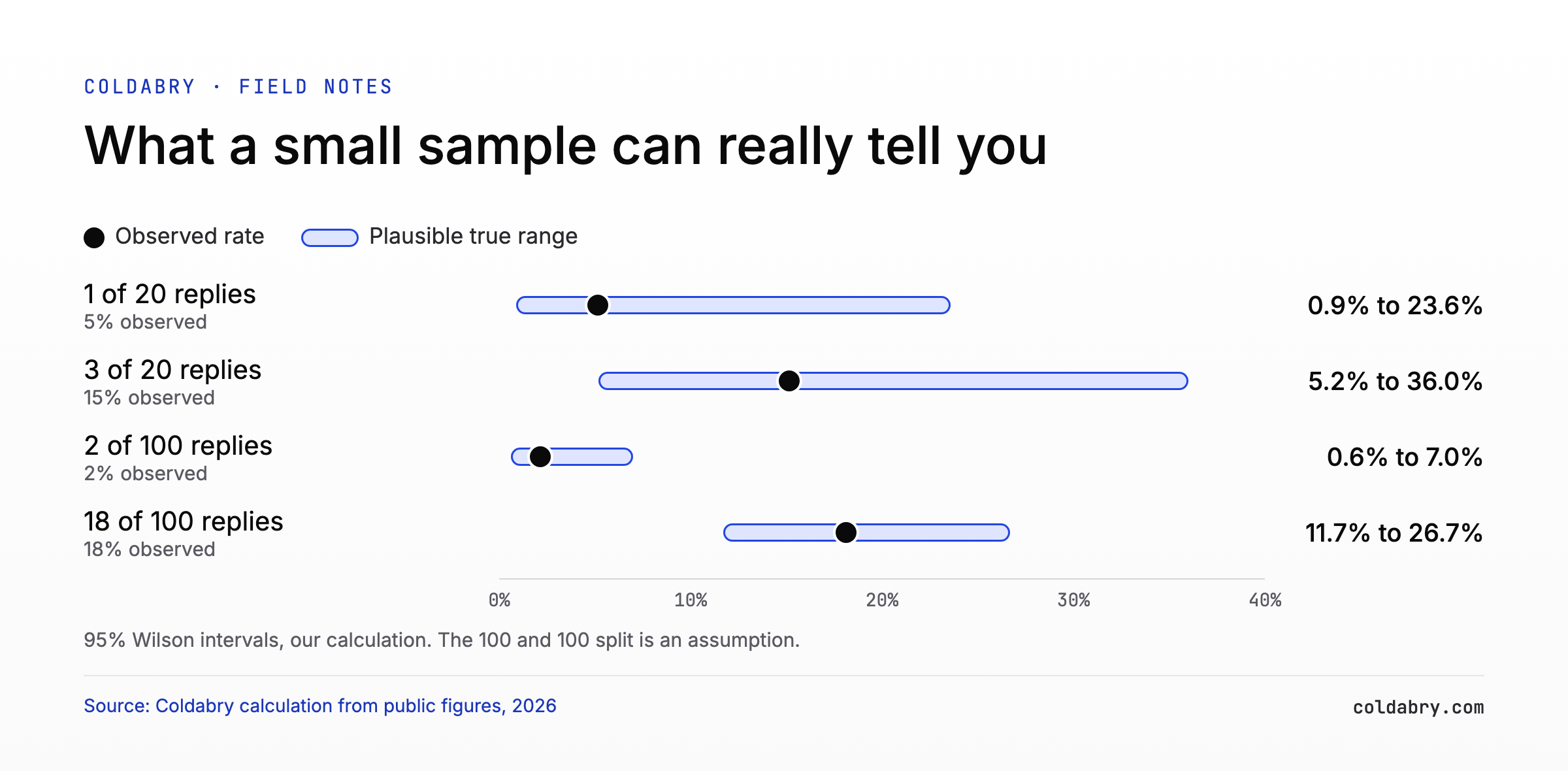
The DEV author gives "200+" sends and no split. If we assume 100 before and 100 after, 2 of 100 has a 95% Wilson interval (the range the true rate plausibly sits in) of 0.6-7.0%, and 18 of 100 gives 11.7-26.7%.
Under that assumption the ranges don't overlap, so something probably changed. It still doesn't show the script did it, because a before-and-after story can't separate wording from a better target list or a better month.
Ask five questions of any reply-rate claim:
- Sample: how many messages, from how many accounts?
- Denominator: replies per message sent, per message opened, or per person?
- Period: when were they sent, and over how long?
- Audience: who received them, and were they cold or warm?
- Who profits: does the publisher sell the script, the pack or the tool?
How many DMs do you need to test a script?
You need about 431 sends per variant to separate a 5% script from a 10% one, and small tests can't tell you much. BeLikeNative suggests comparing versions on groups of 10-20 leads. At that size, 1 reply from 20 sends means the true rate could be anywhere from 0.9% to 23.6%.
The table is our calculation with the standard two-proportion formula: alpha 0.05 two-sided, 80% power, n = (1.96 + 0.84)^2 x (p1q1 + p2q2) / (p1 - p2)^2. The formula is approximate at low rates: an exact test at 51 per variant has closer to 70% power, so treat the first row as a floor. The last column is a worked example that assumes 20 hand-written sends a day across both variants. That pace is an assumption for the arithmetic, not a safe limit.
| Rates you want to tell apart | Sends per variant | Total sends | Days at 20 a day (example) |
|---|---|---|---|
| 2% vs 18% | 51 | 102 | About 5 |
| 5% vs 10% | 431 | 862 | About 43 |
| 2% vs 5% | 585 | 1,170 | About 59 |
| 2% vs 4% | 1,137 | 2,274 | About 114 |
| 3.1% vs 5% | 1,684 | 3,368 | About 168 |
Three rules follow from those numbers:
- Only huge gaps show up fast. At 51 sends per variant you have a fair chance of catching a 2% vs 18% jump, and nothing subtle.
- Change one variable at a time. Swap the question or the reason line, never both, and keep the audience the same.
- Below these volumes, decide on craft. Use the rubric and say so in your notes, instead of treating 3 replies as a finding.
If you do have the volume, multi-armed bandit testing for DM variants shifts sends toward the leader while the test runs.
Cold DM script template you can copy
This template is built from the rubric above. It is untested: we have no send data for it, so treat it as a starting structure, not a proven script. The three examples are illustrative, with invented details.
Template: Saw [specific thing this person posted or did recently]. [One true observation about it, in a single sentence]. [One easy question they can answer in a line]?
Coach, example: Saw your post about members dropping off after the January challenge. The drop you described seems to start once the group check-ins stop. Are you doing anything for members between check-ins right now?
Creator, example: Saw your reel about editing the same wedding gallery until 2 a.m. It sounded like culling was the slow part, not the color work. Is culling still the step you'd most like off your plate?
Expert selling an AI product, example: Saw your thread about the surprise tax bill after your first big client. Your list of things you wished you'd tracked was mostly expenses, not income. Do you log deductions as you go, or sort them out at year end?
If someone replies, answer what they said, and mention your product only when it fits their problem. Typpout's advice for the first message holds up here: "Do not ask for a meeting yet."
Pre-send checklist:
- The reason would make no sense sent to anyone else.
- The thing you reference is recent and you actually read it.
- Every sentence is true, with no statistic you can't source.
- The premise doesn't criticize their results.
- There is exactly one question, answerable in a line.
- There is no pitch, link or meeting request.
- You typed it and you are sending it yourself.
- You logged the date, variant, audience and whether a reply came.
That last item turns a script into evidence. A spreadsheet is enough at low volume. Once it isn't, custom AI automation for outreach reporting can keep the log current, and classifying replies with AI separates interested replies from polite refusals, because a raw reply rate counts both.
Is sending cold DMs allowed on Instagram?
Cold DM automation breaks Instagram's terms, while a person typing relevant messages by hand is a different case. The Instagram Terms of Use, checked November 3, 2026, include this clause:
Instagram Terms of Use: "You can't attempt to create accounts or access or collect information in unauthorized ways. This includes creating accounts or accessing or collecting information in an automated way without our express permission, regardless of whether such automated access or collection is undertaken while logged-in to an Instagram account."
Tools that log in to your account to send cold DMs access it in an automated way, so on our reading they need Instagram's express permission, and without it they break these terms. That clause doesn't address manual messages, which doesn't mean Instagram approves of them: we checked this clause only, not every Instagram rule. For the risk, see how long Instagram automation accounts last. For the official route, see what the Instagram Messaging API can and can't do.
Meta's developer documentation says "All new conversations from Instagram users who aren't followers of your app user will appear in the Requests folder" (checked November 3, 2026). That sentence is about app users, so it doesn't describe every DM, but plan for a first message that may wait in a folder and needs to earn its reply.
The practical rule: manual, low volume, relevant only. This is our reading of the terms, not legal advice. If those first conversations show an audience that wants more than a reply, custom apps built for your own audience are what we build at Coldabry.
FAQ
What is a good reply rate for cold DMs?
A 2-5% reply rate is a fair working bar for cold DMs, which means 20 to 50 replies per 1,000 sends. That range is our reading of vendor figures from other channels: Valley gives about 2% for cold LinkedIn outreach, Fuzzy AI gives 3.1%, and Saleshandy gives 4.5% for cold email. Valley calls anything above 5% strong. We found no Instagram benchmark with a stated source, so use the range as a starting point for your own log, not as a measured standard.
What should the first cold DM say?
The first cold DM should give one specific reason you are writing to this person, one short observation and one question they can answer in a line. Leave out the pitch, the link and the meeting request. Typpout's guide says "Do not ask for a meeting yet," and the best-graded scripts here follow that pattern. Test your draft by swapping in another person's name: if it still reads fine, the reason is too generic. Every line should also be true, so skip any statistic you can't source.
Do cold DM scripts still work in 2026?
Scripts can still start conversations in 2026, but nothing public that we found shows one specific script beating another. Pages that print scripts tend to quote rates without samples, denominators or sources, and the published benchmarks come from LinkedIn and email vendors. Those vendors still report cold replies of about 2% to 4.5%, so replies do happen. Treat a script as a structure you fill with real research on each person, not as a formula, and keep your own log before believing anyone's rate.
How long should a cold DM be?
Typpout advises 3-4 sentences and under 60 words, which is advice and not a measured result. The seven templates graded here run from 7 to 54 words, and the two best on craft are 51 and 46 words. Length did not separate good from bad: the 22-word limited-time offer scored worst because it gave no reason to write. Keep the message short enough to read on a phone, and spend the words on why this person is getting it.
Is it against Instagram's rules to send cold DMs?
Automated cold DMs are, because the Instagram Terms of Use bar accessing or collecting information in an automated way without express permission, so cold DM automation breaks those terms. The clause we quote doesn't address a person typing one relevant message by hand, but that doesn't mean Instagram approves: we checked this clause only. Keep it low volume and relevant to each recipient. Terms change, so read the current page yourself; we last checked it on November 3, 2026, and this is not legal advice.
How many cold DMs should I send before changing the script?
The number depends on the gap you want to detect. By our calculation, separating a 5% script from a 10% one takes about 431 sends per variant, and 2% from 5% takes about 585. Twenty sends prove very little: 1 reply from 20 means the true rate could sit between 0.9% and 23.6%. If you can't reach those volumes, change the script on craft grounds instead of on the numbers. Fix one element at a time, keep the audience the same, and record what you changed.