How Long Do Instagram Automation Accounts Last? (2026)
The only published lifespan claim we found says 30-90 days before a ban; age, warmup, proxy and daily volume decide where you land.

Instagram publishes no lifespan or limit figures, and the only public lifespan estimate we found comes from a vendor: Multilogin, which sells antidetect browsers and proxies, claims automated accounts "typically last 30–90 days before getting permanently banned" (Multilogin). So the honest answer to "How long do Instagram automation accounts last?" is "weeks to a few months, according to one unverified claim." Multilogin's figure is about bot accounts in general, so cold DM outreach accounts are the closest match it offers, not a direct measurement. The first challenge (an action block, "Try again later", a checkpoint) usually arrives well before a ban, and the practice itself breaks Instagram's terms.
This guide separates the first challenge from the final ban, puts Meta's own rules next to vendor claims (labelled as claims), and shows an illustrative survival model plus a tracking sheet so you can measure your own numbers instead of trusting anyone's table.
How long do Instagram automation accounts last?
The one figure in circulation is the 30 to 90 day range above. The same source adds that "very few bot accounts survive 90+ days" and that detection tracks "device fingerprints, IP addresses, behavioral patterns, velocity metrics, and network analysis" (Multilogin). No methodology is given, so treat it as a vendor's experience, not a measurement.
There is a reason no one can give a single number. Chatplace notes that "the company has never published a table of per-action caps" and that "Meta describes limits as dynamic and tied to behaviour, account history and reputation, which is also why two accounts performing the same actions get different outcomes" (Chatplace, 2026). Two identical scripts on two different accounts will not die on the same day.
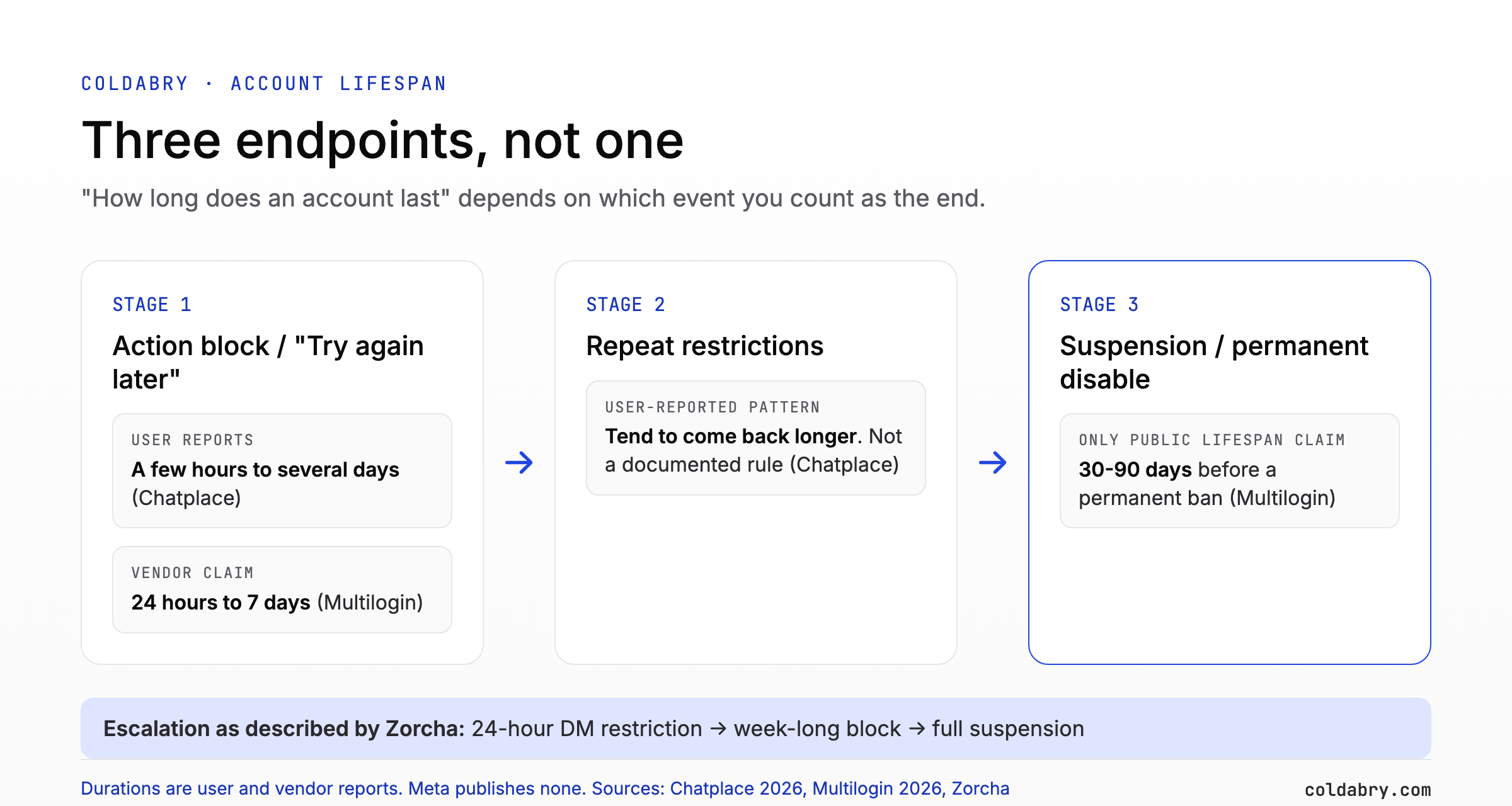
"How long it lasts" also hides three different endpoints:
- First soft challenge. An action block or "Try again later". Users report it lasting "anything from a few hours to several days" (Chatplace); Multilogin lists "24 hours to 7 days" (Multilogin).
- Repeat restrictions. Chatplace says "repeated blocks tend to come back longer", and is clear that this is "the pattern users describe, not a documented rule."
- Suspension or permanent disable. Zorcha describes the ladder as "a 24-hour DM restriction becomes a week-long block, and becomes a full suspension" (Zorcha).
If you want context on large enforcement events, see what the 2026 Instagram ban wave hit; this article stays with the lifespan of individual accounts.
Is automating Instagram DMs against the rules?
Yes, for cold outreach. Instagram's Terms of Use say you can't "create accounts or access or collect information in unauthorized ways", including "accessing or collecting information in an automated way without our express permission, regardless of whether such automated access or collection is undertaken while logged-in to an Instagram account." Any tool that logs into ordinary accounts and sends first-touch DMs at scale is doing exactly that, so cold DM automation breaks Instagram's terms. Every lifespan number in this article describes accounts operating outside the rules.
The official route cannot do cold outreach either. Meta's Messaging API documentation states that conversations start only when an Instagram user sends a message to your app user, that the reply window is 24 hours for most user actions, and that it can last up to 7 days after a user's first message from a click-to-Direct ad (Meta for Developers). A human agent tag extends replies to a 7-day window, and new conversations from non-followers land in the Requests folder.
Running many accounts adds a second layer. Meta's Inauthentic Behavior policy targets "a network of inauthentic assets controlled by the same individual or individuals," prohibits using inauthentic accounts "to evade enforcement," and says "when we identify these networks, we remove the fake accounts, Pages, Groups, or other Meta assets directly involved in the operation" (Meta Transparency Center). In practice, creating new accounts to replace banned ones is itself listed as evading enforcement, and every account tied to that network is exposed to removal.
| What cold outreach needs | What the official API allows | Source |
|---|---|---|
| Send the first message to a stranger | Not possible: conversations start only when the user messages you | Meta Messaging API |
| Follow up days later | 24-hour window for most actions; up to 7 days after a click-to-Direct ad message | Meta Messaging API |
| Manual follow-up by a person | Human agent tag, 7-day window | Meta Messaging API |
| Land in the main inbox | Non-follower conversations go to Requests | Meta Messaging API |
| Automated account creation or access | Not allowed without Meta's permission | Instagram Terms of Use |
| Run many accounts and rotate after bans | Assets directly involved in the network are removed (Inauthentic Behavior policy) | Meta Transparency Center |
What decides how long an automated account survives?
Four factors recur across the third-party sources, and they interact. None has an official threshold, so the "claimed threshold" column below is vendor material.
Account age. Inro says "what changes your effective limit is account age and standing, which build over time rather than being granted" (Inro). Zorcha puts it concretely: "A brand new account sending 50 DMs a day looks very different from a two-year-old account with an established engagement history doing the same thing" (Zorcha).
Warmup. InstantDM, which sells DM automation software, promotes "a proven 14-day protocol used by top-tier growth agencies" and, if reply rates are good, to "scale this number up by 10% to 15% every week until you reach the 40–50 daily limit" (InstantDM). The reason warmup matters is stated more plainly by Chatplace: "New account, high intensity. Volume that would be normal for an established account looks like a bot on a fresh one."
Daily volume and pacing. Inro reports established accounts "somewhere around 50 to 100 a day," while noting Instagram does not publish a daily figure. Pacing matters as much as volume: "An action every 12 seconds for an hour is a script" (Chatplace).
Proxy and IP. Zorcha flags "shared proxy infrastructure that ties your account to IP addresses with suspicious histories," and Multilogin lists IP addresses among the signals Instagram tracks. How proxy types differ is covered in mobile vs residential proxies for social accounts; for survival, the point is that a dirty or shared IP shortens the curve regardless of how careful the rest of the setup is.
| Factor | What the platform reportedly reads (third-party) | Claimed threshold (vendor, unverified) |
|---|---|---|
| Account age | Limits tied to account history and reputation (Chatplace) | New accounts "often blocked after a couple of dozen messages in a day" (Inro) |
| Warmup | High intensity on a fresh account looks like a bot (Chatplace) | 14-day protocol, then +10% to 15% per week (InstantDM) |
| Daily volume and pacing | Velocity metrics and behavioral patterns (Multilogin); even intervals read as a script (Chatplace) | About 50 to 100 a day for established accounts, widely reported (Inro) |
| Proxy / IP | IP addresses and network analysis (Multilogin) | No numeric threshold; shared proxies with bad histories flagged (Zorcha) |
Meta publishes no thresholds for any of these.
How many DMs can a new Instagram account send per day?
The only documented number is message length: "Each message is capped at 1,000 characters, which is fixed and the same for every account. How many messages you can send per day is not published by Instagram at all" (Inro). Meta's own Messaging API docs set text at "1000 bytes or less", so emoji and non-Latin characters use the cap up faster.
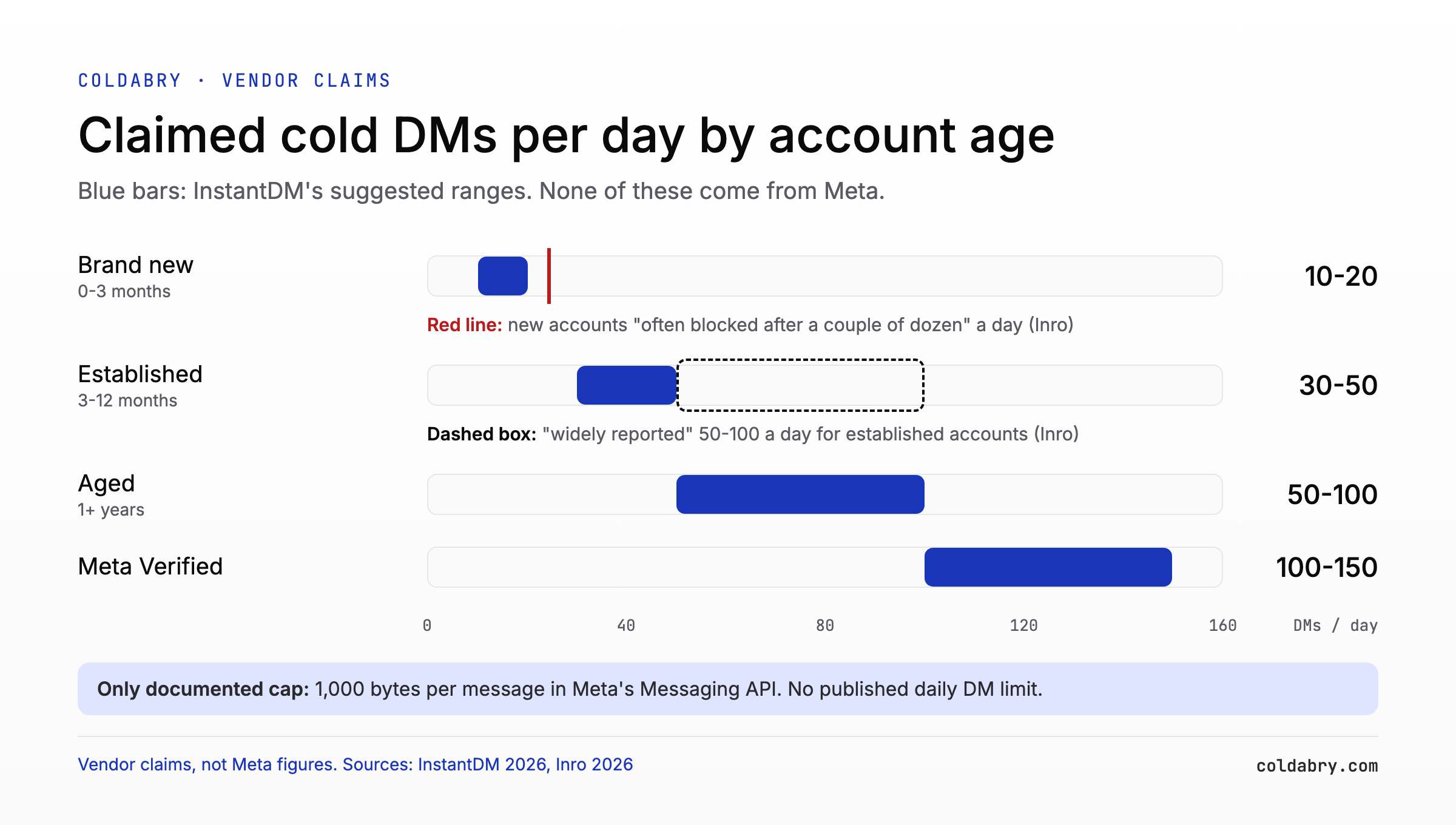
Everything else is vendor guidance. InstantDM's table claims 10 to 20 cold DMs a day for brand-new accounts (0 to 3 months), 30 to 50 for established ones (3 to 12 months), 50 to 100 for aged accounts (1+ years) and 100 to 150 for Meta Verified, with "zero links for the first 30 days" on new accounts (InstantDM). Inro, by contrast, says new accounts are "often blocked after a couple of dozen messages in a day."
The sources disagree, and that disagreement is the finding. "A couple of dozen" as a blocking point sits just above InstantDM's suggested 10 to 20, which leaves very little margin. If a tool or guide quotes a confident safe number, ask where it came from.
Illustrative survival curve: how the factors stack (model, not data)
To see how the factors combine, we built a simple model. It is an illustration with assumed inputs, not measured data from any accounts.
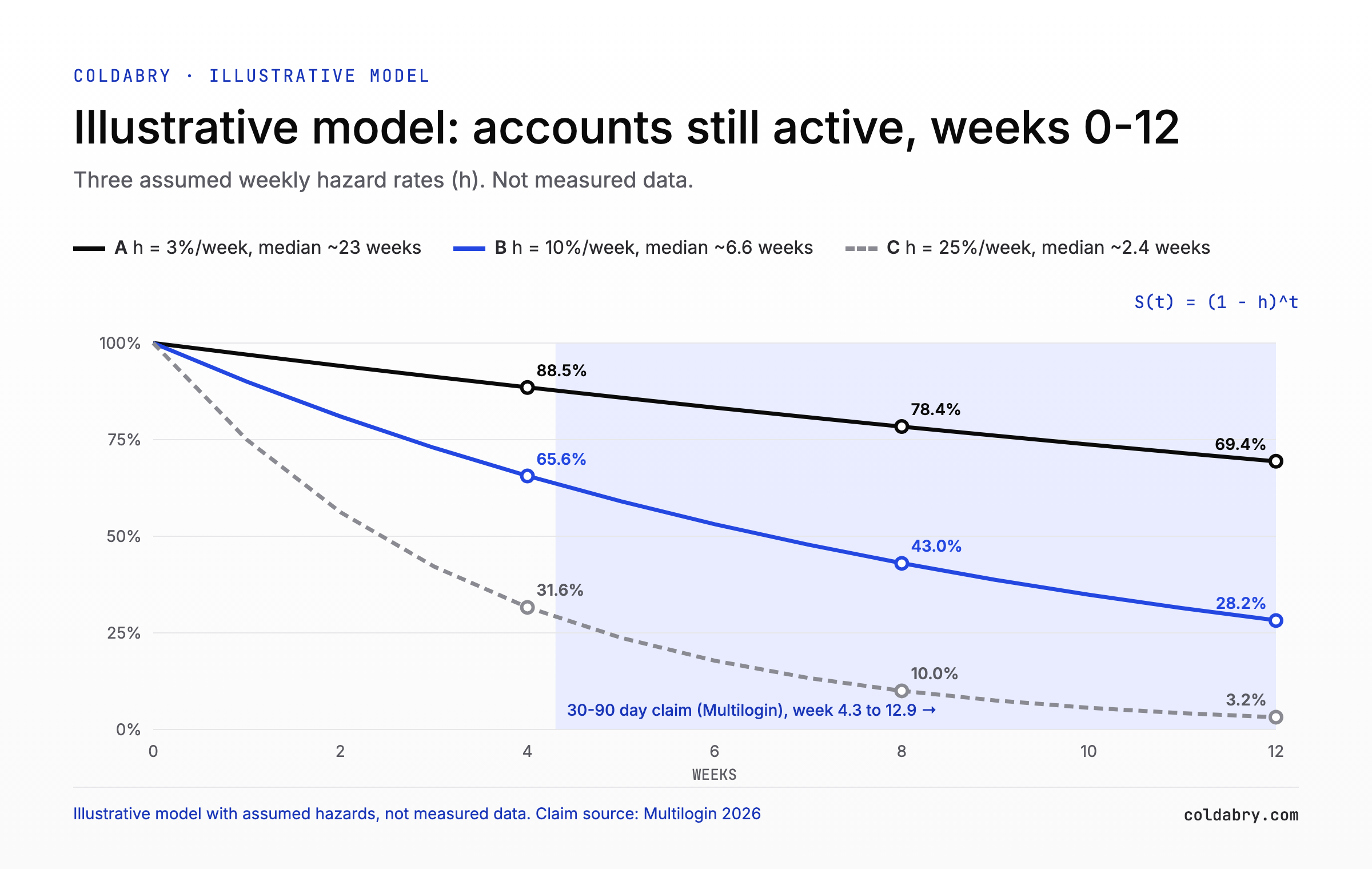
Assumption: each week, an account has a fixed chance h of a disabling event. Survival after t weeks is S(t) = (1 − h)^t, and the median lifespan is ln(0.5) / ln(1 − h). We picked three example profiles:
- Profile A: aged account, warmed up, mobile IP, low and irregular volume. Assumed h = 3% per week.
- Profile B: middle case. Assumed h = 10% per week.
- Profile C: new account, no warmup, shared datacenter IP, high volume. Assumed h = 25% per week.
| Profile | Weekly hazard (assumed) | Alive at week 4 | Alive at week 8 | Alive at week 12 | Median lifespan |
|---|---|---|---|---|---|
| A | 3% | 0.97^4 = 88.5% | 0.97^8 = 78.4% | 0.97^12 = 69.4% | 0.693 / 0.0305 ≈ 23 weeks |
| B | 10% | 0.90^4 = 65.6% | 0.90^8 = 43.0% | 0.90^12 = 28.2% | 0.693 / 0.1054 ≈ 6.6 weeks |
| C | 25% | 0.75^4 = 31.6% | 0.75^8 = 10.0% | 0.75^12 = 3.2% | 0.693 / 0.2877 ≈ 2.4 weeks |
Profile B lands inside the 30 to 90 day claim with a median of about 46 days. Profile C sits well below it at about 17 days, and loses 90% of accounts by week 8. Profile A, at about 161 days, is the optimistic edge case: with a 3% weekly hazard, most accounts would outlive 90 days, far more than Multilogin's "very few bot accounts survive 90+ days" suggests. Treat A as a best case the vendor claim says is rare.
Two caveats. The hazards are assumptions chosen to illustrate, not estimates. And real hazard is not constant: the sources above describe new, high-intensity accounts getting blocked early, so actual curves likely drop faster in the first weeks and flatten later.
How to measure your own account survival honestly
If you already operate accounts, the only numbers worth trusting are your own, recorded consistently. This sheet captures what you need.
| Column | What to record | Example entry |
|---|---|---|
| Account ID | Internal label, never the handle in shared docs | acct-014 |
| Created date | Date the account was created | 2026-06-02 |
| Warmup days | Days of manual-only use before any automation | 14 |
| IP type | Mobile, residential, datacenter, shared or dedicated | mobile, dedicated |
| Daily cold DMs | Average messages per day after warmup | 25 |
| First challenge date | First action block, "Try again later" or checkpoint | 2026-07-10 |
| Challenge type | Action block, checkpoint, restriction | action block |
| Disabled date | Date of suspension or permanent disable, blank if none | (blank) |
| Status | Disabled, or active (censored) | active (censored) |
Censoring: an account that is still alive counts as "survived at least X days." Do not drop it, or your averages will look worse than reality and biased toward early deaths.
Weekly hazard: for each week, hazard = accounts disabled that week / accounts alive at the start of that week. Then survival at week t is the product of (1 − hazard) for every week up to t. Track first challenge and disable separately, since they are two different curves.
Worked example (illustrative numbers): 40 accounts alive at the start of week 3, 4 disabled during it. Week 3 hazard = 4 / 40 = 10%. If survival entering week 3 was 80%, survival after week 3 is 0.80 × 0.90 = 72%.
If the sheet shows short curves no matter what you change, the better move is to stop fighting detection. Inbound flows that start from the user, such as building compliant Instagram DM automation in n8n or turning inbound DM replies into booked calls, run inside the official API. That is where custom AI automation for inbound DM workflows and AI agents that answer inside Meta's 24-hour window fit, without a survival curve at all.
What to do when the first challenge appears
The first block is a warning, not a verdict. Chatplace's guidance is to stop the action that triggered it, and the escalation pattern Zorcha describes means repeating it is how a 24-hour restriction becomes a week-long block and then a suspension.
Note: Four steps after an action block. 1) Stop all automated actions on that account at once. 2) Do not retry the blocked action until the block clears. 3) Log the date and challenge type in your tracking sheet. 4) When you resume, use it manually and at lower volume, with irregular timing.
If the account is already suspended, follow how to appeal a suspended Instagram account. If you are choosing software, read cold DM tools compared by ban risk first, keeping in mind that every cold DM tool operates outside Instagram's terms.
At Coldabry we build inbound DM automation that stays within Instagram's terms, which avoids the survival question entirely.
Sources
- Instagram, Terms of Use
- Meta Transparency Center, Inauthentic Behavior policy, checked 2026-11-03
- Meta for Developers, Instagram Messaging API, checked 2026-11-03
- Multilogin, How To Make Bot Account Instagram, 2026 (vendor claims)
- Chatplace, Instagram limits in 2026, 2026
- Inro, Cold DM Automation on Instagram, 2026
- InstantDM, Instagram DM Limits & Rules 2026, 2026 (vendor claims)
- Zorcha, 7 DM Automation Mistakes
FAQ
How long does an Instagram action block last?
Meta does not publish a duration. Users report action blocks lasting anything from a few hours to several days, according to Chatplace, while Multilogin, a vendor, lists 24 hours to 7 days. Repeated blocks tend to come back longer, which users describe as a pattern rather than a documented rule. Zorcha describes the escalation as a 24-hour restriction turning into a week-long block and then a full suspension. The practical takeaway: stop the triggering action immediately and do not retry, because each repeat appears to lengthen the next block.
How many DMs can a new Instagram account send per day?
Instagram does not publish a daily DM limit. The only documented number is message length: Inro cites 1,000 characters, while Meta's Messaging API docs set text at 1000 bytes or less. Inro also reports that new accounts are often blocked after a couple of dozen messages in a day. InstantDM, a vendor, claims 10 to 20 cold DMs a day for accounts under three months old. Treat both as claims. Because limits are dynamic and tied to account history, two new accounts sending the same volume can get different outcomes, so start lower than any table suggests.
How long should you warm up an Instagram account before automation?
There is no official warmup period. InstantDM, which sells DM software, promotes a 14-day protocol and then a 10% to 15% weekly increase until you reach 40 to 50 messages a day, per its guide. The logic behind warmup is sound even if the numbers are unverified: Chatplace notes that volume normal for an established account looks like a bot on a fresh one. Warmup does not make automation compliant. Cold DM automation still breaks Instagram's terms however slowly you ramp up.
Does Instagram ban accounts for using automation tools?
Yes, it can. Instagram's Terms of Use say you can't "create accounts or access or collect information in unauthorized ways", including "accessing or collecting information in an automated way without our express permission, regardless of whether such automated access or collection is undertaken while logged-in to an Instagram account", and cold DM tools that log into ordinary accounts fall into that category. Meta's Inauthentic Behavior policy goes further for multi-account setups: when Meta identifies a network of accounts controlled by the same people, it removes the assets directly involved. The only sanctioned automation is the official Messaging API, where conversations start only when the user messages first and replies run in a 24-hour window.
Can Instagram tell if you use a proxy?
Instagram does not publish how it treats proxies. Multilogin, a vendor, says Instagram's systems track IP addresses alongside device fingerprints, behavioral patterns and network analysis. Zorcha warns that shared proxy infrastructure ties accounts to IP addresses with suspicious histories, which raises risk for every account on them. A proxy hides your own IP but does not hide automated behavior, uneven volume or a fresh account sending too much. For how proxy types compare, see mobile vs residential proxies for social accounts.