DM Attribution: Track DM Deals From First Message to Revenue
DM attribution works when every conversation gets a source stamp at its first message and that stamp rides the CRM deal to closed revenue.
DM attribution works when every conversation gets a source stamp at its first message (a ref on the ig.me link, UTM tags on any link, or the send log for outbound) and that stamp is copied onto the CRM deal, so closed revenue can be summed by source. This applies to agencies, coaches and service businesses whose deals start in a DM and close days later on a call, a proposal or an invoice. The main caveat: it undercounts, because screenshots, typed URLs and offline closes drop out, so you report DM revenue as a floor, not a full count.
Most DM tracking guides are shaped for e-commerce: someone taps a link, buys, and the store records the order. Service deals do not work like that. There is often no click at all between the first message and the signed invoice, which is why the source has to live on the CRM record rather than in your analytics tool.
This playbook covers the tagging convention, the CRM fields, the attribution model, the ROI arithmetic and the client report. If you still need to get DM leads into the CRM in the first place, start with our guide to syncing Instagram DM leads into your CRM without duplicates and come back here.
What is DM attribution and why GA4 cannot do it alone
DM attribution is the practice of tying revenue back to the private message conversation that started the deal. Private DMs are dark social: private conversations analytics tools cannot see, as Sked Social's attribution guide describes. An untagged click lands as direct or as generic Instagram traffic, and screenshots or typed URLs always arrive as direct, per CreatorFlow.
GA4 makes this worse in two ways. First, its "Paid and organic last click" model "ignores direct traffic and attributes 100% of the key event value to the last channel that the customer clicked through," per Google's attribution models help page. An untagged DM visit lands as Direct, so credit goes to Direct or to an earlier tagged channel. Never to the DM.
Second, the same page states that "the first click, linear, time decay, and position-based attribution models are no longer available as of November 2023." The remaining options are data-driven attribution and two last-click variants. So if you want first-touch credit for a DM, GA4 cannot give it to you. You have to store the first touch yourself, on the CRM record, and do the math there.
That is the core design decision of this playbook: analytics tools help with clicks, but the CRM is the source of truth for which channel started a deal.
How to tag a DM at the first message (inbound and outbound)
The tag has to exist at the first message. A vendor guide from Inro puts it plainly: set it up "before the work starts, not at reporting time, because you cannot tag a lead after the fact." There are three entry paths, and each needs its own stamp.
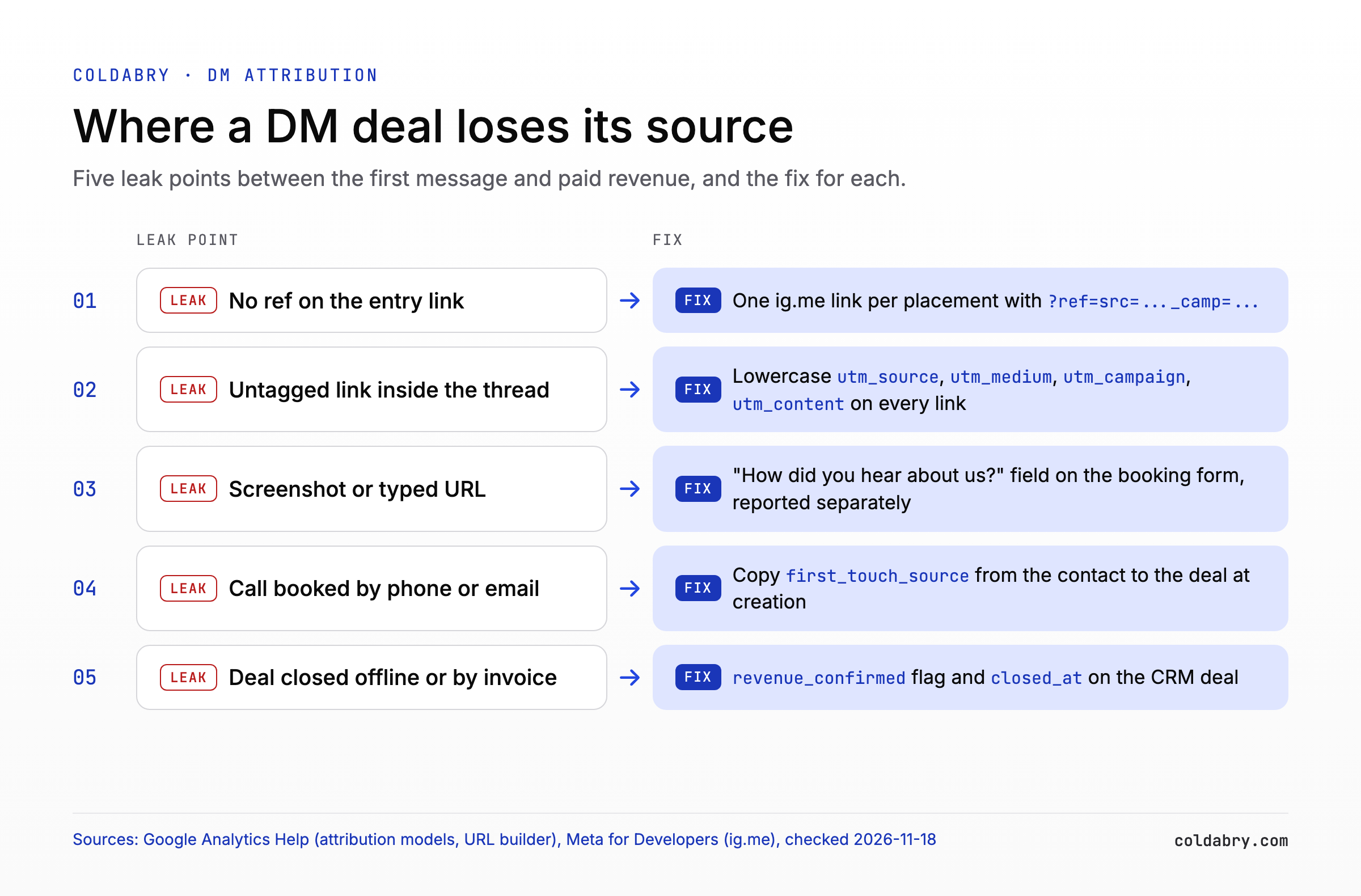
Inbound from an entry link. Meta's ig.me documentation describes ig.me as "a shortened URL service operated by Meta that redirects users to a conversation in Instagram," with the format https://ig.me/<USERNAME>?ref=<REFERRAL_PARAMETER_CONTENT>. When someone opens the thread through that link, your webhook receives a referral event carrying the ref value, with source set to SHORTLINKS. Use one ig.me link per placement: bio, each story campaign, each ad.
The ref has strict rules. Per the same Meta page, it can be up to 2,083 characters and "only alphanumeric characters, and hyphens (-), underscores (_), or equal signs (=) are supported." Periods, slashes and spaces are out, so story.nov/a is invalid. A safe pattern is src=story_camp=nov26_cr=a.
Links inside the thread. Any link you send in the conversation (booking page, case study, pricing) gets UTM parameters. Google's URL builder help says you "should always use utm_source, utm_medium, and utm_campaign," and that utm_content is for differentiating creatives. That makes utm_content the right slot for the script variant, which matters if you are testing DM script variants against each other.
Outbound DMs (you message first). There is no inbound link to tag, because you started the thread. The stamp comes from your send log: list name, script variant, sender account and send date are written onto the contact the moment the first message goes out. A reply then inherits that source automatically.
Note: Instagram's Terms of Use restrict unauthorized automated activity, and accounts that automate cold DMs risk restrictions. If outbound DMs are part of your mix, read our comparison of cold DM tools and their ban risk first. The method below works either way.
Here is a naming convention you can copy. Every value is lowercase, because Google notes that parameter values are case sensitive and that "Meta and meta" are treated as different values.
| Field | Allowed values | Example | Why |
|---|---|---|---|
ig.me ref | Letters, digits, -, _, = (we use lowercase only) | src=story_camp=nov26_cr=a | Meta rejects periods, slashes and spaces |
utm_source | instagram, linkedin, tiktok | instagram | Platform where the thread lives |
utm_medium | dm | dm | One value so every DM visit filters together |
utm_campaign | <placement>-<month><yy> | story-nov26 | Groups a campaign across links |
utm_content | <script>-<variant> | audit-offer-b | Google's slot for differentiating creatives |
| Outbound stamp | out_<list>_<script>_<sender> | out_dentists_v2_acct1 | No link exists, so the send log is the source |
Which deal source fields to add to your CRM
Getting the lead into the CRM is a sync problem, covered in our post on syncing Instagram DM leads into your CRM. Attribution starts after that: the right fields, filled at the right moment, and protected from being overwritten.
The most important rule is that first touch is write-once. It is set when the contact is created, copied to every deal the contact opens, and never changed by later activity. If your automation updates the source field every time a new form or email arrives, your first-touch report quietly turns into a last-touch report.
The second rule is that revenue lives on the deal, not on the contact. A contact may open two deals a year apart, and each one needs its own value and close date. If your current CRM cannot enforce write-once fields or copy values on deal creation, that is the kind of gap that custom CRMs and lead engines built around your pipeline are meant to close.
| Field | Type | Set by | When | Overwrite? |
|---|---|---|---|---|
first_touch_source | Text (from ref, UTM or send log) | Webhook or send log | Contact creation | Never |
first_touch_campaign | Text | Webhook or send log | Contact creation | Never |
first_touch_at | Timestamp | System | Contact creation | Never |
last_touch_source | Text | Any tracked touch | Every new touch | Yes |
touch_count | Integer | System | Every new touch | Yes (increment) |
dm_thread_id | Text | Webhook or send log | First message | Never |
deal_value | Currency | Sales owner | Proposal sent | Yes, until closed |
closed_at | Date | Sales owner | Deal won | No, once set |
revenue_confirmed | Yes / no | Finance or invoice sync | Payment received | Yes |
With these nine fields, every report in the rest of this article becomes a filter and a sum. Deals where first_touch_source starts with src= or out_ are DM-started. Deals where revenue_confirmed is yes are money in the bank.
First-touch vs multi-touch: which model fits DM deals
First-touch answers one question: did DMs start this pipeline? For an agency proving the value of DM work, that is usually the question the client is asking. Last-touch answers a different one, and for service deals it tends to overcredit whatever happened right before the signature, typically a sales call or a proposal email.
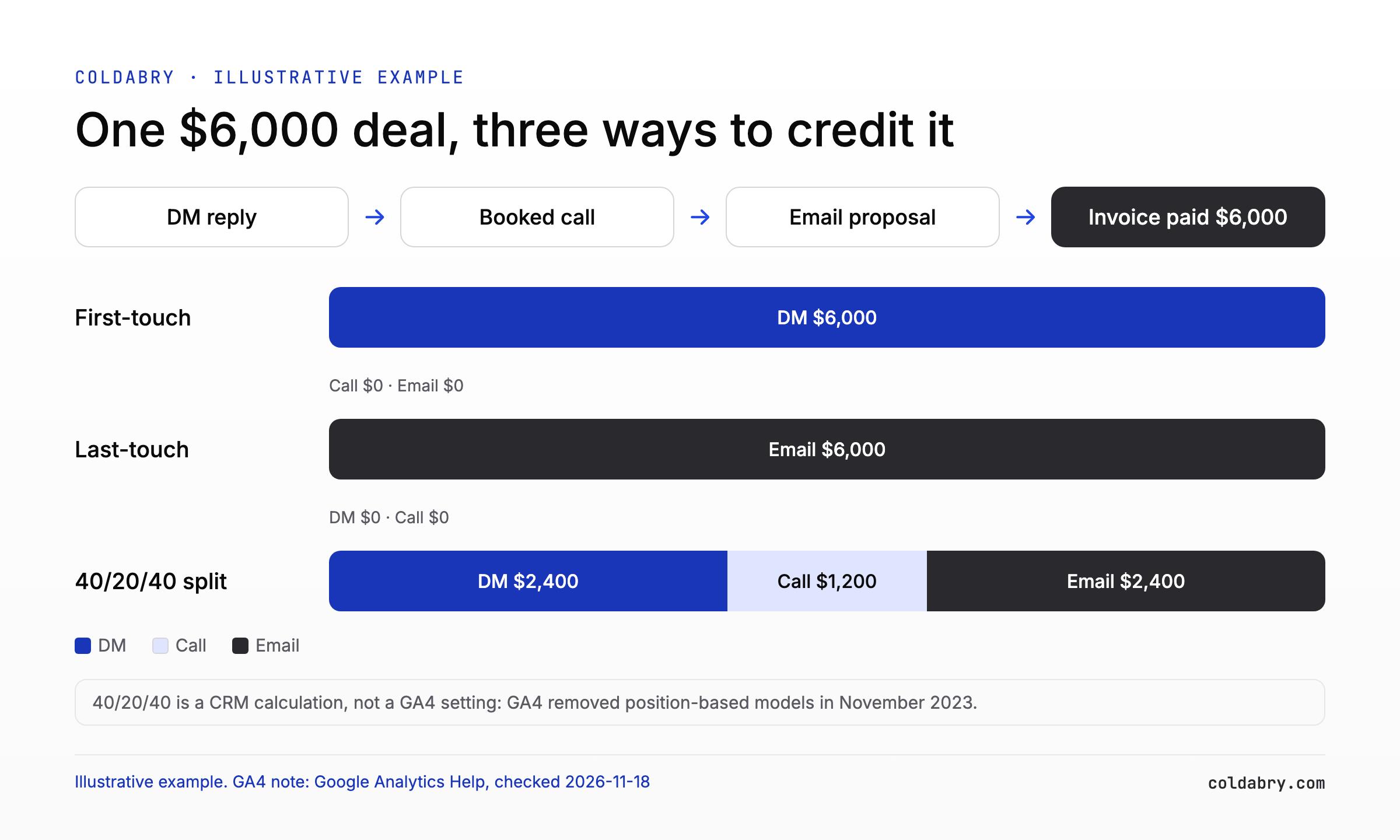
Multi-touch sits in between. Since GA4 no longer offers position-based attribution (per Google), any split you use is a calculation you run in the CRM or a spreadsheet. The 40/20/40 split below (40% to the first touch, 40% to the last, 20% shared across the middle) is our convention for illustration, not a platform setting.
Here is an illustrative deal path. A prospect replies to a DM, then books a call (the step covered in our guide to moving a DM reply to a booked call), then receives a proposal by email, then pays a $6,000 invoice. Three tracked touches: DM, call, email.
| Model | DM credit | Call credit | Email credit |
|---|---|---|---|
| First-touch | $6,000 | $0 | $0 |
| Last-touch | $0 | $0 | $6,000 |
| 40/20/40 (3 touches) | $2,400 | $1,200 | $2,400 |
The arithmetic for the split: 40% of $6,000 is $2,400 for the DM, 20% is $1,200 for the call, 40% is $2,400 for the email. Our recommendation for DM-led service work: report first-touch as the headline, show the 40/20/40 figure as a secondary column if the client runs several channels, and agree on the model before the first report, not after.
How to calculate DM ROI for a client (worked example)
DM ROI is first-touch DM revenue minus the cost of the DM program, divided by that cost. The example below is illustrative, with every assumption stated, so you can swap in your own numbers.
Assumptions for one month:
- Program cost: $2,500 (agency retainer plus tools).
- DMs sent: 1,200.
- Replies: 84.
- Calls booked: 18.
- Deals closed: 5, at $3,000 each.
The arithmetic:
- First-touch DM revenue: 5 × $3,000 = $15,000.
- ROI: ($15,000 − $2,500) ÷ $2,500 = 5.0, so 500%.
- Cost per closed deal: $2,500 ÷ 5 = $500.
- Revenue per DM sent: $15,000 ÷ 1,200 = $12.50.
| Stage | Count | Conversion from previous stage |
|---|---|---|
| DMs sent | 1,200 | n/a |
| Replies | 84 | 84 of 1,200 · 7% |
| Calls booked | 18 | 18 of 84 · 21.4% |
| Deals closed | 5 | 5 of 18 · 27.8% |
| First-touch revenue | $15,000 | 5 × $3,000 |
| ROI | 500% | ($15,000 − $2,500) ÷ $2,500 |
Two things to watch. Count only deals with revenue_confirmed set to yes in the ROI line; booked calls and open proposals are pipeline, not revenue. And if the sales cycle runs longer than a month, deals started by this month's DMs will close next month, so agree a lookback window with the client (for example, deals closed within 90 days of first_touch_at).
How to report DM revenue to clients without overclaiming
The point of the report is to show money, not activity. Inro's agency guide frames it as showing "qualified leads, bookings, sales, revenue attributed, and cost per result, not the message counts most agencies send" (Inro). Messages sent belong in an appendix, if anywhere.
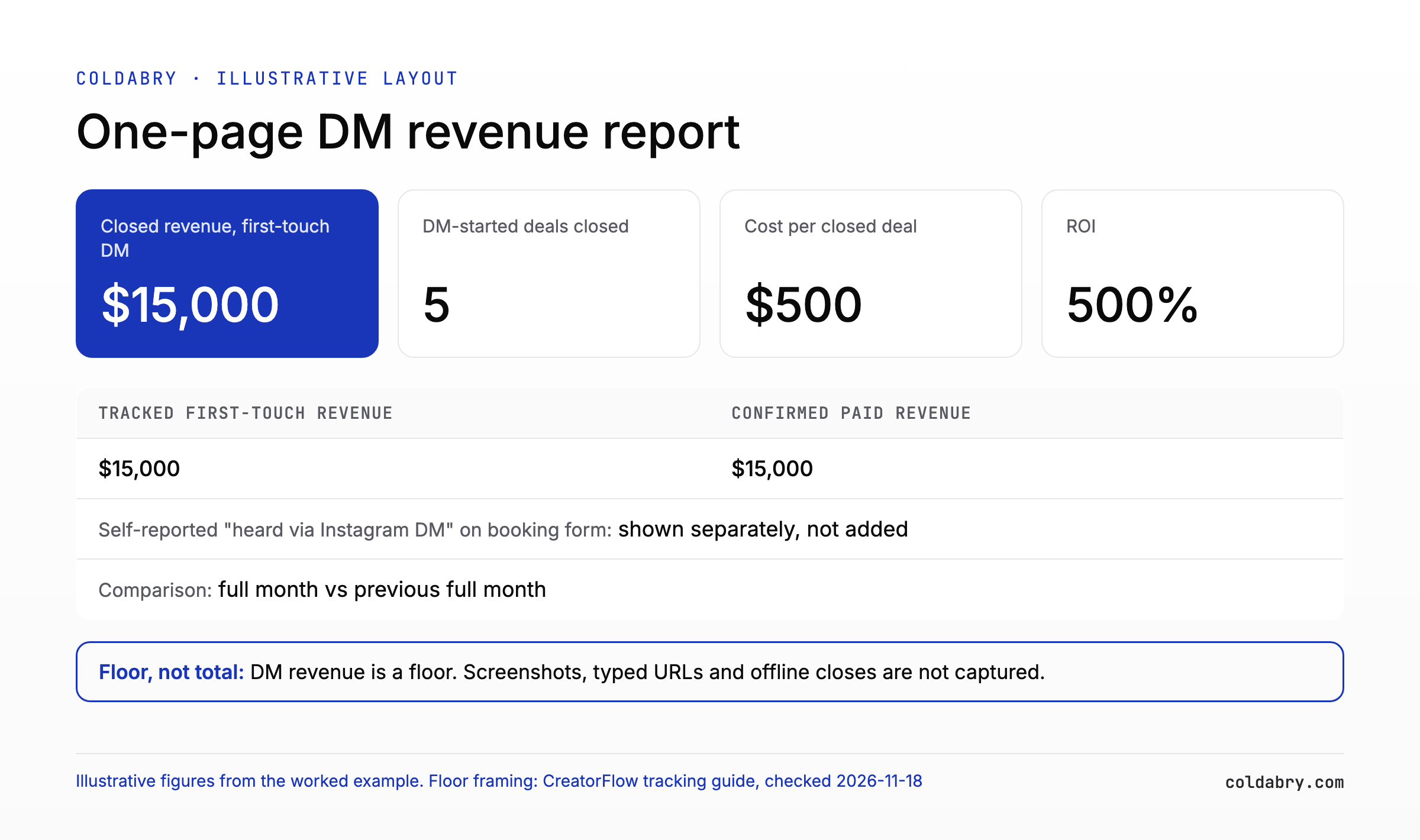
Be explicit that the figure is a floor. CreatorFlow's tracking guide notes that DM tracking "undercounts" because screenshots, cross-device journeys, long consideration windows and blocked tracking remove real orders, and recommends treating the figures "as a floor." Saying this up front protects you when a client's own records show more DM-driven deals than your report does.
Recover some of the missing deals with a self-reported field. Sked recommends surveys and feedback forms to learn how people found a brand (Sked Social). Add a "How did you hear about us?" question to the booking form and report its answers as a separate, self-reported line, never merged into the tracked total.
A one-page monthly layout that works:
- Four KPI tiles: first-touch DM revenue (closed), DM-started deals closed, cost per closed deal, ROI.
- A two-column revenue table: tracked first-touch revenue and confirmed (paid) revenue.
- A self-reported line from the booking form question.
- Full month against the previous full month, never a partial month against a full one.
- One sentence on the floor caveat.
If the client also buys referrals or cold email from you, the report should compare channels on the same basis; our post on how SMMA agencies compare DMs with referrals and cold email covers that comparison. Pulling the numbers by hand every month is slow, and it is a common candidate for automated reporting across your CRM and analytics stack.
Common DM attribution mistakes (checklist)
Most broken DM reports fail for a small number of repeatable reasons. Run this list before the first client report and again whenever you add a new placement or tool.
Checklist: 1) All UTM values lowercase, since Google treats
Metaandmetaas different values and missing parameters show as "(not set)". 2) Every ig.merefuses only letters, numbers,-,_and=. 3) Test-click every tagged link and confirm the parameters survive any redirect or link shortener. 4)first_touch_sourceis write-once and copied to the deal at creation. 5) Booked calls and open proposals are never counted as revenue. 6) Referral deals are not credited to DMs just because a DM happened somewhere in the thread. 7) A lookback window (for example, 90 days) is agreed with the client in writing. 8) Self-reported sources are shown on their own line. 9) Comparisons are full month against full month. 10) Consent and cookie settings are checked so tracked visits are not silently dropped.
The last item catches more teams than you would expect; see how a consent banner can silently kill your tracking for what that looks like in practice.
Coldabry builds custom CRMs and reporting automation of this kind for teams that want DM revenue tracked from the first message.
FAQ
How do you attribute sales to Instagram DMs?
Give every conversation a source stamp at its first message and carry it to the deal. For inbound threads, use one ig.me link per placement with a ref value, which Meta passes to your webhook when the thread opens. For links sent inside the thread, add lowercase UTM parameters. For outbound DMs, write the list, script and sender from your send log onto the contact. Then copy that first-touch source onto the CRM deal when it is created, and sum closed, paid revenue by source. The CRM, not your analytics tool, is where the attribution lives.
Why do DM-driven visits show up as direct traffic?
Private messages are dark social: conversations analytics tools cannot see. An untagged DM link lands as direct or generic Instagram traffic, and screenshots or typed URLs always arrive as direct. GA4's paid and organic last click model also skips direct visits when another channel is in the path, so the credit goes to that channel or to Direct, never to the DM. The fix is to tag every link you send in a DM with UTM parameters and to stamp the source on the CRM contact, so the deal keeps its origin even when the website visit does not.
Can you track DM sales without UTM links?
Yes, for most service deals. UTMs only track clicks to a website, and many DM deals close with no click at all: a reply, a call, a proposal and an invoice. Instead, store the source on the CRM record. Inbound threads opened through an ig.me link carry a ref value in the referral webhook. Outbound threads take their source from the send log. A "How did you hear about us?" question on the booking form fills some remaining gaps, reported separately. UTMs remain useful for links inside the thread, but they are not the backbone of DM attribution.
Should agencies use first-touch or multi-touch for DM deals?
For DM-led service work, first-touch is usually the right headline because it answers the client's real question: did the DM program start these deals? Last-touch tends to credit the call or proposal email that closed the deal, which hides the DM entirely. If the client runs several channels, add a multi-touch column such as a 40/20/40 split calculated in the CRM. GA4 removed its position-based and first click models in November 2023, so either model has to be computed from your own deal data. Agree the model in writing before the first report.
How accurate is DM attribution?
It undercounts, and you should say so. Screenshots, typed URLs, cross-device journeys, long consideration windows and blocked tracking all remove real deals from the tracked total. That is why the tracked figure should be presented as a floor: the DM program produced at least this much revenue. Accuracy improves when first touch is write-once on the CRM record, every link is tagged in lowercase, and each placement has its own ig.me ref. A self-reported source question on the booking form recovers part of the gap, as long as it stays on its own line.
How do I prove DM outreach ROI to a client?
Report revenue and cost, not messages sent. Sum the closed, paid revenue on deals whose first-touch source is a DM, subtract the monthly program cost, and divide by that cost. For example, $15,000 of DM-started revenue on a $2,500 monthly cost is a 500% ROI and $500 per closed deal. Show the funnel with counts and percentages, compare full months only, and state the lookback window you agreed with the client. Add a one-line note that the figure is a floor, so the number holds up when the client checks it against their own records.