AI Automation Agency Clients: The Instagram DM Playbook
AI automation agencies win clients on Instagram with a hand-sent DM about one visible problem, then a 2-minute demo. The playbook, scripts and the ToS line.
AI automation agencies land clients on Instagram by hand-sending a short DM that names one visible, costly problem on the prospect's own account (a slow reply, a booking form with no follow-up), then showing a 2-minute demo that fixes it. This playbook for winning AI automation agency clients fits agencies selling to owner-run local businesses and creators, where the person who reads the DMs is the person who signs. The main caveat: automating the cold send itself breaks Instagram's Terms of Use, so your automation belongs behind the reply, not in front of it.
The irony works in your favor. The prospect's own unanswered messages and missed bookings are the proof, and the demo you send is the product you will sell them.
This post is the DM playbook only. If you are still deciding between channels, read how DMs compare with referrals and cold email first.
How do AI automation agencies get clients from Instagram DMs?
The chain has six links, and most agencies break it at link two or five. They pick a niche without a DM habit, or they pitch "AI" instead of showing a fix on the prospect's real account.
- Niche: businesses where bookings, quotes or orders already arrive by DM.
- Offer: one workflow, one outcome, fixed scope.
- List: accounts with visible signs of the problem your offer fixes.
- Opener: a hand-written message with one observation and one question.
- Demo: a short recording or live bot built on their situation.
- Pilot: a small, time-boxed paid or free trial that turns into a retainer.
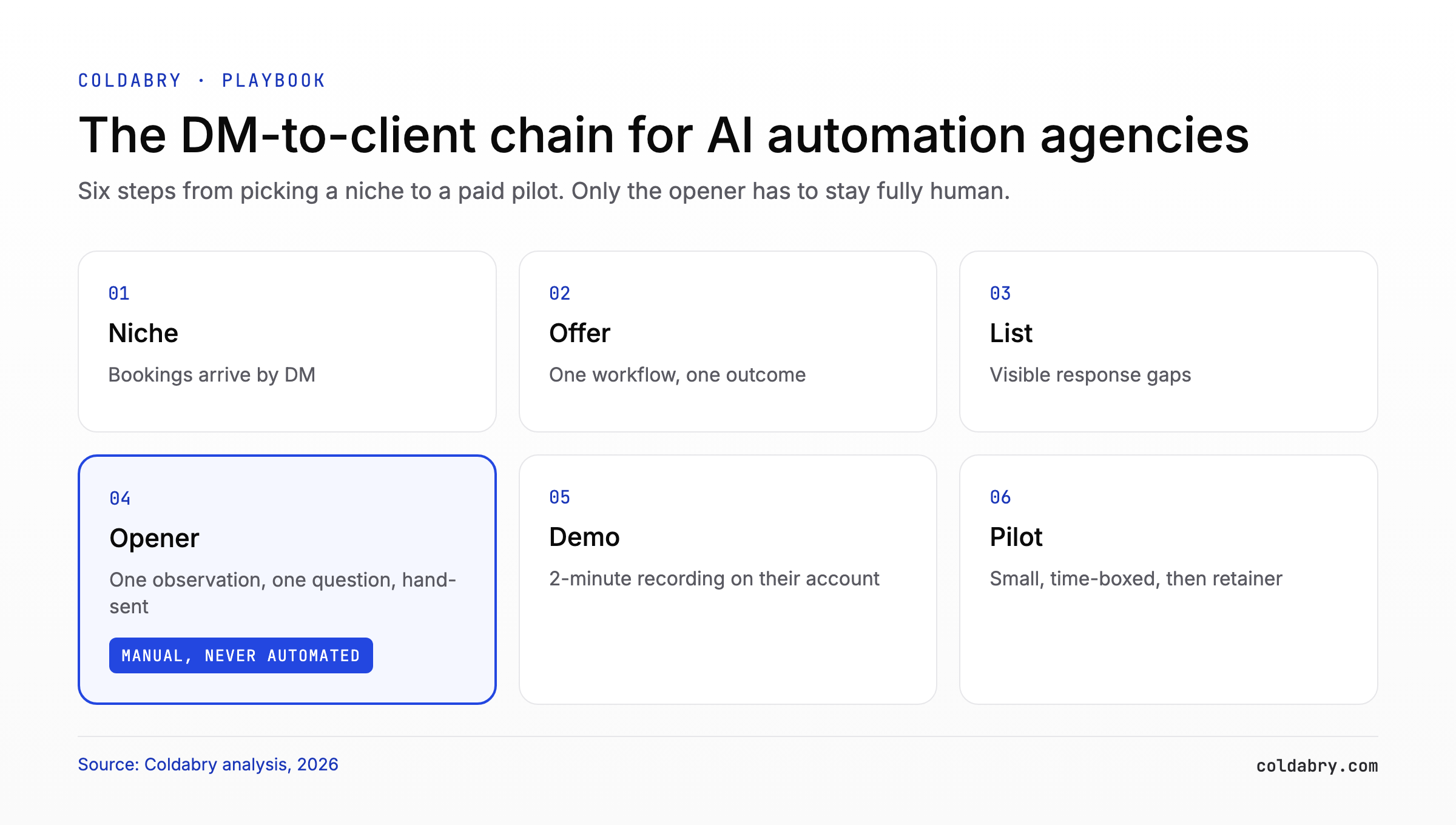
Each section below covers one link, with the artefacts you can copy. The section on automation explains why link four stays manual even for an agency whose whole business is automation.
Which niche should an AI automation agency pick for Instagram?
Pick a niche where the owner reads their own DMs and money already moves through them. Instagram outreach works when the buyer and the inbox are the same person, and when the gap you fix is visible from outside.
Score candidate niches on four criteria:
- Owner reads DMs: no gatekeeper, no marketing department.
- Revenue arrives by DM: bookings, quotes or orders start in the inbox.
- Visible response gap: you can see slow replies, dead comment threads or a "DM to book" bio that leads nowhere.
- Recurring revenue per customer: one recovered lead is worth enough to justify a retainer.
| Niche | Owner reads DMs | Revenue by DM | Visible gap | Recurring revenue | Total (of 12) |
|---|---|---|---|---|---|
| Med spa / aesthetics | 2 | 3 | 3 | 3 | 11 |
| Hair and beauty salon | 3 | 3 | 3 | 2 | 11 |
| Gym / online coach | 3 | 2 | 2 | 3 | 10 |
| Home services | 2 | 2 | 2 | 1 | 7 |
| Dentist | 1 | 1 | 2 | 2 | 6 |
| Restaurant | 2 | 1 | 2 | 1 | 6 |
Note: These scores are our judgment on a 1 to 3 scale, not measured data. Re-score with what you see in your own market after browsing 30 accounts per niche.
Dentists and restaurants score low mainly because bookings run through phone, platforms or front desk staff. That does not make them bad clients, only bad Instagram DM targets.
What offer gets AI agency clients to reply?
The offer that gets replies is one workflow with one outcome and a fixed scope, written in the prospect's words rather than yours. "AI automation" is a category. "Every booking DM answered in under a minute and pushed to your calendar" is something an owner can picture on a busy Saturday.
Offer formula: [one trigger they already have] + [one outcome they can count] + [fixed scope and timeline]. Example: "When someone DMs to book, they get an answer and a calendar slot within a minute, set up in two weeks, one fixed price."
Keep the first offer narrow enough that you could demo it before the call. A narrow offer also makes the pilot easy to judge: either bookings from DMs went up or they did not.
On price, avoid copying numbers from guides. One 2026 guide lists a "$0 to $500 pilot", a "$500 to $2,000 simple build" and retainers "roughly $300 to $1,500" a month, but presents them as unattributed market-observed ranges. If you want a reference for structure rather than amounts, see how fixed-price builds and retainers are scoped: a fixed build price plus an optional monthly retainer, agreed in writing.
How to build a lead list of businesses that need automation
Build the list by hand from signals you can see on the account itself. A list of 50 accounts with a visible gap beats 500 scraped handles, and it keeps you inside the rules: Instagram's Terms bar collecting information in an automated way without Meta's express permission, which is what scrapers do.
Browse niche hashtags and location tags in the app, open each profile, and log only accounts that show at least two of these signals.
| Signal | Where to see it | What it tells you |
|---|---|---|
| "DM to book" in bio | Bio text | Bookings start in the inbox, so reply speed costs money |
| Bio link goes to a plain form | Tap the link | No instant confirmation or calendar slot |
| Unanswered questions in comments | Last 5 posts | The owner is behind on messages |
| Price or availability questions repeated | Comments, story replies | An FAQ answer could be automated |
| Reviews mention slow replies | Google reviews for the business | The gap is already hurting reputation |
| Posted in the last 14 days | Grid | The account is active and the owner will see your DM |
| Running ads | Sponsored label, Meta Ad Library | They pay for leads and lose some in the inbox |
For each account, write one line of notes: the specific gap, with a screenshot. That line becomes your opener, and the screenshot becomes part of your demo.
The Instagram DM sequence that books AI automation agency clients
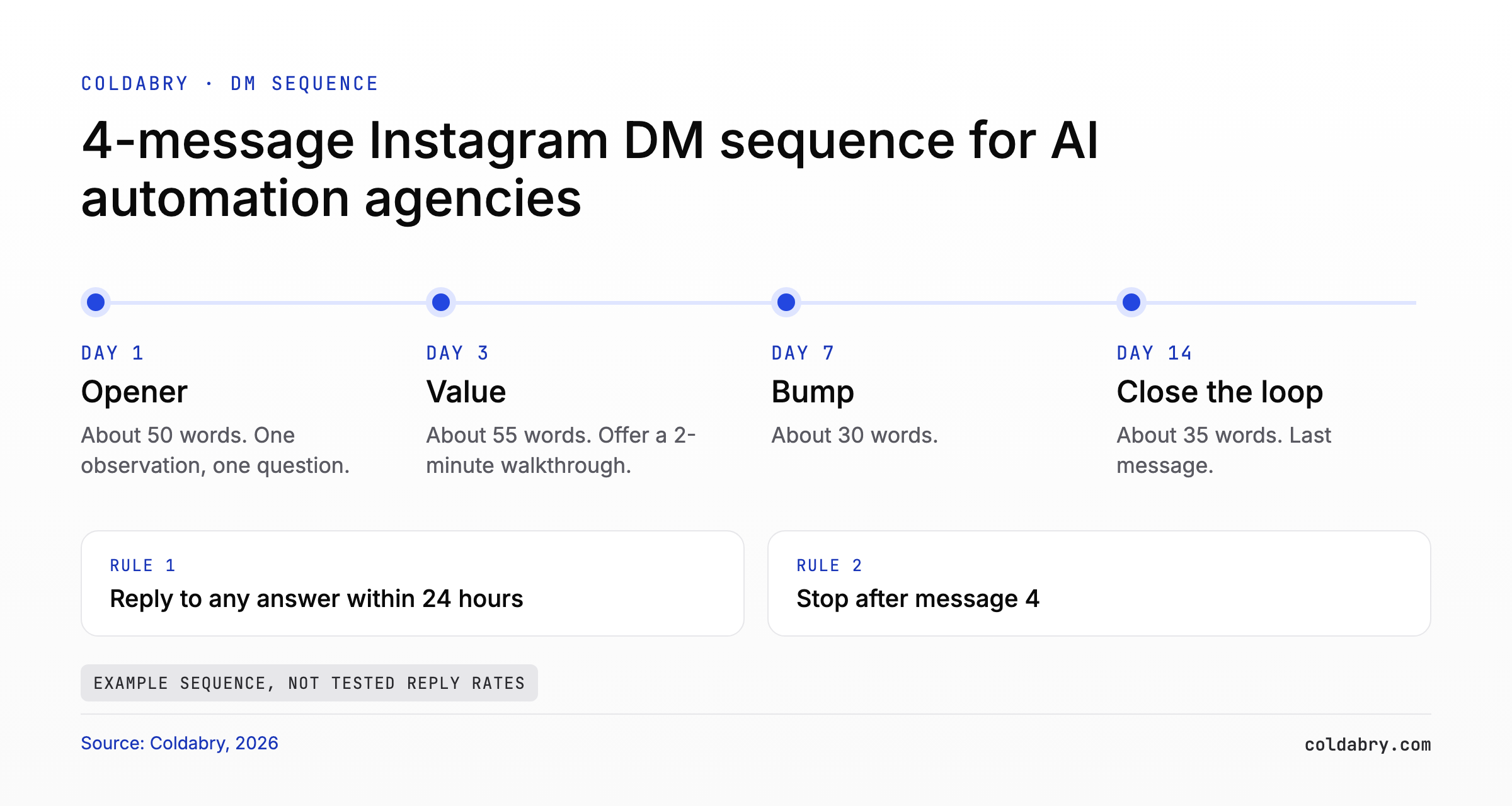
Send four messages over 14 days, each written for that account, and stop after the fourth. The opener stays under 60 words and asks one question. Below is the full sequence; it is an example to adapt, not a tested template with known reply rates.
Message 1, day 1 (opener, about 50 words):
Opener: Hi Maya, I was looking at your lash studio's page. Your bio says "DM to book", but the link goes to a form with no calendar, and two questions on your last post about Saturday slots have no answer yet. Do most of your bookings still come through DMs?
Message 2, day 3 (value, about 55 words):
Value follow-up: I recorded a 2-minute walkthrough of what a booking DM to your account could look like: instant answer, three open slots, confirmed in your calendar. Built it on a test account using your service list. Happy to send the link, or I can just tell you the three changes if that's easier.
Message 3, day 7 (bump, about 30 words):
Bump: Quick one, Maya: did the Saturday questions on your last post get sorted? If DMs are under control, no worries, I'll leave it there.
Message 4, day 14 (close the loop, about 35 words):
Close the loop: Last note from me. If booking DMs ever pile up on busy weeks, the walkthrough is ready and takes two minutes to watch. Good luck with the new studio space.
The names and details are illustrative. Two rules make the sequence work: reply to any answer within 24 hours, and never send message 2 if they already replied to message 1 (switch to a conversation). For more openers to compare against, see these graded public cold DM templates.
What proof assets close the deal?
The asset that closes is a short recording of the prospect's own funnel, broken and then fixed. Generic case studies prove you can build something; a walkthrough of their account proves you understood their problem.
| Asset | Effort | When to send | What it proves |
|---|---|---|---|
| 2-minute screen recording of their DM-to-booking path | 15 to 20 minutes | Message 2, or right after a reply | You saw the specific gap |
| Live demo bot on a test account with their services | 1 to 3 hours | After they say yes to seeing it | The fix works, today |
| One-page before/after mock of the booking flow | 30 to 60 minutes | On the call, or as the pilot proposal | What changes, in plain terms |
| Portfolio of systems you run | One-time | When they ask "who else have you done this for?" | You ship and maintain work |
Effort figures are our estimates for a solo builder with a reusable demo template. Keep the recording to two minutes; one 2026 guide also recommends a "two-minute Loom" for the same reason: owners watch it between appointments.
A portfolio only helps when it is real. For a sense of how production work can be presented without inflated claims, see the AI apps and automations we run in production. Never show a prospect another client's results unless you have permission and the numbers are yours to share.
What should you automate in Instagram outreach, and what must stay manual?
Automate everything after the prospect writes back, and keep the cold first message manual. That line comes straight from Meta's own documentation, not from caution.
Meta's Instagram Messaging API lets an app message a user "only after an Instagram user has sent your app user's Instagram professional account a message." The reply window "for most user actions" lasts 24 hours, can stretch to 7 days after a Click-to-Direct ad, and a response can be tagged to use a separate 7-day Human Agent window. Any tool that sends cold DMs therefore works outside the official API, through browser or app automation, which runs into the Terms clause against automated access and collection. The practical risk is restrictions on the sending account.
| Task | Automate? | Why |
|---|---|---|
| Research notes and lead scoring from your own manual log | Yes | Runs on your data, not on Instagram |
| CRM logging and follow-up reminders (day 3, 7, 14) | Yes | Reminds a human to send; sends nothing itself |
| Demo bot on your own test account | Yes | Inbound messages to your account, inside the API |
| Reply and booking after the prospect messages you | Yes, via the official API | Allowed within the 24-hour window |
| Cold first message | No, send by hand | The API cannot start a conversation |
| Follow, like or comment bots | No | Automated actions outside the API |
| Scraping profiles or follower lists | No | Automated collection without permission |
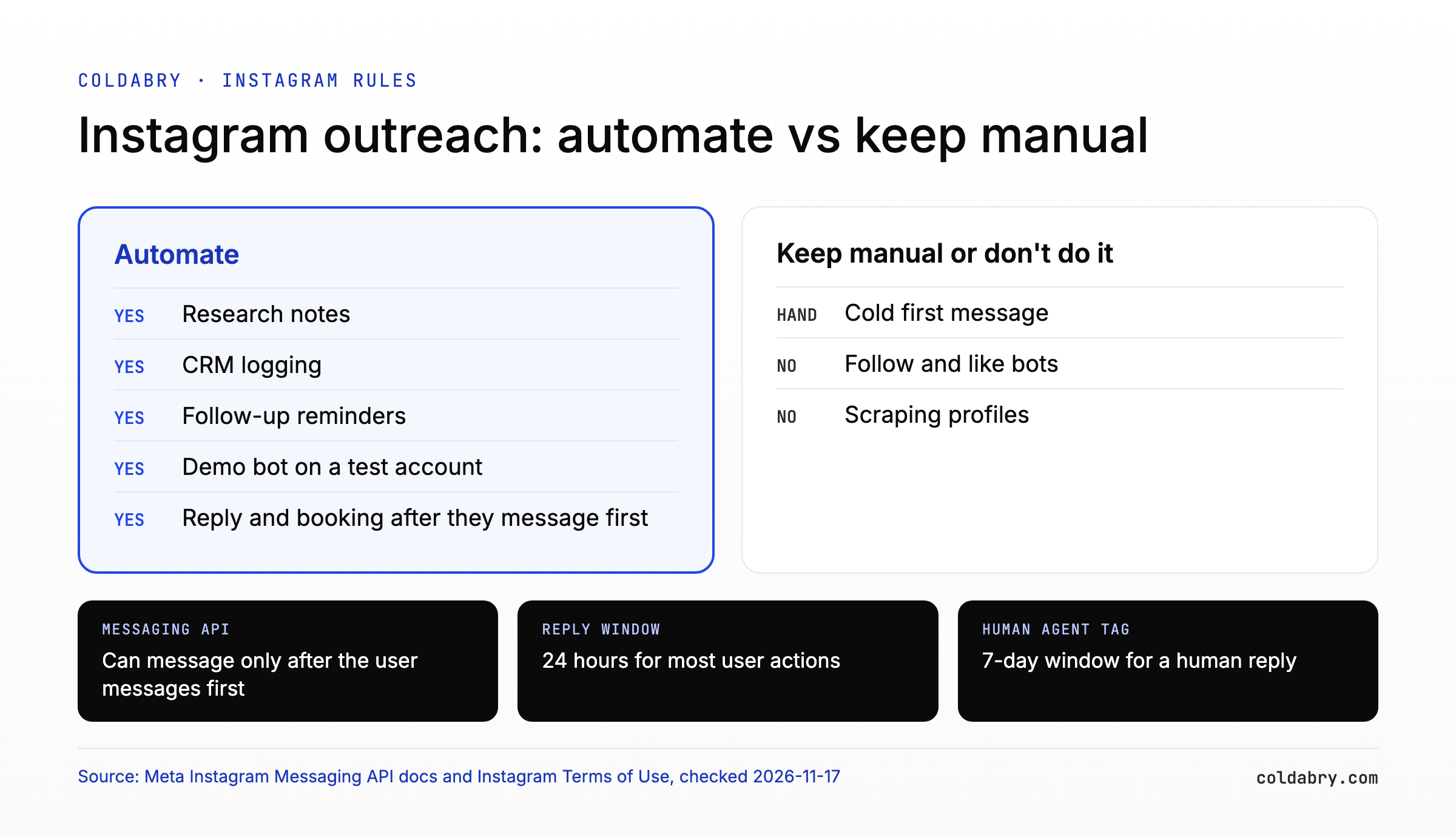
This split is also your pitch. What you sell the client sits in the "automate" column: automating the booking once a lead replies, plus the logging and handoff around it. If you build these systems for clients, the scope looks like custom AI automation for outreach ops or outreach agents with human escalation, where a person takes over before anything sensitive is sent. For what reply data says about AI-written vs human DMs, see our separate breakdown rather than a repeat here.
How many DMs does it take to land one client? (worked example)
Nobody has a sourced answer, so measure your own. The rates that circulate are estimates: one guide calls 1-5% cold reply rates a directional benchmark, not a verified study, a vendor page claims up to around 39 percent positive replies with no source, and another guide's 0.5-2% cold-to-meeting figure is the author's estimate.
Here is a transparent example with every rate assumed, so you can swap in your own:
| Step | Assumption | Arithmetic | Result |
|---|---|---|---|
| Hand-sent openers | 20 per business day, 20 days | 20 × 20 | 400 DMs |
| Replies | 10% reply (assumed) | 400 × 0.10 | 40 replies |
| Demos | 25% of replies watch or take a demo (assumed) | 40 × 0.25 | 10 demos |
| Pilots | 30% of demos start a pilot (assumed) | 10 × 0.30 | 3 pilots |
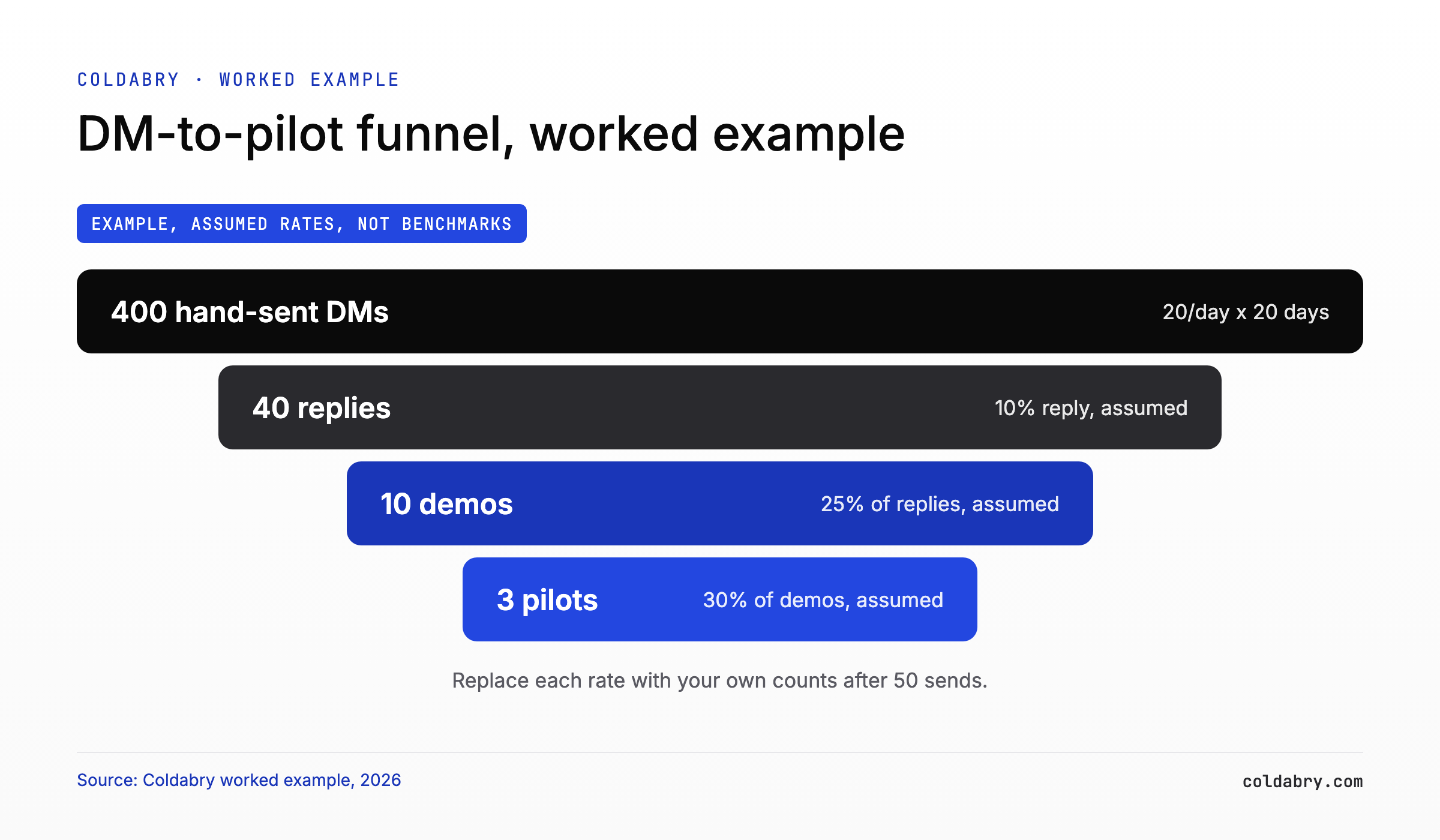
Under these assumptions, one month of manual sending yields three pilots. Whether those become retainers depends on the pilot result, which is why the offer has to be measurable.
After your first 50 sends, replace each assumption with your real count. OutlierKit's heuristic is a useful early check: if 50 sends produce fewer than 3 replies, fix the first line or the list before sending more.
FAQ
How do AI automation agencies get their first client?
Most first clients come from a narrow offer shown on the prospect's own account. Pick one niche where bookings arrive by DM, build a hand-checked list of 50 accounts with a visible response gap, and send each a short opener naming that gap. When someone replies, send a 2-minute recording of their booking path fixed, then offer a small, time-boxed pilot with one measurable outcome. The first client is rarely about volume; it is about one owner seeing their own problem solved before they have paid anything.
Is it against Instagram's rules to automate cold DMs?
Yes. Instagram's Terms of Use bar accessing or collecting information in an automated way without Meta's express permission, and Meta's official Messaging API only lets a business message someone after that person has messaged first. A tool that sends cold first messages therefore runs outside the official API, which puts the sending account at risk of restrictions. Automating replies, booking and follow-up reminders after a prospect writes to you is a different case: that runs through the official API inside a 24-hour window.
What is the best niche for an AI automation agency on Instagram?
The best niches share four traits: the owner reads the DMs, revenue already starts in the inbox, the response gap is visible from outside, and each customer brings recurring revenue. Med spas, salons and coaches usually fit all four. Dentists and restaurants often route bookings through phone, front desk staff or platforms, so their Instagram inbox matters less. Score niches yourself after browsing about 30 accounts in each, because local habits differ between markets.
How many Instagram DMs should an AI agency send per day?
Meta publishes no daily DM number, so treat any specific limit you see online as a claim. One 2026 guide suggests twenty to forty targeted messages per business day, but presents it as an unattributed range. A practical rule is to send only as many as you can personalize with a real observation from the account itself, and to track your own reply rate before raising the pace. Quality matters more than volume: identical messages sent in bulk are what tends to trigger action limits on an account.
Should an AI automation agency offer a free pilot?
A pilot works when it is small, time-boxed and measured on one number, such as booking DMs answered within a minute. Free pilots lower the barrier for a first client and give you a case to show, but they attract owners who are curious rather than committed. A low fixed fee, credited against the build if they continue, filters better. Whatever you choose, agree in writing what success looks like before you start, so the pilot ends in a clear yes or no.
Can an AI appointment setter replace a human setter for outreach?
For inbound conversations, largely yes: once a prospect messages the account, an AI setter can answer, qualify and book through the official API within the reply window, with a human agent taking over when needed. For cold outreach, no. The official API cannot start a conversation, and tools that do it anyway work outside Meta's rules. Keep the first message human and let the AI handle everything after the prospect writes back.
Coldabry builds custom AI apps and agents that clients own, including the reply-and-booking side of systems like the one described here.