SMMA Small Town Clients: Niche, Pricing, Remote or Local
SMMA small town clients can pay if you sell one outcome at a fixed price: local firms spend 6-10% of revenue on marketing. How to pick niche and price.
Small-town clients can pay for an SMMA, but only in niches whose revenue supports a fee: the largest share of US local businesses spend 6-10% of revenue on marketing (LocaliQ, 2025, n=400), so a shop doing $150,000 a year has roughly $750 to $1,250 a month for everything, ad spend included. That ceiling applies to anyone selling SMMA services to small town clients, in a city of tens of thousands, or in a country where local prices are low. The main caveat: when the ceiling is too low, the fix is a different niche, a smaller scope, or selling remotely. Discounting your retainer is not the fix.
Can SMMA work with small town clients?
Yes, with one condition: the business must be big enough, and in a niche valuable enough, that a new customer covers your fee. In a small town, word of mouth travels fast and reviews carry weight. Across US local businesses in general, the same LocaliQ survey found 48% of local business owners called reviews "extremely important" and 38% "very important".
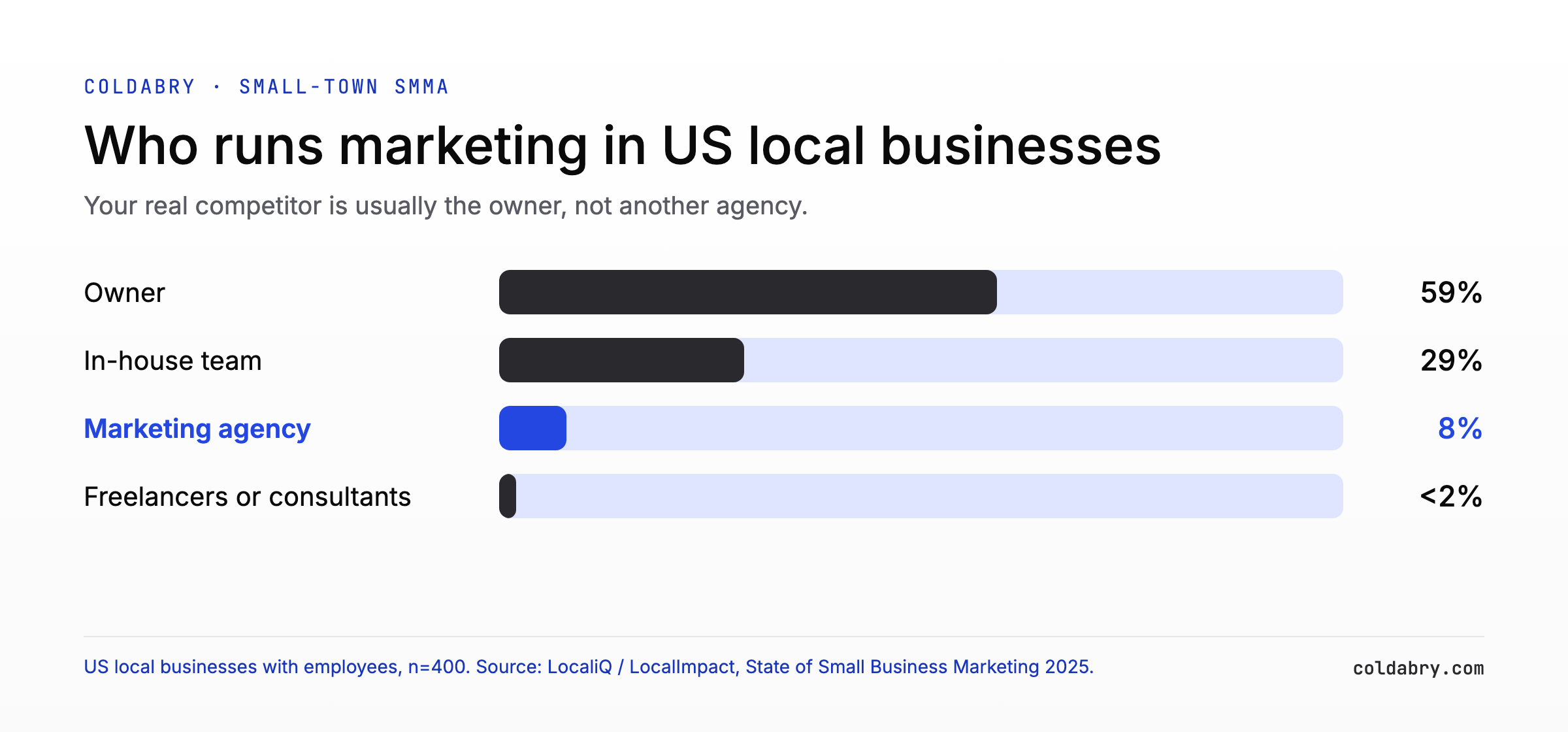
The harder fact is who you are competing with. Most of the time it is not another agency. It is the owner. LocaliQ found that in 59% of small businesses the owner is still the primary person responsible for marketing, 29% use an in-house team, and only 8% use an agency. Fewer than 2% rely on freelancers or consultants.
So your pitch is not "hire us instead of the agency down the road." It is "stop doing this yourself on Sunday nights." The survey covers US local businesses with employees, so solo shops are not in it.
The model can work at scale. A 2023 AgencyAnalytics profile of London Road Marketing describes an agency in Lethbridge, Alberta, that started in 2016 with two clients and by 2023 served over 100 small-business clients a year. The founder chose "small to medium-sized cities where local really matters and talent is hard to find."
How much can a small-town business afford to pay an SMMA?
Work it out from revenue, not from your own price list. Take the 6-10% band from LocaliQ, which is where the largest share of businesses sit (about four in ten). About one-third spend more than 10%, so roughly a third of clients will sit above this range, and a smaller share below it.
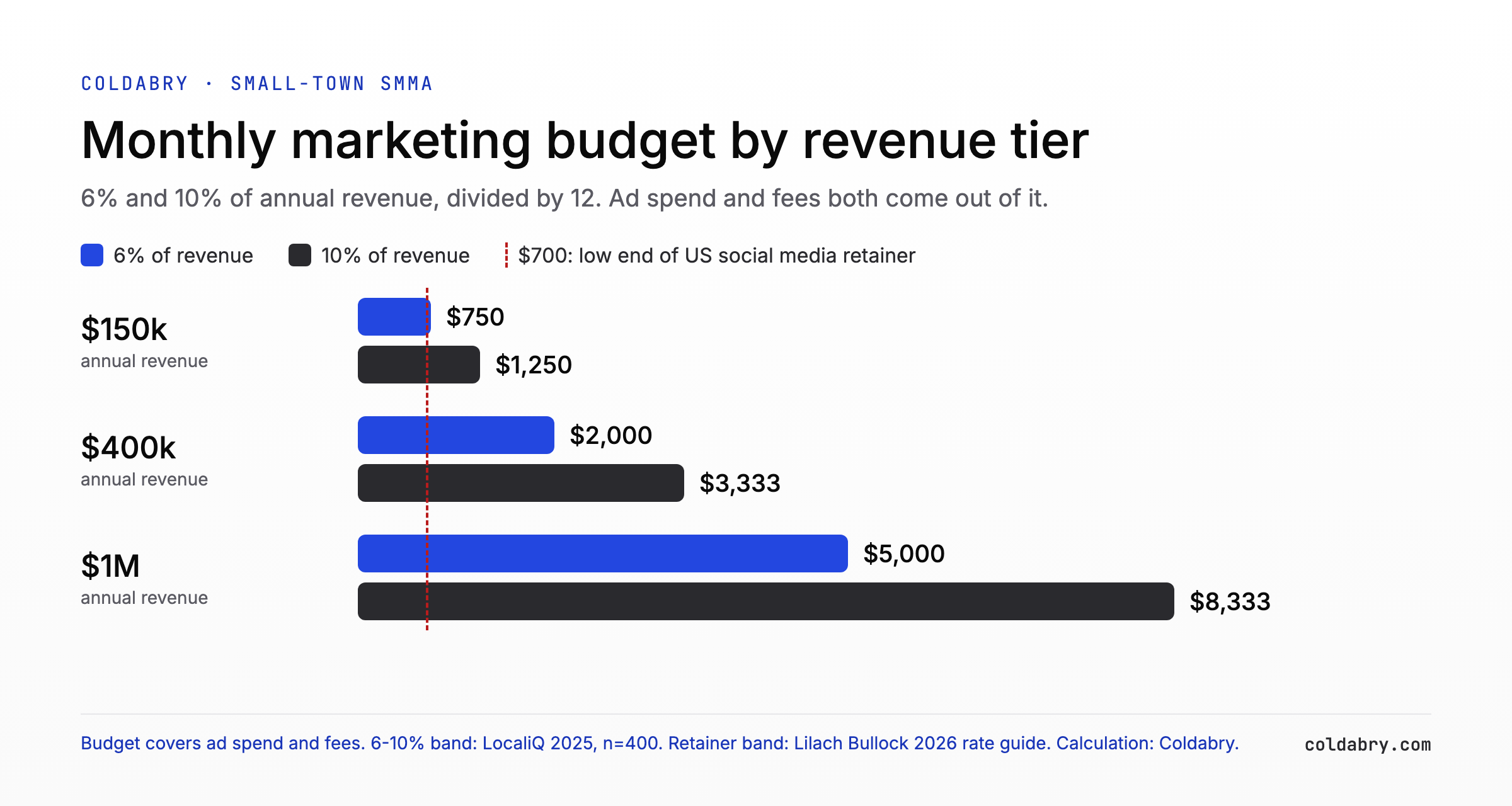
Worked example (assumptions stated). Three revenue tiers, two budget shares. The marketing budget covers everything: ad spend, tools, printing, and your fee. We then assume about half goes to ad spend and media. That 50% split is our assumption, not survey data. Change it to match the client.
| Annual revenue | Budget at 6% | Budget at 10% | Monthly total | Fee room if half is ad spend (assumed) |
|---|---|---|---|---|
| $150,000 | $9,000 / yr | $15,000 / yr | $750 to $1,250 | $375 to $625 |
| $400,000 | $24,000 / yr | $40,000 / yr | $2,000 to $3,333 | $1,000 to $1,667 |
| $1,000,000 | $60,000 / yr | $100,000 / yr | $5,000 to $8,333 | $2,500 to $4,167 |
The arithmetic for the first row: $150,000 × 6% = $9,000 a year, divided by 12 = $750 a month. At 10%, $15,000 a year = $1,250 a month. Half of that leaves $375 to $625 for management.
Now compare with practitioner rates. One UK consultant's 2026 rate guide says most small businesses can afford £500 to £2,500 a month for marketing help, and that a business that cannot afford £500 a month "usually isn't ready for outsourced marketing at all." The same guide puts social media management for 2-3 platforms at $700 to $2,000 a month in the US.
Read together, the table gives a clear rule. A $150,000 business sits at or below the floor of a normal social media retainer. A $400,000 business can afford a one-channel retainer. A $1M business can afford a full retainer. In a small town, your client list is limited by how many businesses in your niche are above roughly $400,000 in revenue, not by how many businesses exist.
Ignore bigger survey averages: QuickBooks' roughly $78,000 average ad budget for 2025 includes firms with 100+ employees.
Which niche pays in a small or low-price market?
Pick niches where one new customer is worth more than a month of your fee. In a small market you cannot make up for low-value clients with volume.
Score a niche on five criteria before you build a single post. The examples in the table are illustrative: they show how the filter works, not measured market data for any town.
| Criterion | Pass looks like | Fail looks like | Illustrative pass | Illustrative fail |
|---|---|---|---|---|
| Average ticket | One sale covers a month of your fee | You need dozens of extra sales to break even | Dental implants, roofing | Cafe, barber |
| Repeat or lifetime value | Customers return for years, or the job is large once | Small one-off purchases with no follow-up | HVAC service plans | Souvenir shop |
| Number in town | Enough to keep a pipeline, after you count them | Two or three, and they all know each other | Count on Google Maps first | Count on Google Maps first |
| Owner reachable | Owner answers the phone and decides alone | Franchise or head office decides marketing | Independent real estate office | Chain branch |
| One measurable outcome | Calls, booked jobs, or quote requests you can count | "Brand awareness" with no way to track sales | Booked roof inspections | Nail salon "more followers" |
A niche needs at least four passes. The third row is the one beginners skip. A city of 60,000 may have only a handful of roofers or implant clinics. Do not guess. Open Google Maps, search the niche plus the town and the nearest towns within driving distance, and write down every business with a website and recent reviews. If the list is under 15, the niche cannot carry an agency on its own, and you either combine two related niches or widen the area.
LocaliQ found 64% of local businesses use sales or revenue as their primary success metric. If you cannot connect your work to sales in a niche, that niche will churn.
What to sell when local clients pay too little
Shrink the scope, not the rate. The UK rate guide puts it in one line: "The answer isn't to drop your rate, it's to drop the scope."
The London Road founder describes the same idea for small budgets: "putting money where it needs to go first," then going further down the list only when there is extra budget. In practice that means a package ladder. Each rung is a complete offer, not a cut-down version of the top one.
| Rung | Scope | Deliverables | Price basis | Who it fits |
|---|---|---|---|---|
| 1. Setup project | One-off, fixed end date | Google Business Profile cleanup, review request flow, one landing page, tracking for calls and forms | Fixed price, quoted on scope | Businesses near $150,000 revenue, or any first-time buyer |
| 2. One-channel retainer | One channel, fixed monthly output | For example 8 posts and monthly review replies, or one ad campaign with a set budget | Fixed monthly fee, scope in writing | Businesses around $400,000 revenue |
| 3. Full retainer | Strategy plus several channels | Content, paid ads, reporting tied to booked jobs | Monthly fee, or fee plus a share of ad spend | Businesses near $1M revenue and up |
Rung 1 is the most underused offer in small markets. It has a clear end and a visible result, and a client who paid once is far easier to move to a retainer. The UK guide prices one-off projects at £1,500 to £5,000, "priced on scope not hours".
For paid ads, the same guide recommends a minimum monthly fee of £500 to £750 "so tiny budgets don't waste your time", on top of 10 to 20 percent of ad spend. Set your own floor and keep it.
Many service businesses split work this way. Our own fixed-price build versus monthly retainer page follows the same logic: fixed price when the scope is clear, retainer when work keeps changing. At low prices, margin depends on delivery cost, so automating repetitive delivery work like reporting, review replies and post scheduling is often what makes rung 2 profitable. Our notes on picking automation wins with real ROI explain how to choose which task to automate first.
How to price SMMA services in a low-price country
Price against the value of the client's outcome, not against local wages or your hours. Owners everywhere compare your fee with what a new customer is worth to them.
Three pricing rules hold in any low-price market:
- Anchor to the revenue tier. Use the calculator above with the client's real revenue. If the fee room is below your floor, offer rung 1 or walk away.
- Fix the scope in writing. The UK guide says retainers are healthiest "only if the scope is fixed." In cheap markets, scope creep kills margin faster than low rates.
- Show the fee as a number of customers. "Two extra jobs a month cover this" beats a deliverables list.
Rule of thumb: if three new customers a month do not cover your fee at least twice over in gross profit, you are in the wrong niche, not charging too much.
Worked example (all figures assumed for illustration). You charge $600 a month. A roofing contractor has an assumed average job of $1,500 and an assumed 40% gross margin. Three new jobs bring $4,500 in revenue and $1,800 in gross profit, three times your fee. A cafe with an assumed $8 ticket and 60% margin earns $4.80 per extra sale, so it needs 125 extra sales a month just to cover the same $600. Same fee, same country, opposite verdict.
So the common complaint that local clients in some countries pay too little is often a niche problem: high-ticket trades exist in every economy.
Should you sell to clients outside your town or country?
Go remote when your local niche count is too small or revenue tiers sit below your floor; stay local when in-person trust is your main advantage.
| Factor | Stay local | Sell remote or abroad |
|---|---|---|
| Trust | In-person meetings, referrals, shared contacts | Must be earned with proof, calls and a clear offer |
| Budgets | Capped by local revenue tiers | Can target markets and niches with higher revenue |
| Competition | Few agencies, mostly owners doing it themselves | Many agencies pitching the same niches |
| Time zones | None | Call windows and slower replies |
| Payment | Local invoices, local currency | Cross-border fees, contracts, currency risk |
| Proof needed | Local name recognition can be enough | Case studies with verifiable results |
Decision rule. Count your niche businesses within driving distance and check how many sit at or above the $400,000 tier from the calculator. If you can name at least 15 viable prospects, start local and use local proof to move up. If you cannot, sell remotely into one niche in one market, and keep the same package ladder.
Local visibility is a real asset. The London Road founder published a weekly video series every Monday for two and a half years and, in the 2023 profile's words, "built up a small-town level of notoriety." A remote agency has no equivalent shortcut, so proof matters more. Read why buyers distrust agency case studies before you lean on yours abroad.
There is a third path. Instead of hand-made retainers, productize: one fixed package, or a small tool, sold to many similar businesses in many towns. If the tool is the product, a custom app you sell to many similar businesses removes the ceiling that one town puts on hourly work.
Why small-town prospects ghost (and what to change)
Most small-town prospects ghost because the pitch asks a busy owner to change how they do marketing without showing what it is worth. The owner is usually the person doing the marketing, budget is the most cited challenge (23% named limited budgets in LocaliQ's survey, ahead of standing out from competitors at 20%), and a generic "we'll grow your socials" message gives them no reason to reply.
Three changes fix most of it. Lead with one outcome the owner can count. Show local proof, even a small project. And follow up on a short, fixed schedule instead of either one message or ten. For the follow-up cadence, see how many follow-ups to send before a prospect counts as gone, and for message wording, our cold DM templates graded on public data. Instagram's terms restrict unauthorized automation, so send cold DMs by hand.
Before you pitch a small-town business: checklist
- Look up the business on Google Maps and note its review count, rating and last review date.
- Estimate its revenue tier and run it through the budget calculator.
- Confirm the niche scores at least four passes on the scorecard.
- Pick one outcome to promise, such as booked calls or quote requests, and how you will count it.
- Choose the rung you will offer first, usually the setup project.
- Prepare one piece of local or niche proof you can show in under a minute.
- Write the first message around the outcome, with no service list.
- Set a fixed follow-up schedule and a date when you stop.
- Know your floor price and the scope you will drop if the budget is lower.
- Find out who decides: the owner, a partner, or a head office.
If your town cannot support the fee you need after that, the answer is a niche change or a remote market. Discounting will not solve it. A productized tool is one way past a single town's ceiling. At Coldabry we build custom AI apps that businesses own and sell to their own audience.
FAQ
Can you start an SMMA in a small town?
Yes, if you choose a niche that can pay. In LocaliQ's 2025 survey of US local businesses, the owner was the primary person responsible for marketing in 59% of firms, and only 8% used an agency. That is room for you, but budgets are capped by revenue. Before starting, count niche businesses on Google Maps within driving distance and estimate which ones clear about $400,000 in revenue. If you find fewer than 15 viable prospects, combine niches, widen the area, or plan to sell remotely from the start.
How much should I charge small local businesses for social media management?
Charge what the client's revenue supports, with a floor you never go below. One UK consultant's 2026 rate guide puts social media management for 2-3 platforms at $700 to $2,000 a month in the US and £500 to £1,500 in the UK. To check fit, take 6% and 10% of annual revenue, divide by 12, and subtract ad spend: a $400,000 business has $2,000 to $3,333 a month for all marketing; if half goes to ad spend, about $1,000 to $1,667 is left for your fee. If the fee room is below your floor, offer a one-off setup project instead of a cheaper retainer.
What do I do if local businesses can't afford my retainer?
Reduce the scope, not your rate. Offer a fixed-price setup project first: Google Business Profile cleanup, a review request flow, a landing page and call tracking. It has a clear end and builds trust for a later retainer. If they cannot afford that either, the UK guide cited above suggests they are not ready for outsourced marketing and need a template or a short consultation. Discounting a full retainer leaves you with no margin and teaches the client to expect everything for little.
What is the best niche for an SMMA in a small town?
The best niche is one where a single new customer is worth more than a month of your fee. Score candidates on five criteria: average ticket, repeat or lifetime value, number of such businesses in reach, whether the owner decides alone, and one measurable outcome like booked jobs. Illustrative passes: roofing, HVAC, dental implants. Cafes and barbers often fail on ticket size. Always count the businesses on Google Maps before committing, because a small town may only have a handful in any one niche.
Should I target US clients if clients in my country pay too little?
Only after checking that the problem is the market and not the niche. High-ticket trades exist in every economy, and a roofer or clinic in a low-price country may still afford a fixed setup project. If your local niche count or revenue tiers are too low, selling remotely into one niche in one market can raise budgets, but you trade in-person trust for more competition, time zone gaps, cross-border payments and a higher proof bar. Lead with verifiable results.
How many clients can a small town support for one agency?
There is no fixed number; you work it out per niche. List every business in your niche within driving distance using Google Maps, then remove chains whose marketing is decided at head office and businesses too small to fit your floor price using the revenue calculator. What remains is your realistic prospect pool. Only part of that pool will buy, so it needs to be several times your target client count. If it is too small, add a related niche or sell to the same niche in neighboring towns.