Instagram DM Ads vs Cold DMs: Cost and the 7-Day Window
Instagram DM ads now open a messaging window of up to 7 days; cold DMs open none until the prospect replies. Here is the cost math and when each one wins.
For most businesses with any ad budget, Instagram DM ads (Click to Direct ads) beat cold DMs on cost per qualified conversation once account risk is priced in, and since Meta's developer documentation was updated on 28 September 2026 they get a messaging window of up to 7 days instead of the usual 24 hours (Meta for Developers, Instagram Messaging API). Cold DMs only win at near-zero budget, with manual, low-volume sending to a short, well-researched list. The caveat: Meta says "up to" 7 days, the clock starts at the person's first message after tapping the ad, and it does not say when the window is shorter.
This comparison of instagram dm ads vs cold dm outreach is for creators, coaches and companies deciding where the next dollar or the next hour of prospecting goes. Below: what the new window is, how it compares with the Human Agent tag and WhatsApp, a worked cost example with every assumption stated, a 7-day follow-up plan with message texts, and a break-even table you can fill in with your own numbers.
Instagram DM ads vs cold DM: the short answer
The two channels differ less in "paid vs free" than in who starts the chat, which rules apply after that, and what you risk.
| Factor | Click to Direct ads | Cold DMs |
|---|---|---|
| Who starts the chat | The prospect, after tapping your ad | You, without an invitation |
| Messaging window | Up to 7 days from their first message (Meta) | None until they reply; replies from other entry points get 24 hours |
| Main cost driver | Ad spend per conversation started | Your hours, or a tool subscription |
| Terms-of-service risk | Low when you use the official API | Gray when manual, against the terms when automated |
| Scale ceiling | Budget and creative | Hours per day, or account limits |
| Best for | Offers with a clear price and a budget to test | High-value, small, hand-picked lists at zero budget |
The sections below justify each row. If you only need the decision, skip to the break-even calculator near the end.
What is the new 7-day Instagram messaging window?
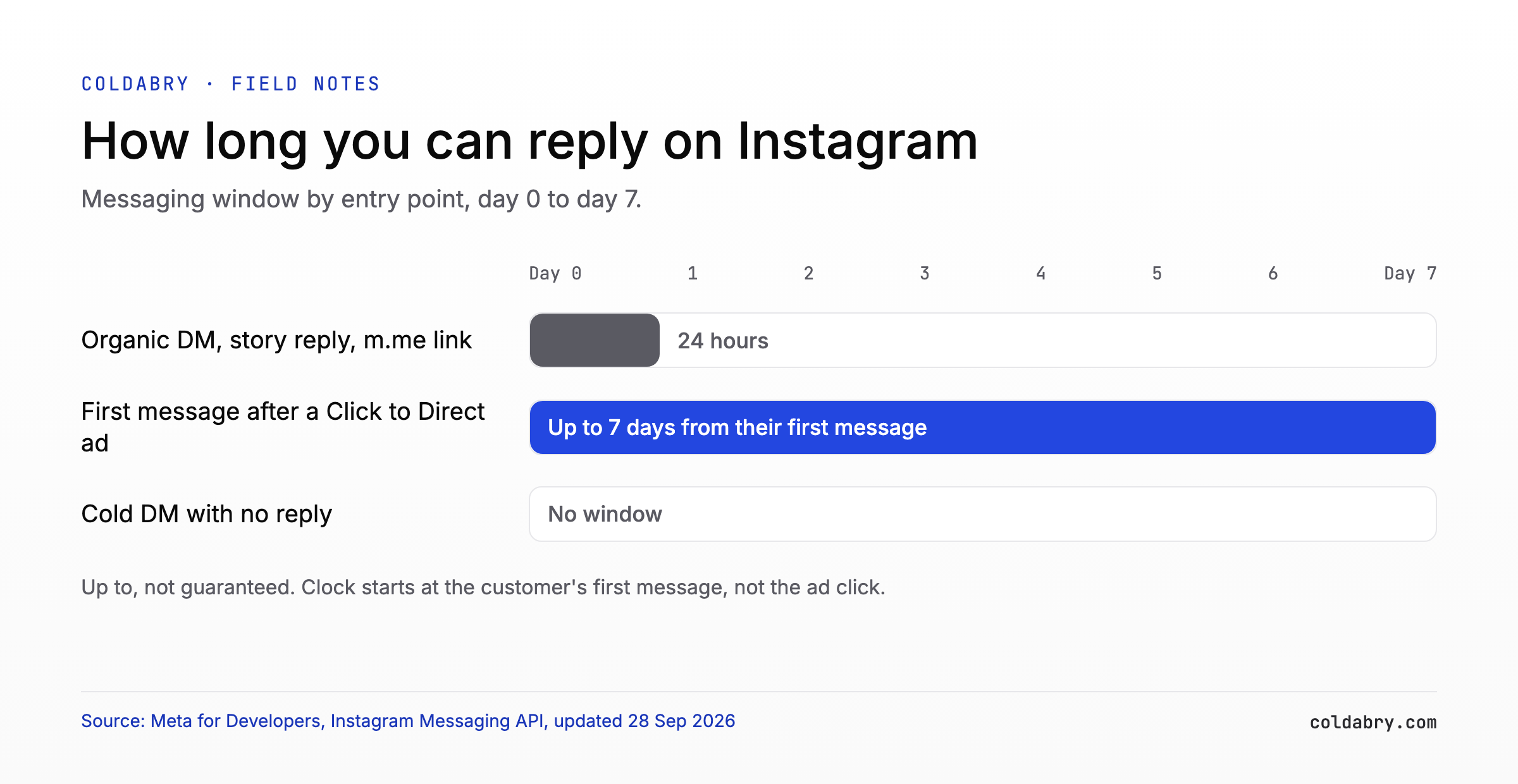
Meta's Instagram Messaging API documentation, stamped "Updated: 28 Sep 2026", says the length of the standard messaging window depends on the user action that opens it. For most actions it is 24 hours. When the action is a person sending their first message after clicking a Click to Direct ad, the window may last up to 7 days from that message (Meta for Developers). That is our paraphrase of the page, not a verbatim quote.
What the window covers, and what it does not:
- Start point. The 7 days count from the customer's first message after tapping the ad, not from the ad click or from your reply (Spur).
- No message, no window. Someone who taps the ad and never writes opens no window at all (Spur, same page).
- Other entry points stay at 24 hours. A DM from your profile, a story reply or an m.me link still gets 24 hours (Spur).
- "Up to" is not a guarantee. Meta does not say when a window would be shorter, so put the important messages in the first few days.
- Second messages. Meta does not say whether a later message from the customer moves the 7-day end date. Spur advises treating the end date as fixed from the first message, and so do we.
- Attribution. The first message carries a
referralobject withsource: ADS, thead_idand the ad title, per Spur's reading of Meta's webhook examples.
The vendor glossary at Inro describes the same rule: 24 hours for most actions, up to 7 days after a message sent from a Click to Direct ad.
7-day ad window vs Human Agent tag vs WhatsApp
Three different "7 days" now exist in Meta's messaging products, and they are easy to mix up. They are not interchangeable.
| Rule | Instagram Click to Direct window | Human Agent tag | Click to WhatsApp ads |
|---|---|---|---|
| Length | Up to 7 days from first message | 7 days after the contact's message | Free for up to 7 days |
| Who can send | Your app, automated or human | A person on your team, by hand | Your app |
| Promotional content | Allowed inside the standard window | Not for sales or automated messages | Free-form text only for 24 hours, then approved templates |
| Extra requirement | None beyond the ad entry point | Human Agent permission plus the HUMAN_AGENT tag | Templates after 24 hours |
Sources for the table: Meta's doc describes the Click to Direct window and says a human agent reply can be tagged to use the 7-day Human Agent window (Meta for Developers). Spur quotes Meta's policy that messages inside the standard window "may contain promotional content", that the Human Agent tag is meant for cases like a business closed for the weekend or an issue that needs more than 24 hours, and that WhatsApp ad chats are free for up to 7 days but free-form text is limited to 24 hours after the last message (Spur). Inro adds that tagged messages may not be promotional, with no deals, offers, coupons or discounts (Inro).
The practical consequence: inside the Click to Direct window you can follow up with an offer, automated or not. Outside it, the Human Agent tag is not a loophole for sales follow-ups.
How much does a conversation cost: DM ads vs cold DMs
Compare both channels in one unit: cost per qualified conversation = total cost / qualified conversations. Not message starts, because a Click to Direct ad optimized for conversations started will also find people who just say "hi". Not DMs sent, because a cold DM nobody answers is not a conversation.
We found no primary or credible benchmark for Instagram cost per conversation started, or for cold DM reply rates; the figures circulating are vendor claims without a method. So the example below uses assumptions only. Replace them with your own numbers.
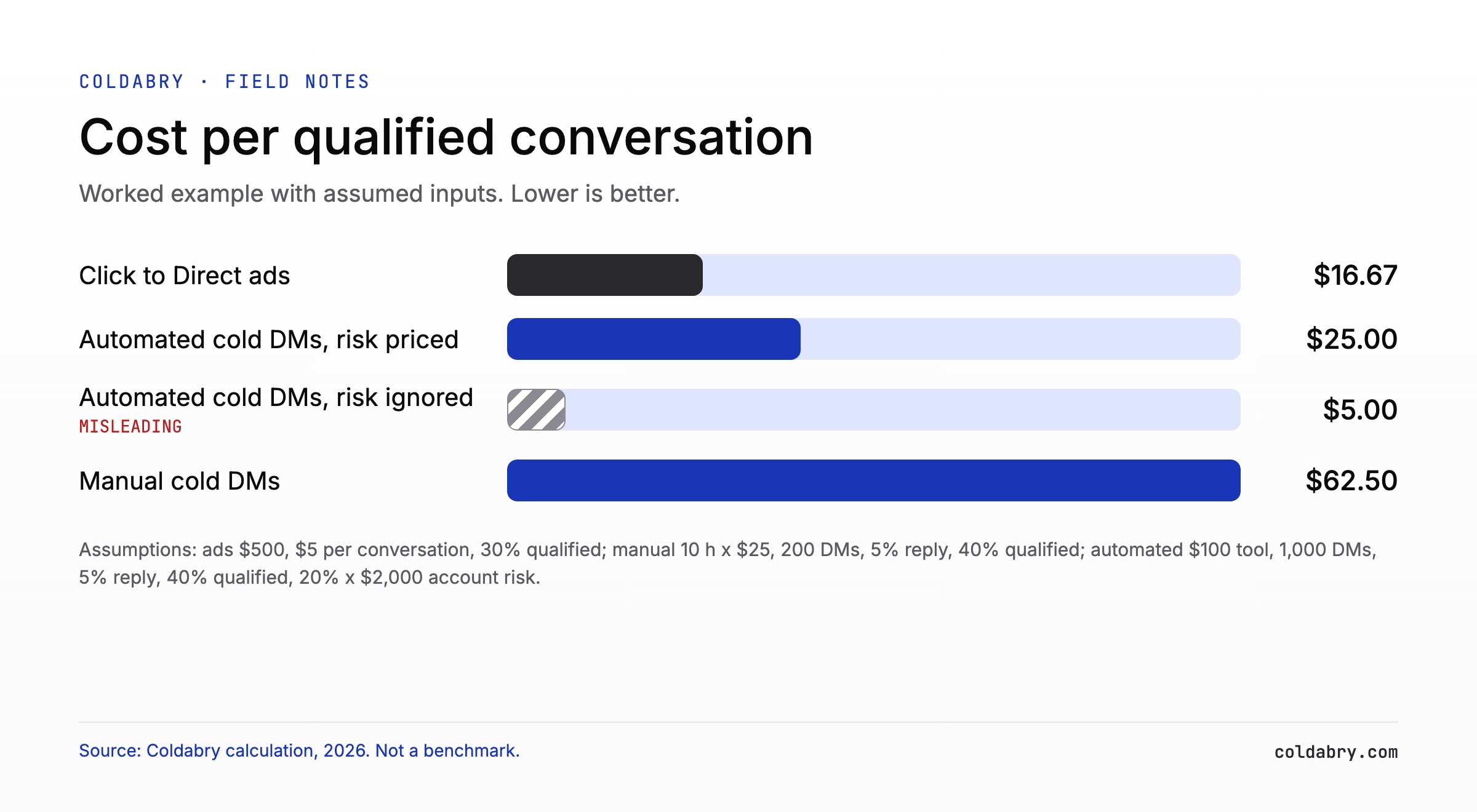
Worked example (assumed inputs, not benchmarks): one month, one offer, three ways to get conversations.
A. Click to Direct ads. Assumed: $500 spend, $5 per conversation started, 30% of conversations qualified.
- Conversations: 500 / 5 = 100
- Qualified: 100 x 0.30 = 30
- Cost per qualified conversation: 500 / 30 = $16.67
B. Manual cold DMs. Assumed: 10 hours of research and sending, valued at $25 an hour, 200 DMs, 5% reply rate, 40% of replies qualified.
- Cost: 10 x 25 = $250
- Replies: 200 x 0.05 = 10
- Qualified: 10 x 0.40 = 4
- Cost per qualified conversation: 250 / 4 = $62.50
C. Automated cold DMs. Assumed: $100 a month tool, 1,000 DMs, same 5% reply rate and 40% qualified, plus account risk priced as a 20% chance of losing an account you value at $2,000 (followers, history, time to rebuild), which is an expected cost of 0.20 x 2,000 = $400.
- Cost: 100 + 400 = $500
- Qualified: 1,000 x 0.05 x 0.40 = 20
- Cost per qualified conversation: 500 / 20 = $25.00 (or $5.00 if you ignore the risk, which is the mistake)
Under these assumptions ads win, automated cold DMs come second only because the risk is priced, and manual cold DMs are the most expensive per conversation but carry the least cash outlay. Change the reply rate or the account value and the order can change, which is why the calculator section exists. For tool prices to plug into option C, see our cold DM tools compared by cost per 1,000 DMs and ban risk.
When cold DMs still win (and why automating them breaks Instagram's terms)
Cold DMs still make sense in a narrow set of cases:
- Zero ad budget. If you cannot spend $1 on ads, hours are your only currency.
- Very small, high-value lists. Twenty podcast hosts, fifteen potential partners, ten buyers for a five-figure offer. A researched, personal message to each is worth more than an ad that reaches thousands of strangers.
- Relationship, not volume. You reference their work, you ask a real question, you send a handful a day by hand.
There is also a technical reason the two channels behave differently. Through the official API, a business replies inside a window that the person opened (Meta for Developers). A cold DM is the business writing first, so there is no window, and outside one sending fails with error 10 and subcode 2018278 (Spur). That is why mass cold DM tools drive the app or a browser instead of the API.
Note: automating cold DMs breaks Instagram's terms of use, which prohibit accessing the service or collecting information in automated ways without permission. Manual cold DMs are a gray area; automated ones put the whole account at risk, including the account you would run ads from. We covered what that looked like in practice in the 2026 Instagram ban wave. No tool can make automated cold DMs safe.
If you want automation without that risk, it has to sit on the official side: replying to people who wrote to you first, which is what what the Instagram Messaging API can and cannot do explains in detail.
How to use the 7 days: a follow-up plan for Click to Direct ads
The new window changes the follow-up math more than the cost math. A 24-hour window gives you one shot at a reply; up to 7 days gives you room for a short sequence, as long as you front-load it because "up to" is not a promise.
Ground rules before the plan:
- Reply in minutes, not hours. Spur quotes Meta's policy that responding to people's messages as soon as possible is highly encouraged.
- Count from their first message. Store the timestamp and the
ad_idfrom thereferralobject (source: ADS) so every chat is tied to the ad that produced it. - Stop at the window end. Do not switch to the Human Agent tag to keep selling; it is not for sales or automated messages.
- Qualify early. One question on day 0 separates buyers from "hi" senders.
The plan below assumes a coaching or done-for-you offer with a booking step. The texts are examples to adapt; brackets are placeholders.
| When | Goal | Example message |
|---|---|---|
| Day 0, within minutes | Answer and qualify | "Thanks for reaching out about [offer]. Quick question so I send the right info: are you looking to [outcome A] or [outcome B]?" |
| Day 0, after their answer | Give the one useful thing | "Got it. Here is how it works for people in your spot: [2 lines]. Price is [price]. Want me to send the booking link?" |
| Day 1 | Remove the main objection | "One thing people ask before booking: [common question]. Short answer: [answer]. Happy to hold a slot for you this week." |
| Day 3 | Proof and a concrete option | "Here is what the first [week/session] looks like: [3 steps]. I have [day] or [day] open. Which works?" |
| Day 6 | Last message, clean close | "Last note from me so I do not crowd your inbox: the link is here [link] if the timing is right later. Good luck with [their goal]." |
| After day 7 | Nothing | Only reply if they write again; that opens a new standard window. |
The day 0 reply is where most of the value sits, and it is also the hardest step to staff around the clock. That is the case for an AI agent that answers ad chats inside the window through the official API, with a person taking over for qualified leads. If the work is routing rather than talking (tagging chats by ad_id, pushing qualified ones to a calendar or CRM, stopping sequences when the window closes), that is custom AI automation for routing ad conversations. If you are comparing off-the-shelf builders for the same job, start with ManyChat pricing and alternatives.
Break-even calculator: which channel fits your budget
Fill in the middle column with your own numbers. The example column repeats the assumed inputs from the worked example above so you can check your arithmetic.
| Line | Your number | Example (assumed) |
|---|---|---|
| 1. Monthly ad spend | ____ | $500 |
| 2. Cost per conversation started | ____ | $5 |
| 3. Share qualified | ____ | 30% |
| 4. Qualified conversations (1 / 2 x 3) | ____ | 30 |
| 5. Close rate on qualified chats | ____ | 10% |
| 6. Average deal value | ____ | $400 |
| 7. Ad revenue (4 x 5 x 6) | ____ | $1,200 |
| 8. Cold DM hours per month | ____ | 10 |
| 9. Value of one hour | ____ | $25 |
| 10. Qualified cold conversations | ____ | 4 |
| 11. Cold revenue (10 x 5 x 6) | ____ | $160 |
| 12. Net ads (7 minus 1) | ____ | $700 |
| 13. Net manual cold (11 minus 8 x 9) | ____ | minus $90 |
How to read it:
- Line 12 above zero: ads pay for themselves at your close rate and deal value. Scale slowly and watch line 2.
- Line 12 below zero, line 13 above zero: your offer converts in conversation but the ad does not bring the right people. Fix targeting or the qualifying question before spending more, and keep manual outreach running.
- Both below zero: the problem is the offer, the price or the close rate, not the channel.
- Break-even ad cost: the highest cost per conversation you can afford is line 3 x line 5 x line 6. In the example: 0.30 x 0.10 x 400 = $12 per conversation started.
If you plan to sell a product of your own to the audience these chats build, our pricing for custom AI builds shows what that side costs.
FAQ
Are Instagram DM ads better than cold DMs?
For most businesses with some ad budget, yes. Click to Direct ads start conversations the prospect opened, which gives you an official messaging window of up to 7 days and lets you automate replies through Meta's API. Cold DMs start conversations nobody asked for, cost hours or a tool subscription, and become an account risk once automated. Cold DMs still win for tiny, high-value lists sent by hand, or when the ad budget is zero. Compare both in cost per qualified conversation, with your own reply and qualification rates, rather than cost per message sent.
How long can a business message someone after an Instagram ad?
Up to 7 days from the person's first message after they tap a Click to Direct ad, according to Meta's Instagram Messaging API documentation updated on 28 September 2026. The window does not start at the ad click or at your reply, and someone who taps the ad but never writes opens no window. Meta says "up to", without stating when a window is shorter, so schedule important follow-ups in the first days. Every other entry point, such as a profile DM or a story reply, still gets the standard 24 hours.
Does the 7-day window apply to website ads with a "Send message" button?
It is not documented. Meta's Marketing API lists two formats: pure click-to-message ads with destination types such as MESSAGING_INSTAGRAM_DIRECT, and website ads with a message extension that adds an Instagram Direct button (Meta for Developers). The 7-day rule in the Messaging API doc names Click to Direct ads only. Until Meta says otherwise, assume website ads with a message button get the standard 24-hour window, and test by logging when sends start to fail.
Is cold DMing allowed on Instagram?
Sending a personal message by hand to someone you do not know is not banned outright, but it sits in a gray area: too many unanswered messages can trigger limits or reports. Automating cold DMs is different. Instagram's terms prohibit accessing the service or collecting information in automated ways without permission, and the official API only allows replies inside a window the person opened. Tools that send cold DMs at volume work around that by driving the app or a browser, which puts the account at risk. No tool can make it safe.
Is the 7-day window the same as the Human Agent tag?
No. The Click to Direct window is a standard messaging window: your app can reply, automated or manual, and Meta's policy allows promotional content inside it. The Human Agent tag is a separate exception that lets a person on your team reply by hand within 7 days of the contact's message, for cases like a business closed for the weekend. It needs the Human Agent permission and the HUMAN_AGENT tag, and it is not meant for sales or automated messages. Using it to extend ad follow-ups misuses the tag.
What happens when the window closes?
Your app can no longer send messages to that person through the API. According to Spur, sends outside the window fail with error 10 and subcode 2018278. If the person writes again, from any entry point, that opens a new standard window, normally 24 hours. Plan the sequence so your last useful message goes out before day 7, store the first-message timestamp, and stop automations automatically at the end date instead of retrying failed sends.
We build agents and automations like the ones described here on the official API, for businesses that want to own the system rather than rent it.