Cold Email Follow Up: How Many to Send and When (2026 Data)
Two big 2026 datasets disagree on cold email follow-ups. We reconcile them: how many to send, how far apart, what each one says, six templates and the spam limits that cap it.
A typical case: an agency founder sends one cold email to 400 well-picked prospects and gets a handful of replies. Now the question is whether to send four more or stop before the domain gets flagged. Every cold email follow-up guide has an opinion, and the 2026 data points two ways.
Short answer: send 3-4 follow-ups after the first email (4-5 emails in total), spaced 3-4 days apart at first and wider later, over about 2-3 weeks. Each follow-up needs a new angle, and the third email deserves the most work: in the Belkins 2026 study (2025 data) it booked 35.6% of all email-sourced meetings, more than any other step.
Stop the moment someone replies, bounces or opts out, and keep your Gmail spam rate under the recommended 0.10%, never 0.30% or higher. If five emails get silence, switch channel instead of sending a sixth: Belkins reports LinkedIn reply rates of 7%+ across 2025.
How many follow-up emails should you send for a cold email?
Published recommendations range from three to ten emails in total, counting the first one.
| Source | Data | Recommendation |
|---|---|---|
| Belkins 2026 study | 7,530,489 emails, 2025, agency-managed campaigns | 3-5 steps in total |
| Instantly Benchmark 2026 | Platform-wide, Jan 1 to Dec 18, 2025 | 4-7 touchpoints |
| lemlist | Millions of platform campaigns, period not stated | 4-9 follow-ups |
| Woodpecker (older data) | No dataset size stated | 2-3 follow-ups |
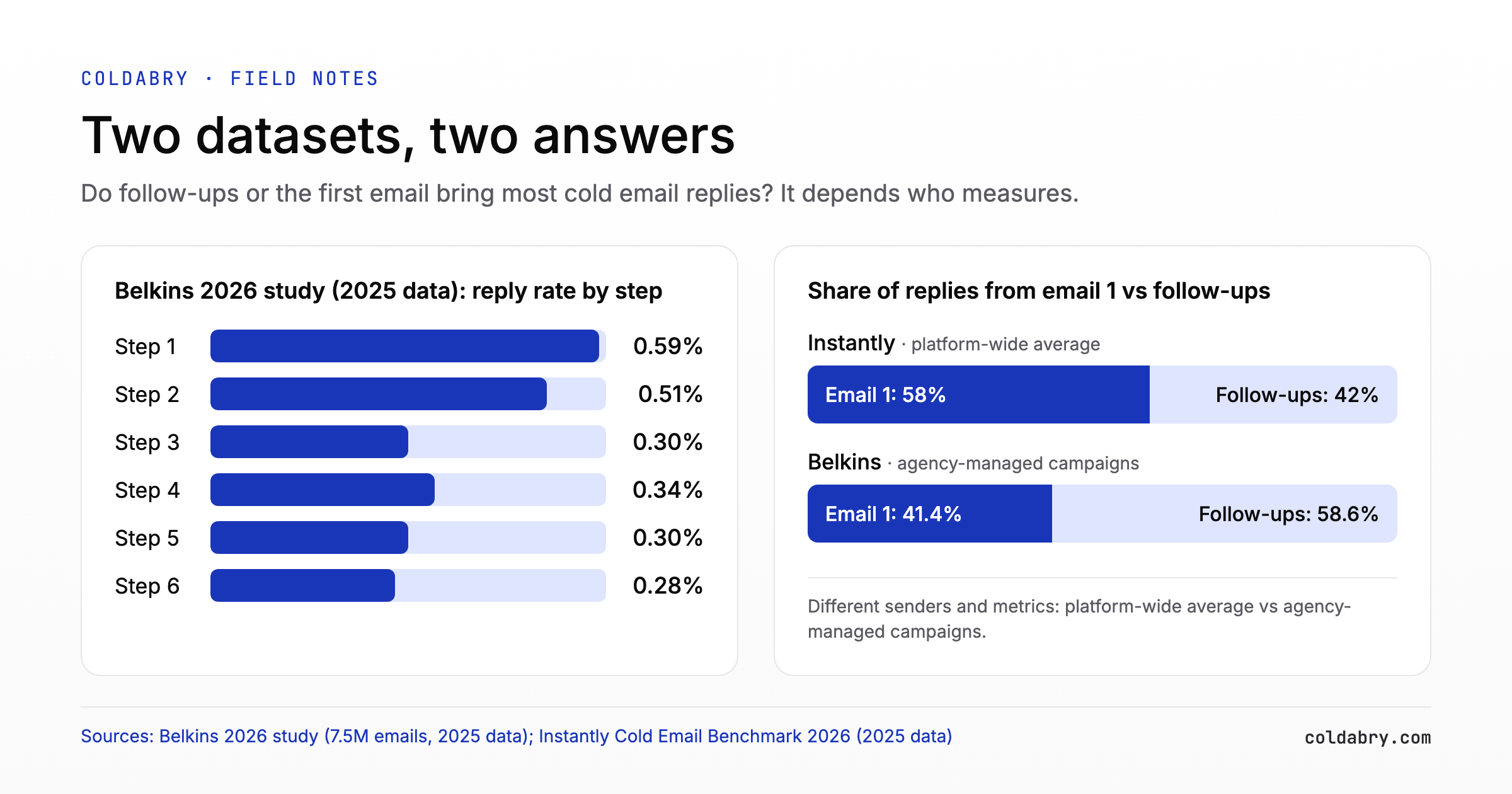
The headline numbers also clash. Instantly says 58% of all replies come from step one. The Belkins 2026 study says the initial email captures just 41.4%, and follow-ups 58.6%. The Belkins 2025 study (2024 data), built on 16.5 million emails sent in 2024, found reply rates falling with sequence length: 8.4% at one email, 7.8% at two, 6.8% at three, 5.8% at four and 3.8% at five or more.
Three things explain the gap:
- Different metrics. The 2026 study reports a per-step reply rate (0.59% at step 1) without publishing the formula; the low values suggest per email sent. The 2025 study reports the share of unique recipients who replied. Instantly divides all replies by all emails sent, for a 3.43% average.
- Different senders. Belkins measures its own managed campaigns. Instantly and lemlist average across thousands of workspaces, weak senders included.
- Different years and goals. One dataset counts replies, another counts meetings, and the 2025 study has since been replaced.
What holds across all of them: follow-ups add replies (Woodpecker's older figure goes from 9% with no follow-up to around 13% with at least one), and returns fade past roughly the fifth email (Belkins, Instantly).
Our verdict: 4-5 emails in total for most B2B lists, fewer for enterprise buyers and founders. In the 2025 study, enterprises were "basically allergic to persistence", and founder reply rates fell from 6.94% at the second follow-up to 3.01% by the fourth.
Which follow-up email books the most meetings?
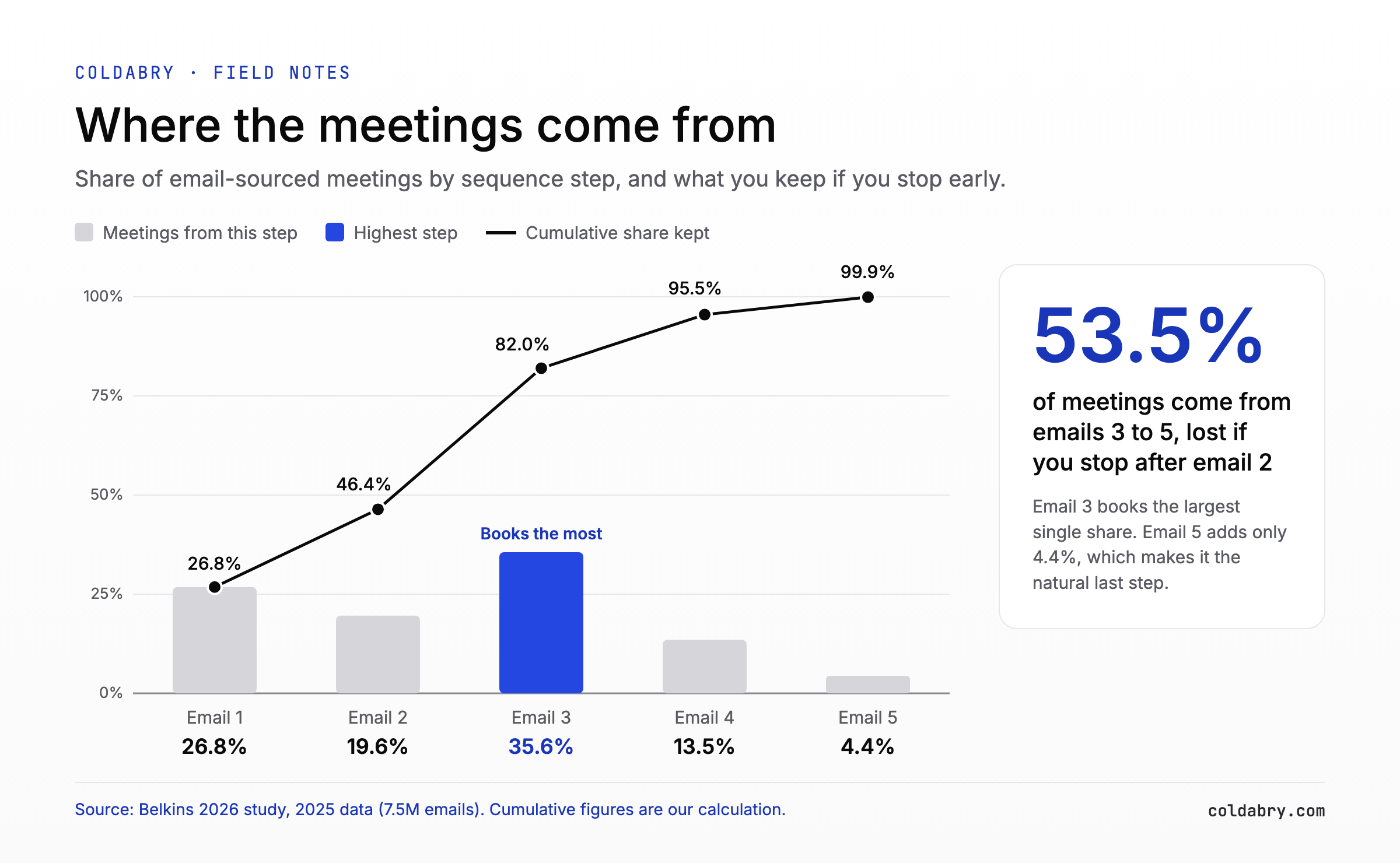
Replies are not meetings. In the 2026 study, step 3 "generates more meetings than steps 1 and 2 combined", and the appointment rate stabilizes at 0.2% from step 3 onward, twice the rate of the first two steps.
Our calculation from Belkins' meetings-by-step chart shows what you keep if you stop early:
| Stop after | Meetings from this step | Cumulative share kept |
|---|---|---|
| Email 1 (first email) | 26.8% | 26.8% |
| Email 2 (first follow-up) | 19.6% | 26.8 + 19.6 = 46.4% |
| Email 3 (second follow-up) | 35.6% | 46.4 + 35.6 = 82.0% |
| Email 4 (third follow-up) | 13.5% | 82.0 + 13.5 = 95.5% |
| Email 5 (fourth follow-up) | 4.4% | 95.5 + 4.4 = 99.9% (chart rounding) |
Stopping after two emails gives up about 53.5% of the meetings, the share Belkins puts on steps 3 to 5 together. The fifth email added 4.4%, which is why it is the natural last step. Belkins' advice for step 3 is blunt: "write it as if it's the first email you're sending." Put your best alternative angle there, not a reminder.
How long to wait before a cold email follow-up
Timing advice agrees more. Instantly recommends spacing touches 3-4 days apart. Woodpecker's 2026 formula uses 3-4, then 7-8, then 12-14 days in total, with a re-engagement 30-60 days later. lemlist suggests gaps of 2, 4, 4 and 5+ days, for a total of 10-25 days.
Our synthesis of those sources:
| Day | Gap | Job of the email | Basis | |
|---|---|---|---|---|
| 1 (first email) | 0 | - | Relevant problem, one clear ask | Instantly |
| 2 (first follow-up) | 3 | 3 days | Short in-thread bump | Instantly, Woodpecker |
| 3 (second follow-up) | 7 | 4 days | The reframe, written as a new first email | Belkins, Woodpecker |
| 4 (third follow-up) | 12 | 5 days | Proof or a useful resource | Instantly, Woodpecker |
| 5 (fourth follow-up) | 18 | 6 days | Breakup with a long horizon | Woodpecker, Belkins |
| Optional | 30-60 days later | - | Re-engage only with new context | Woodpecker |
Compress the gaps for time-sensitive offers and stretch them for enterprise buyers. Instantly also found Wednesday gets the highest engagement and Friday the most auto-replies.
What should each follow-up email say?
Give every email one job. Instantly's data backs this: the best step 2 emails "feel like replies, not reminders" and outperform formal follow-ups by about 30%.
| Length | CTA type | Opening line example | |
|---|---|---|---|
| 2 (first follow-up) | 1-3 lines | Yes or no question | "Following up on my note below." |
| 3 (second follow-up) | Under 80 words | Interest check | "A different angle from my last note." |
| 4 (third follow-up) | Under 80 words | Soft question | "One example from a team like yours." |
| 5 (fourth follow-up) | 2-4 lines | Low commitment, later date | "I haven't heard back, so I'll stop here." |
The 80-word cap follows Instantly: elite performers average fewer than 80 words per first-touch email. Two more rules:
- A new angle each time: case study, different pain point, useful resource.
- Skip "just checking in", guilt trips, fake deadlines and re-attaching the same deck.
Note: Google's sender guidelines say not to start subject lines with "Re:" or "Fwd:" unless the message is an actual reply or forward. A bump inside the original thread is a real reply. A new email dressed up with "Re:" is not.
6 cold email follow-up templates you can copy
Brackets are placeholders: replace each with something specific and verifiable.
Template 1: The in-thread bump (Day 3, email 2)
Subject: (reply in the same thread)
Hi [First name], following up on my note below. Is [problem you named] on your list this quarter?
Why it works: it reads like a reply, the format Instantly found beats formal follow-ups.
Template 2: The reframe (Day 7, email 3)
Subject: [Different pain point] at [Company]
Hi [First name], a different angle from my last note. Teams like [peer type] often lose [specific time or cost] to [second problem]. We fix that with [one-line approach]. Would it be worth comparing notes on how [Company] handles it today?
Why it works: Belkins found step 3 books more meetings than steps 1 and 2 combined, so it gets a fresh pitch and a fresh subject.
Template 3: Proof in one line (Day 12, email 4)
Subject: Re: [Different pain point] at [Company]
Hi [First name], one example. [Client type] had [problem], and after [what changed] they saw [result you can verify]. Is that something you'd want at [Company]?
Why it works: one concrete outcome beats a feature list.
Template 4: Something useful, no ask (alternative for Day 12, email 4)
Subject: Re: [Different pain point] at [Company]
Hi [First name], no pitch this time. I noticed [specific observation about their site, offer or process]. Here's a quick fix: [one practical step]. Happy to send the full list of what I spotted if it helps.
Why it works: it is useful whether or not they reply.
Template 5: Right person or referral (email 4 or 5)
Subject: Right person for [topic]?
Hi [First name], I may have the wrong contact. Are you the right person for [topic] at [Company], or is there someone better I should talk to?
Why it works: a one-line question is easy to answer, even with a name.
Template 6: The breakup with a long horizon (Day 18, email 5)
Subject: Close the loop?
Hi [First name], I haven't heard back, so I'll assume [problem] isn't a priority right now and I'll stop here. If it moves up the list, worth reconnecting next quarter?
Why it works: Belkins ends its sequences with a low-commitment ask and a long time horizon, and Woodpecker calls this the permission-based breakup.
Templates 3 and 4 reply inside template 2's thread, so "Re:" is genuine; drop it for new emails.
Can too many follow-ups hurt deliverability? Gmail, Yahoo and Outlook limits
Yes, and the limits are tight.
| Provider | Spam rate limit | Unsubscribe rule | Authentication |
|---|---|---|---|
| Gmail | All senders below 0.3%; recommended below 0.10% | One-click unsubscribe for marketing and subscribed mail at 5,000+ a day | DMARC required at 5,000+ a day |
| Yahoo | Below 0.3% | Bulk senders: one-click unsubscribe, visible link, honor within 2 days | SPF or DKIM for all; SPF, DKIM and DMARC for bulk senders |
| Outlook.com / Hotmail / Live (consumer) | Not published as a number | Functional unsubscribe links (best practice) | SPF, DKIM, DMARC at 5,000+ a day; failing mail rejected with 550 5.7.515 since May 5, 2025 |
Both Gmail and Yahoo measure spam rate against mail delivered to the inbox. Google defines it as the share of messages delivered to the inbox and then marked as spam, counting only DKIM-authenticated mail, and Yahoo calculates it based on mail delivered to the inbox. Our reading: messages that already land in spam do not dilute your rate.
Google adds the flip side: if much of your mail already goes to spam, the dashboard rate can look deceptively low (Postmaster Tools). Recovery is slow: Google warns that improvements in spam rate take time to reflect positively.
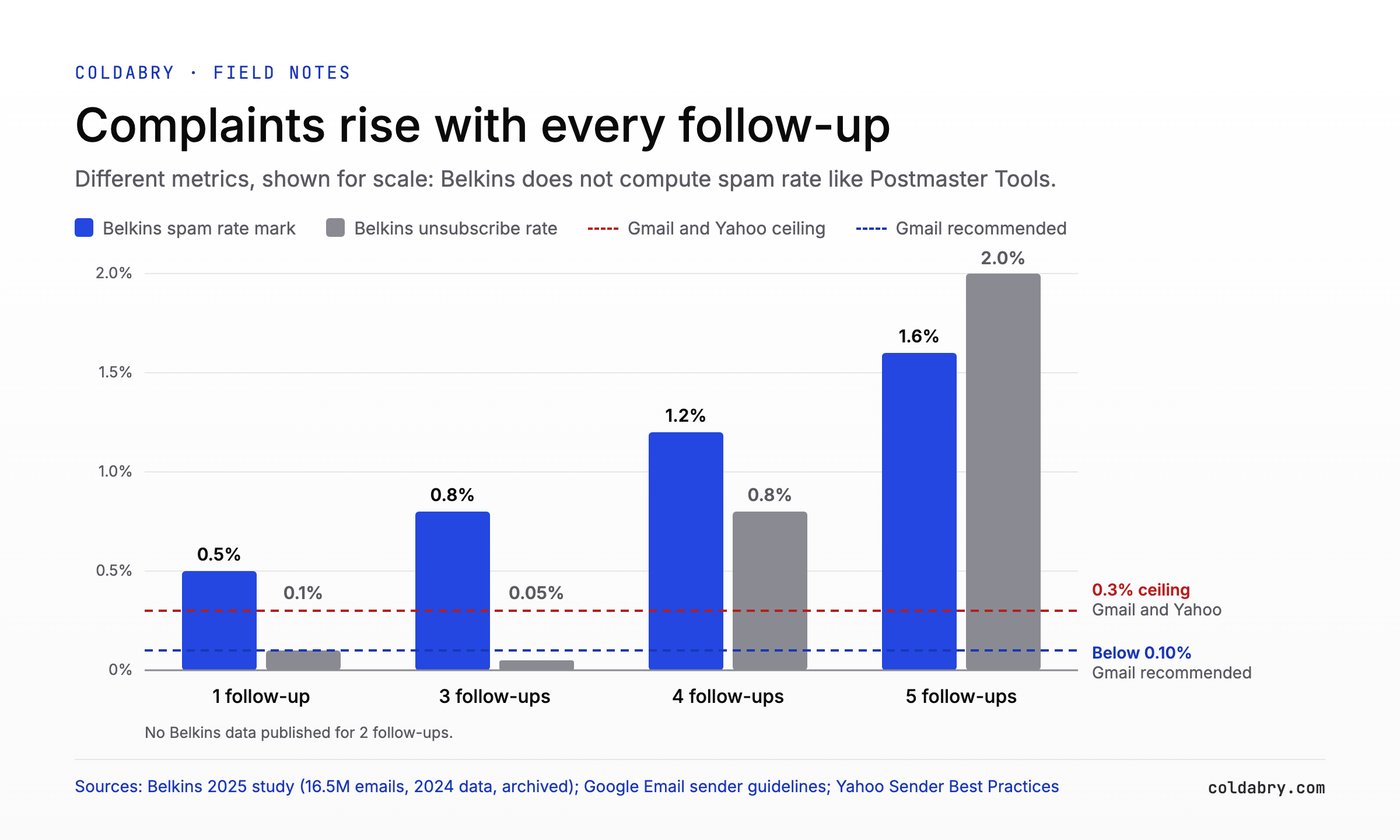
The Belkins 2025 study (2024 data) shows how complaints grow with sequence length. Its "spam rate mark" rose from 0.5% at one follow-up to 0.8% at three, 1.2% at four and 1.6% at five; unsubscribes went from 0.1% to 0.05%, 0.8% and 2.0% (archived study). Belkins does not define that metric the way Postmaster Tools does, so the two are not directly comparable.
Belkins' text says the 4th follow-up (your 5th email) "more than triples your risk of getting marked as spam"; its chart puts the tripling at five follow-ups (0.5% to 1.6%), so read the curve as a direction, not exact steps. Our rule: cap the sequence at five emails, and cut it to four the first time Postmaster shows a spam rate above 0.10%.
A worked example with stated assumptions: 400 new prospects a week on Gmail addresses, five emails each, is 2,000 sends. Assume 90% reach the inbox, so 1,800 count toward the rate. The 0.3% ceiling is 1,800 x 0.003 = 5.4 complaints, so five reports in a week keep you just under it and a sixth pushes you over. Google's 0.10% target is 1,800 x 0.001 = 1.8, fewer than two.
The weekly view flatters you: Postmaster Tools reports data by day. Spread over seven days, 1,800 inbox deliveries is about 257 a day, so one report on a single day is 1 / 257 = 0.39%, above the ceiling. Low-volume days may be missing data. A sixth email adds 400 more sends to people who stayed silent five times.
Two more habits: Belkins stopped tracking opens in 2024 because the pixels hurt deliverability, and Instantly advises keeping bounces below 2%.
When should you stop following up on a cold email?
Write stop rules down before the first send, so nobody improvises at email 5.
| Trigger | Action | Why |
|---|---|---|
| Any human reply (yes, no or a question) | Stop the sequence, route to a person | Woodpecker lists replies as a stopping condition |
| Out-of-office auto-reply | Pause, resume after the return date | Instantly sees the most auto-replies on Fridays |
| Hard bounce | Stop and remove the address | Keep bounces below 2% (Instantly) |
| Unsubscribe or "remove me" | Stop at once, suppress everywhere | Yahoo: within 2 days for bulk senders. CAN-SPAM: within 10 business days, B2B included |
| "Not the right person" | Ask one referral question, then stop | Template 5 |
| Five emails, no response | End email; try LinkedIn or a call for high-value accounts, or re-engage in 30-60 days with new context | Belkins: LinkedIn 7%+ reply rates, calls connected with 18.6% of prospects; Woodpecker |
| Complaint spike in Postmaster Tools | Pause the whole campaign, not one lead | Gmail: high spam rate leads to more spam classification |
The US rule is in the FTC's CAN-SPAM guide, which says the law "makes no exception for business-to-business email". EU and UK rules differ and can be stricter for some recipients, so check the rules where your prospects live.
These rules work best when the system enforces them. In the AI sales engine we built for a B2B skincare brand, follow-ups run automatically and reply classification maps inbound answers to a status, so interested replies drop into the sales funnel and a human enters only when it matters. Reply triage is a good example of agentic workflows that replace manual ops, and a cheap first test of picking automation wins with real ROI.
If your outreach also runs on Instagram, the same logic applies to cold DM follow-up sequences and to a two-channel Instagram DM plus cold email sequence. In our Instagram outreach engine, a person approves the replies an AI setter drafts.
The short version: 4-5 emails, a reframe at email 3, a breakup at email 5, and spam rates watched as closely as replies. At Coldabry we build this kind of stop-and-route logic into the custom automations we make for clients, as in the case study above.
FAQ
How many follow-ups is too many for a cold email?
For most B2B lists, more than four follow-ups (five emails in total) is too many. The Belkins 2026 study found that beyond step 5, volume falls sharply, and its fifth email added only 4.4% of meetings. Instantly says returns diminish beyond seven touches unless each adds genuine new value. Complaints climb as well: in the Belkins 2025 study (2024 data), its spam rate mark went from 0.5% at one follow-up to 1.6% at five. Enterprise buyers and founders tolerate even fewer.
Is it OK to follow up on a cold email after a week?
Yes. A week is a normal gap for the second follow-up. Woodpecker's 2026 formula places it at 7-8 days after the first email, and lemlist suggests a whole sequence lasting 10-25 days. For the first follow-up, 3-4 days is the more common recommendation, with wider gaps later. Compress it for time-sensitive offers, stretch it for enterprise, and treat anything after 30 days as a re-engagement that needs new context.
Should a follow-up be a reply in the same thread or a new email?
Use the same thread for short bumps, and a new thread when you change the angle. A reply-style second email works well: Instantly found that step 2 emails that feel like replies outperform formal follow-ups by about 30%. For the reframe at email 3, a fresh subject helps it read like a new first email. Google's sender guidelines say subject lines should not start with "Re:" or "Fwd:" unless the message is an actual reply or forward, so never fake a thread.
What is a breakup email and does it still work?
A breakup email is the last message in a cold email follow-up sequence. It tells the prospect you will stop writing and leaves the door open. Woodpecker calls it the permission-based breakup and places it around days 14-18. Belkins ends its sequences with a low-commitment ask and a long time horizon, such as whether it is worth reconnecting next quarter. It is easy to answer and removes pressure. Keep it short and polite, and actually stop afterward.
What is a good reply rate for cold email follow-ups?
Instantly's 2026 benchmark puts the overall average reply rate at 3.43%, with the top quartile at 5.5% and above and the top 10% at 10.7% and above. That figure divides all replies, including those to follow-ups, by all emails sent, so it describes the whole sequence. Belkins measures differently: the Belkins 2026 study (2025 data) gives per-step rates from 0.59% at step 1 to 0.28% at step 6, without publishing the formula. Compare yourself only with a benchmark that uses the same formula.
Can follow-ups get my domain flagged as spam?
Yes, if recipients report them. Gmail requires all senders to keep the spam rate in Postmaster Tools below 0.3% and recommends staying below 0.10%. Yahoo sets the same 0.3% limit. Both calculate the rate against mail delivered to the inbox, so a few complaints on a small campaign move it quickly: on 1,800 inbox deliveries, two reports already exceed the recommended level. Stop sequences on any reply or opt-out and pause campaigns when complaints rise.
Sources
All checked October 9, 2026.
- Belkins, Sales follow-up statistics in B2B: 2026 study.
- Belkins, 2025 study, 2024 data (archived).
- Instantly, Cold Email Benchmark Report 2026.
- Woodpecker, The Cold Email Follow-Up Formula.
- Woodpecker, Follow-up statistics.
- lemlist, How many cold email follow-ups.
- Google, Email sender guidelines and Postmaster Tools spam rate.
- Yahoo, Sender Best Practices.
- Microsoft, Outlook requirements for high-volume senders.
- FTC, CAN-SPAM Act: A Compliance Guide for Business.