Cold DM Length and Reply Rate: What the Data Shows
Keep cold DMs short, but the evidence is email: Hunter's 34M emails peak at 20-39 words, and length bands differ by about one point of reply rate.
Keep a cold DM short, but the best evidence we could verify is cold email, not DMs: Hunter's analysis of 34 million cold emails found the highest reply rate at 20-39 words (4.5%), and every length band landed within about one point of it. That verdict on cold DM length applies to anyone writing first messages by hand on Instagram or LinkedIn. The main caveat: Hunter sells email finding and outreach software, and its numbers are observational, so they describe what short emails did, not what shortening yours will do.
We have no send data of our own. Every figure below is a published one, labeled by publisher and by what that publisher sells, and the only numbers we add are marked as our calculation.
How long should a cold DM be?
Aim for under 100 words and start around 20-39, then let your own results overrule that. Hunter's sample covers campaigns sent by its users between 2022 and 2024, and it reports that emails under 100 words averaged a 3.9% reply rate against 3.7% for longer ones. That is a gap of 0.2 points.
The shape of the data matters more than the winner. The curve is bumpy: 4.5% at 20-39 words, 3.4% at 40-59, then back up to 4.1% at 80-99. If length alone drove replies, you would expect a smoother slope, so there is no magic number here. The gap between the best and the worst band is 1.1 points (our arithmetic: 4.5 minus 3.4).
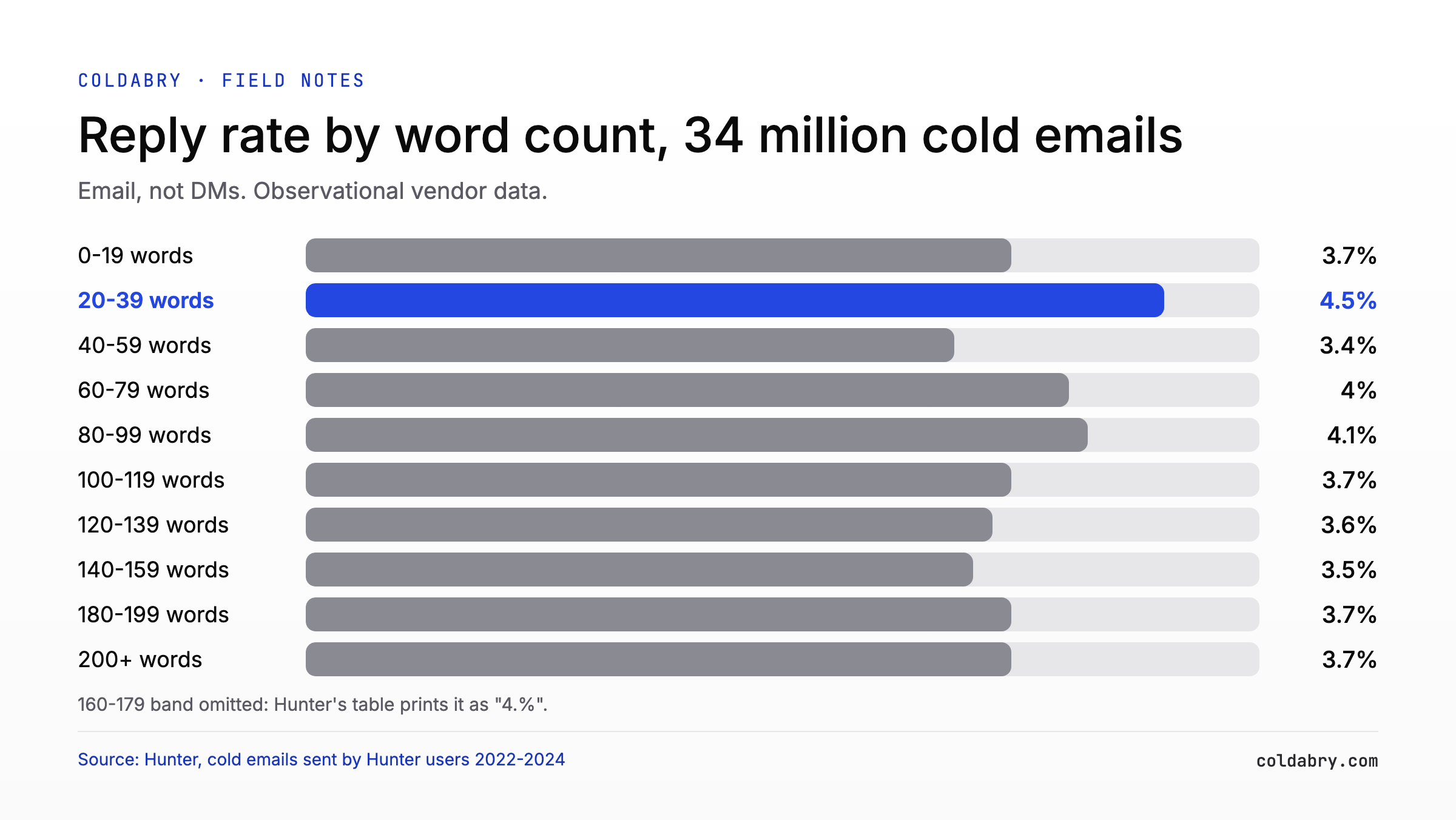
Hunter's own warning belongs next to any chart of this data: "this doesn't mean that if you adjust the email copy you're currently using to match this word count range, your reply rate will improve." The set also has filters. Hunter dropped campaigns with fewer than 50 emails, dropped those with reply rates over 30% or under 0.5%, and did not account for reply sentiment. So a "reply" here can be a polite no.
What do cold email studies say about message length?
Cold email studies agree on short and disagree on the number. Hunter says 20-39 words. Reply.io, which sells sales outreach software, said in a 2023 webinar that "something between 50 to 70" words gave the highest reply rate. Saleshandy, which sells cold email software, advises keeping a first email under 100 words, though we found no length data behind that advice on the page.
The older 50-125 word recommendation traces to a 2016 Boomerang study. We know it only through Hunter's critique, which says the study's 51% response rate for 75-100 words "didn't focus on cold emails." Hunter is criticizing a rival data set there, so read that with the motive in mind, but a 51% figure sits far from any cold benchmark in this table.
| Publisher (year) | Sells | Sample | Channel | Measured | Finding |
|---|---|---|---|---|---|
| Hunter (data 2022-2024) | Email finding and outreach software | 34 million emails, filtered | Cold email | Average reply rate by word count | 20-39 words highest at 4.5% |
| Reply.io (2023) | Sales outreach software | "Millions" of emails, size per group not stated | Cold email | Reply and "interested" rate | 50-70 words highest; zero questions highest |
| Reply.io (2022) | Sales outreach software | 2 million emails | Cold email | Reply rate with emojis | 3.06% vs 3% for all emails |
| Outreach (2019) | Sales engagement software | Nearly 2,000 samples per subject line | Email subject lines, own reps | Reply rate | 42% decline with emojis |
| Saleshandy (2026) | Cold email software | 30.31 million emails, its claim; the page gives conflicting date windows | Cold email | Benchmarks; length is advice only | Under 100 words advised |
| Fuzzy AI (2026) | Warm-first LinkedIn automation | 10,000 messages | LinkedIn messages | Reply rate, warm vs cold; not length; denominator unclear | 13.1% warm, 3.1% cold |
| Boomerang (2016), via Hunter | Meeting scheduling and email productivity tools, per Hunter; study not read directly | Not checked | Not cold email, per Hunter | Response rate | 51% at 75-100 words |
Different samples and filters may explain part of the disagreement. Hunter documents its filters, while the Reply.io transcript gives neither a sample per group nor a significance test, so the two numbers cannot be reconciled from what is public. The safe reading is the overlap: under 100 words.
Does asking a question in a cold DM get more replies?
The only verified data says more questions do not help, and it comes from one vendor's email data. In Reply.io's 2023 webinar, emails with zero questions had the highest average reply rate, and templates with three questions got 30% fewer replies. The sentence does not state the baseline for that 30%. Reply.io says the "interested" rate was also higher at zero questions, and it suggests a soft call to action with no question as well as "one question max."
Evidence level: low. One vendor, email only, no sample size per group, no significance test in the transcript. Treat it as a reason to avoid stacking questions, not as proof that a question hurts.
Reply.io's "quick question" finding (2.5% vs 3%) is about subject lines. DMs have no subject line, so it does not carry over.
The practical reading is one clear ask per message, phrased as a question or not. Here is an illustrative message, written for this article and never tested: "Hi Sam, your thread on onboarding emails made me rethink ours. I put together a short teardown of your welcome flow. Would a link be useful?" That is 26 words with one soft question. For the personal line at the start, see these AI prompts for personalizing cold DMs.
Do emojis hurt cold DM reply rates?
Unproven either way: the verified email data runs from neutral to negative, it measures different placements, and we could verify nothing for DMs. Reply.io's 2022 study of 2 million emails put emails with emojis at 3.06% against 3% for all emails analyzed, which it calls "within the margin of error." Outreach's 2019 test saw a 42% decline, but only in subject lines, only on its own reps' emails, and only at steps 5, 9, 15 and 17 of a sequence. Reply.io also reports more of both reply types with emojis, 18 positive per 100 replies against 15 overall and 20 negative against 18, with no significance test stated.
Outreach itself cautions that "this doesn't mean that our results will be true for you." Neither source tells you what an emoji does in the first line of a DM.
| Source | Where the emoji sat | Result | Trust level |
|---|---|---|---|
| Reply.io (vendor, 2022) | In the email; position not broken out in the figures we read | 3.06% vs 3%, no real effect | Medium for email, older; 2 million emails overall, emoji subset size not stated |
| Outreach (vendor, 2019) | Subject line, mid or late sequence step | 42% decline in reply rate | Medium for subject lines, none for DMs |
| Reddit post in r/InstagramMarketing | First line of an opener, as claimed | Claims emojis hurt; no figure used here | Unverified claim, possibly promotional. We could not read the thread. |
If you want a rule, leave emojis out of your default message and make them a test variable only if they fit your voice. Do not expect to settle it at Reply.io's effect size: confirming a 3% vs 3.06% gap would take 1,281,194 sends per variant (our calculation, method below).
Does cold email data apply to Instagram and LinkedIn DMs?
Partly: brevity and a single ask are plausible on DMs, subject-line findings are not, and DM reply rates by length remain unknown in everything we could verify. Email studies measure a different reading situation. A DM has no subject line, and Meta's developer documentation says new conversations from non-followers land in the Requests folder of a connected professional account. Our inference, not a measured finding, is that a stranger's message is judged there on its first lines, and that personal accounts behave similarly.
| Finding | Transfers to DMs? | Why (our judgment) |
|---|---|---|
| Shorter tends to do slightly better | Partly | The direction is plausible, the size is unmeasured on DMs |
| The exact 20-39 word band | No | A starting point, since the band comes from email and is bumpy even there |
| One question at most | Partly | One clear ask is sensible anywhere; the data is one vendor's email set |
| "Quick question" subject lines | No | DMs have no subject line |
| Emojis in subject lines | No | Same reason, and the test used mid or late sequence steps |
| Emojis anywhere in an email | Partly | Neutral in one email study with placement not stated, nothing verified for DMs |
| Warm beats cold | Partly | Measured on LinkedIn messages, not on Instagram |
| Reply rate levels such as 3% or 4.5% | No | Channels and denominators differ |
Rates also fail to compare across sources. Fuzzy AI says its figures use total messages sent, though its methodology names open-to-reply conversion as the primary metric, so the denominator is unclear. It also warns that rates on a different denominator are not comparable.
A hard limit applies on Instagram. Cold DM automation through non-official tools breaks Instagram's Terms of Use, which bar "accessing or collecting information in an automated way without our express permission." The official route does not fill the gap either: Meta's documentation says conversations start only when an Instagram user messages the account first, as we cover in what the Instagram Messaging API can and cannot do. Comment-triggered private replies are a separate feature, and they need the person to comment first, so they are not cold outreach. We give no safe send number, because Meta publishes none we can cite.
What matters more than cold DM length?
Prior contact looks far bigger than word count, though no source we verified measures both in one data set. Fuzzy AI, which sells warm-first LinkedIn automation and so has a stake in this result, reports a 13.1% reply rate for messages sent after engaging with the prospect's public content and 3.1% for cold ones. Fuzzy states that this is "not a controlled experiment."
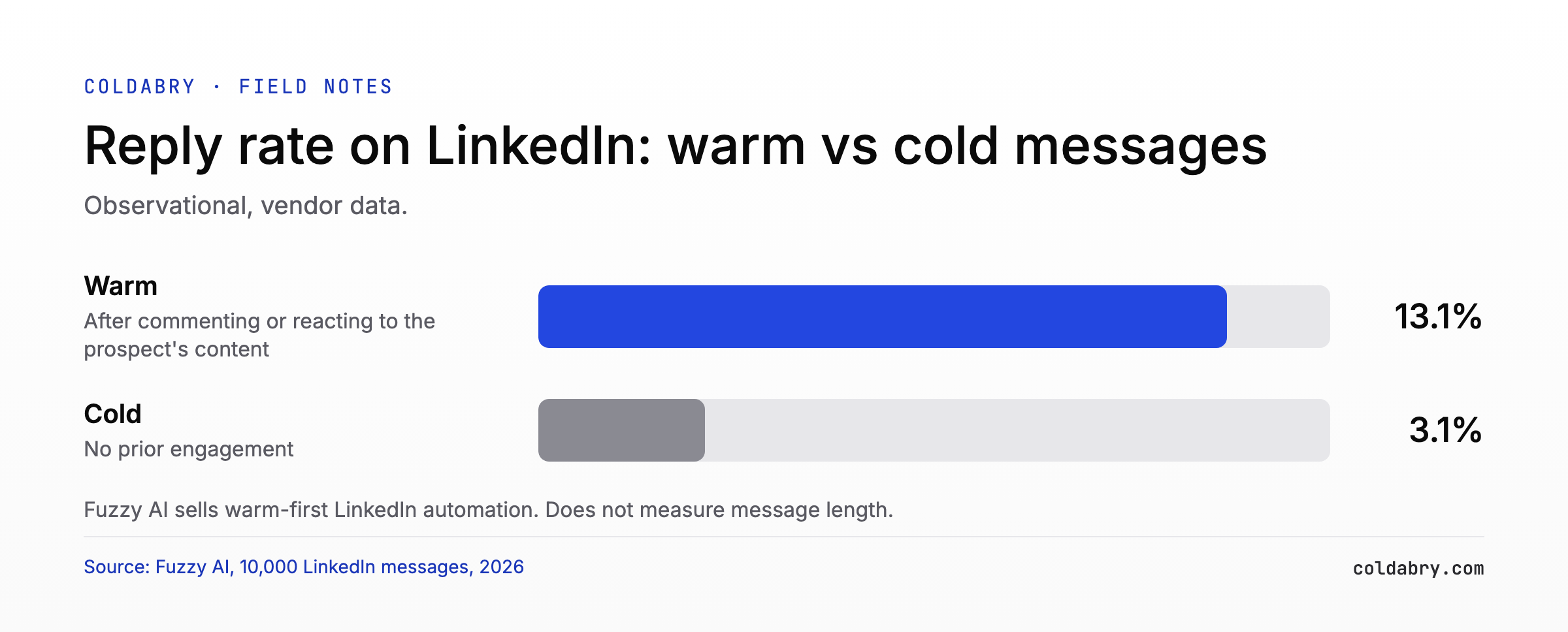
A second data point is thinner. Fuzzy reports that LinkedIn consultant Melanie Goodman got an 11.4% reply rate on 763 cold pitches and 36.4% on 77 post-engagement follow-ups. That is one person's inbox, reported secondhand, and we did not read the original.
Fuzzy also writes that message length "should be calibrated to the level of existing familiarity," and adds: "Cold messages with no prior context need more scaffolding." That cuts against a bare short-is-better rule, and Fuzzy shows no length data for it, so a fuller cold version is worth testing against a short one. List size may matter too: Saleshandy claims campaigns under 200 prospects got nearly twice the reply rate of those targeting 500 or more, a figure we could not check independently.
Who you message comes before how you word it, so spend effort on ranking profiles by reply odds and on how many cold email follow-ups to send before trimming another five words. For work outside Instagram's inbox, such as a CRM or a spreadsheet you maintain, AI agents with guardrails and audit trails let a person see and correct what the software did.
How do you test cold DM length on your own messages?
Split one list at random, send two versions by hand, and count replies against total sent. This method is for manually sent messages only, for the Terms reasons above.
- Change one variable. Length, or a question, or an emoji. Never two at once.
- Write two versions. For a length test, for example 25 words against 70 words, with the same ask in both. For a question test, close one version on a question and the other on a no-question line such as Reply.io's "If this is something you're interested in happy to share more details."
- Fix the target sample first. Pick it from the table below and do not stop early because one version looks ahead.
- Split one list at random. Do not give version A your best prospects.
- Hold the rest constant. Same sender, same week, same channel.
- Use total sent as the denominator. Not opened messages, not accepted requests.
- Count replies in a fixed window. For example 7 days after each send. That window is our assumption, so pick yours in advance.
- Track positive replies too. Hunter's study ignored sentiment, and a shorter message that earns more "no thanks" replies has not won.
Log one row per message, using an ID instead of a person's handle:
| Column | Example value |
|---|---|
| Recipient ID | r-0142 |
| Channel | |
| Variant | A |
| Word count | 26 |
| Question (Y/N) | Y |
| Emoji (Y/N) | N |
| Sent date | 2026-11-02 |
| Reply (Y/N) | Y |
| Positive (Y/N) | N |
The sample you need depends on the gap you want to detect. These figures are our calculation, using two-sided 5% significance, 80% power and the normal approximation for two proportions. The first four rows use example rates, not benchmarks.
| Baseline reply rate | Variant reply rate | Sends per variant |
|---|---|---|
| 10% (example) | 20% (example) | 199 |
| 5% (example) | 10% (example) | 435 |
| 10% (example) | 15% (example) | 686 |
| 5% (example) | 7.5% (example) | 1,471 |
| 3.7% (Hunter) | 4.5% (Hunter's top band) | 9,643 |
| 3% (Reply.io) | 3.06% (Reply.io emoji rate) | 1,281,194 |
A worked example: at a 10% baseline, 199 sends per variant can detect a jump to 20%, roughly 20 replies against 40. At low volume you will only see large gaps like that one, so treat small tests as directional. A difference the size of Hunter's length bands will stay out of reach for almost anyone sending by hand.
Tagging is the tedious part. You can use AI for labeling replies as positive or negative, and once the sheet grows, custom AI automation for outreach reporting can summarize the rows you enter by hand, while sending and inbox reading stay manual. Check a sample of labels by hand either way.
Until your own log says otherwise, write under 100 words, make one ask, and put your effort into who receives the message.
FAQ
What is a good reply rate for a cold DM?
We could not verify any Instagram cold DM reply rate, so there is no reliable public benchmark for it. The closest figure is Fuzzy AI's 3.1% for cold LinkedIn messages, from a vendor that sells warm-first automation. Saleshandy claims a 4.5% average for cold email, on a page with conflicting date windows, in a different channel. Fuzzy says its figures use total messages sent, though its methodology names open-to-reply conversion as the primary metric, so the denominator is unclear, and it warns that rates on a different denominator are not comparable. The most useful benchmark is your own baseline, measured against total sends over a fixed window.
How many words should a first cold message have?
Under 100 words is the safest reading of the public evidence, and 20-39 words is a reasonable starting point. Hunter's analysis of 34 million cold emails found 20-39 words highest at 4.5%, Reply.io said 50-70 words, and Saleshandy advises under 100. All of that is cold email from vendors selling outreach software, not DM data. Hunter's bands sit within about one point of each other, so the wording, the fit with the recipient and the ask probably matter more than hitting an exact count.
Should a cold DM end with a question?
Zero questions scored highest in the only data we could verify, one is Reply.io's stated ceiling, and more than one is a poor bet. That data is Reply.io's email analysis from 2023: emails with zero questions had the highest average reply rate, and templates with three questions got 30% fewer replies, with no baseline stated. That comes from a single vendor and from email rather than DMs, so end on one easy, low-pressure ask, phrased as a question or not, and test it on your own list.
Do emojis in the first line reduce replies?
Nobody has shown that with data we could verify. A post in r/InstagramMarketing claims emojis in line 1 hurt, but we could not read it, and it may be promotional, so treat it as a claim. Reply.io's 2022 study of 2 million emails found no real effect, 3.06% against 3%. Outreach's 2019 test found a 42% decline, but only in subject lines of mid or late sequence emails. A DM has no subject line, so neither study answers the first-line question.
Is it against Instagram's rules to automate cold DMs?
Yes, when it runs through non-official tools. Instagram's Terms of Use bar accessing or collecting information in an automated way without Instagram's express permission, whether or not you are logged in. The official Messaging API does not offer a way around this, because Meta's documentation says conversations start only when an Instagram user messages the account first. Private replies to comments need the person to act first too. So a compliant cold DM on Instagram is one a person sends by hand. Meta publishes no send limit we can cite, and no tool can promise an account stays safe.
How many messages do I need to test a cold DM?
It depends on the gap you want to detect. By our calculation (two-sided 5% significance, 80% power), spotting a jump from 10% to 20% takes 199 sends per variant. Smaller gaps cost far more: a gap the size of Hunter's, 3.7% to 4.5%, takes 9,643. The rates in the first example are assumptions, not benchmarks. If you send fewer than a few hundred messages per version, only large differences will show, so read the result as directional.