AI Reply Classification: Labels, Prompt and Accuracy
AI reply classification sorts outreach replies into interested, objection, not now, unsubscribe and more. Taxonomy, prompt, thresholds and real accuracy data.

AI reply classification works when an LLM returns one label from a fixed set of 6 to 8 labels as JSON, and anything risky (an unsubscribe, legal wording, low agreement) goes to a human. Prompted LLMs are good classifiers, but published studies show they are still measurably weaker than a small model fine-tuned on your own labeled data (Bucher and Martini, 2024; Edwards and Camacho-Collados, 2024).
This guide is for email and DM outreach teams that get more replies than one person can triage the same day. The main caveat: the confidence number a model writes about itself is overconfident (Xiong et al., ICLR 2024), so routing thresholds have to be checked against a sample of replies you labeled by hand.
What is AI reply classification and what labels do you need?
AI reply classification is the step between "a reply arrived" and "something happens": a model reads the new text of a reply and assigns an intent so automation can act on it. Reply.io's knowledge page puts the reason plainly: "Each intent demands a different action, and several are opposites: an out-of-office should not stop outreach, an unsubscribe must" (Reply.io).
A label earns its place only if it triggers a different action or carries a different cost when wrong. Our suggested starting set:
| Label | Example reply | Action | Cost of a miss |
|---|---|---|---|
| interested | "Sounds good, what does it cost?" | Stop sequence, alert the rep now | High: a warm lead goes cold |
| question | "Do you work with agencies?" | Stop sequence, rep answers same day | Medium: slow answer, lost momentum |
| objection (budget, timing, incumbent, no_need, trust) | "Thanks, we're all set" | Stop sequence, optional tailored reply by subtype | Medium: wrong tone if auto-answered |
| not_now | "Ping me after Q1" | Pause, store resurface date, resume then | Medium: you lose a timed opportunity |
| referral | "Talk to Ana, she owns this" | Create new contact, stop current one | Medium: the right person never hears from you |
| out_of_office | "Back on the 14th" | Keep sequence, shift next step past return date | Low: a mistimed follow-up |
| unsubscribe | "Take me off your list" | Suppress everywhere, permanently, log it | Very high: compliance and domain risk |
| wrong_person / bounce | "She left the company" | Mark contact invalid, stop | Low: wasted sends |
| other | Anything that fits nowhere | Human queue | Low if reviewed |
Three choices differ from most published taxonomies:
- Pricing questions count as interested. The LeadHaste prompt says the same: "Pricing questions are interested, not objection" (LeadHaste).
- Not now is separate from objection. Reply.io describes "ask later" as "a timing objection; pause and resurface at the named time" (Reply.io). A dated pause is a different action from closing the thread. Resurface timing is covered in how many follow-ups to send.
- Unsubscribe is a flag, not only a label. Reply.io's example "Not the right person, try Ana, and take me off your list" is "a referral and an unsubscribe in one message" (Reply.io). One primary label plus independent flags keeps the opt-out.
How accurate are LLMs at text classification? (published evidence)
We found no public benchmark for LLM accuracy on outreach replies. Vendor accuracy percentages are self-reported, so we do not quote them. Peer-reviewed research on general text classification does exist, and it points one way.
| Study | What was tested | Finding |
|---|---|---|
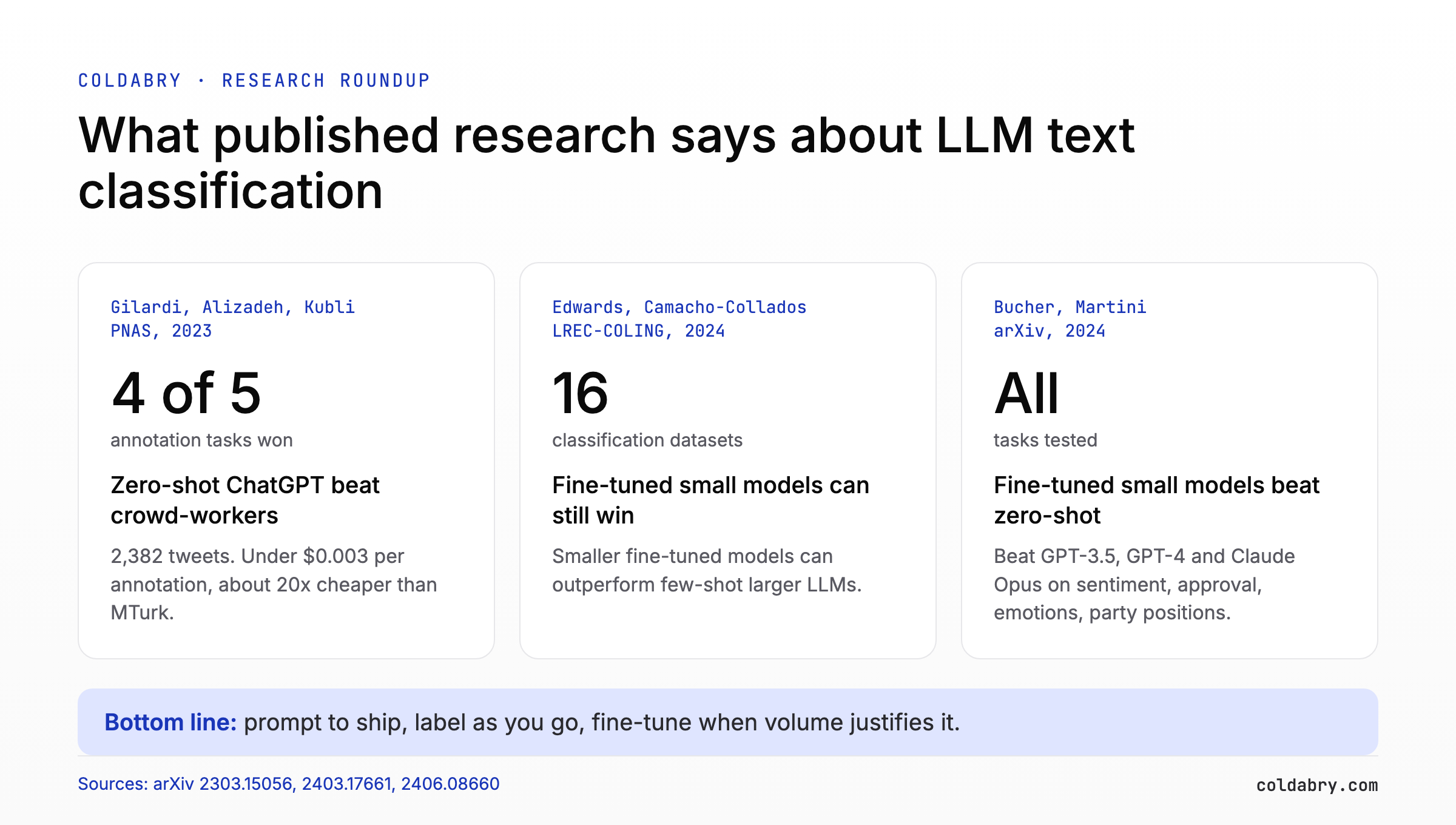
| Gilardi, Alizadeh and Kubli (PNAS, 2023) | 2,382 tweets; relevance, stance, topics, frames | Zero-shot ChatGPT beat crowd-workers on 4 of 5 tasks, at under $0.003 per annotation, about 20 times cheaper than MTurk |
| Edwards and Camacho-Collados (LREC-COLING, 2024) | 16 datasets: binary, multiclass, multilabel | Fine-tuned smaller models can still outperform few-shot larger LLMs |
| Bucher and Martini (2024) | GPT-3.5, GPT-4 and Claude Opus zero-shot vs fine-tuned small models | Fine-tuning on application-specific data "achieves superior performance in all cases" |
A prompted model is good enough to ship: the 2023 study, run in the GPT-3.5 era, already beat paid crowd-workers on most tasks. But prompting is not the ceiling: both 2024 papers found a smaller model trained on task-specific labels wins.
So: launch with a prompt, store every human correction as a labeled example, and test a fine-tuned classifier once you have a few thousand. Reply.io adds the warning that matters most for evaluation: aggregate accuracy hides which intents fail, and one rare class can carry most of the cost (Reply.io).
The prompt: a JSON reply classifier you can copy
Illustrative example: this is our own prompt, written for this guide. It is not a tested product and comes with no accuracy figure. Run it on your own labeled replies before it touches a live sequence.
It borrows two rules from LeadHaste (classify only the new text; polite brush-offs are objection/no_need) (LeadHaste) and differs on unsubscribes and confidence.
SYSTEM
You classify replies to outreach messages (email or direct message).
Return only JSON that matches the schema. Do not add commentary.

INPUT
- outbound: the last message we sent
- reply: the prospect's reply, with quoted thread removed if possible

LABELS (choose exactly one)
interested | question | objection | not_now | referral | out_of_office | unsubscribe | wrong_person | other

RULES
1. Classify only the new text written by the prospect. Ignore quoted earlier messages and signatures.
2. Pricing, availability or "how does it work" questions with buying intent = interested.
3. Neutral information questions without buying intent = question.
4. Polite brush-offs ("thanks, we're all set") = objection with objection_type "no_need".
5. A named future time ("after Q1", "next month") = not_now. Put the date in resurface_date as YYYY-MM-DD only if the reply states or clearly implies it; otherwise null.
6. A named other person = referral. Copy the name or address exactly as written into referred_contact. Never invent a contact.
7. Any opt-out wording ("remove me", "stop", "unsubscribe", "don't contact me") sets unsubscribe = true, whatever the primary label is.
8. requires_human = true for: legal or privacy terms (GDPR, CCPA, lawyer, lawsuit), threats or abuse, press or partnership requests, existing-customer confusion, sarcasm you are unsure about, and any reply you cannot place in one label.
9. Never invent dates, names, companies or prices.
10. reason: one short sentence quoting the words that decided the label.

SCHEMA
{
  "label": "interested|question|objection|not_now|referral|out_of_office|unsubscribe|wrong_person|other",
  "objection_type": "budget|timing|incumbent|no_need|trust|other|null",
  "resurface_date": "YYYY-MM-DD or null",
  "referred_contact": "string or null",
  "unsubscribe": true,
  "requires_human": false,
  "reason": "string",
  "language": "ISO 639-1 code"
}
Each field feeds a downstream action:
| Field | Why it is there |
|---|---|
| label | Picks the branch in your workflow |
| objection_type | Different follow-up per objection |
| resurface_date | Dated pause for not_now and out_of_office |
| referred_contact | Creates the new contact for a referral |
| unsubscribe | Independent of label, so opt-outs survive mixed replies |
| requires_human | The model's escalation vote |
| reason | Shows the reviewer the deciding words |
| language | Routes unsupported languages |
Use your provider's structured-output or JSON-schema mode so malformed output never reaches your CRM. The prompt has no "confidence" field on purpose; the next section explains why.
What confidence threshold should you use for routing?
Do not route on the confidence score the model writes into its own answer. The ICLR 2024 study on confidence elicitation found that "LLMs, when verbalizing their confidence, tend to be overconfident, potentially imitating human patterns of expressing confidence" (Xiong et al.). Prompt templates that send replies to a human when "confidence is below 0.7" (LeadHaste) rely on exactly that number.
The same paper reports that "consistency among multiple responses" is one of the techniques that helps reduce overconfidence, while noting that "none of these techniques consistently outperform others" (Xiong et al.). That gives a workable rule: run the classifier three times at a temperature above zero (or once on each of two different models), and auto-act only when the labels agree.
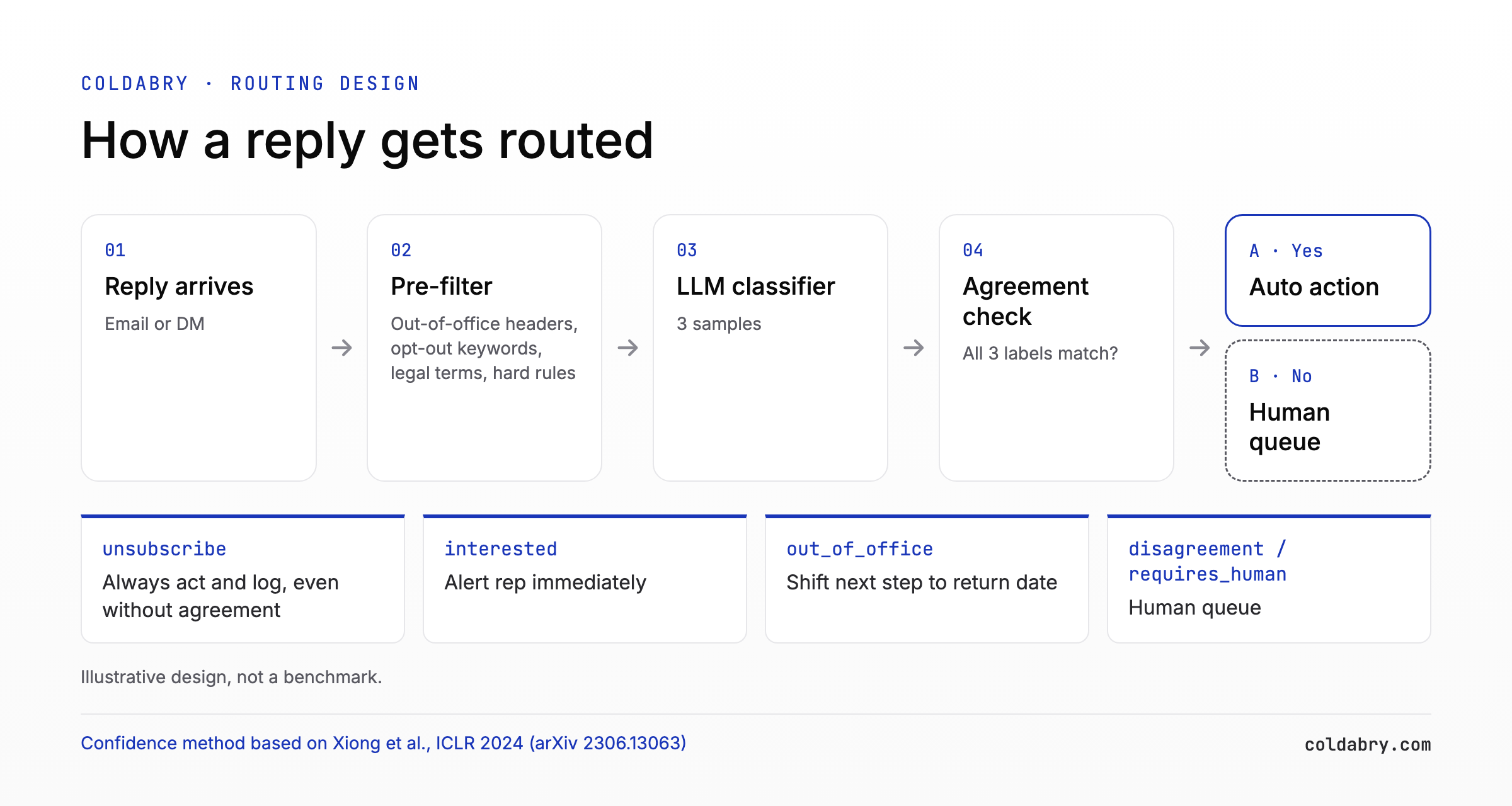
Thresholds should differ by label, because the cost of a mistake differs. LeadHaste states the asymmetry well: "a false escalation costs a minute of review; a hostile reply answered by automation can cost the domain" (LeadHaste). Reply.io adds that "unsubscribes and legal requests are a sliver of volume but carry most of the risk, which is exactly where sampled human review belongs" (Reply.io). So act on any unsubscribe vote or keyword hit and log it, always alert a rep on interested, and auto-act on objection, not_now and out_of_office only on 3 of 3 agreement.
Worked example (our calculation, all inputs assumed). A team receives 1,000 replies a month. Assume a person needs 30 seconds to read and route one reply. Without a classifier: 1,000 × 30 s = 30,000 s, or 500 minutes a month. Assume the agreement check lets 80% of replies auto-route, so 200 go to a human: 200 × 30 s = 6,000 s, or 100 minutes. Add the weekly audit time. Whether that saving justifies a build is covered in picking automations with real ROI.
A bounded decision plus a hand-off when unsure is the pattern behind agentic workflows that escalate to a human, and it is the core of how AI agents that escalate to a human when unsure are designed.
How to set up human review and measure errors
The LeadHaste template suggests testing on 20 real replies before going live and then logging "every classification next to the eventual human judgment for a week" (LeadHaste). Twenty is a smoke test. We suggest 200 to 300 hand-labeled replies (our assumption), so rare labels like unsubscribe appear often enough to see failures.
Score each label separately, in a confusion table where rows are the human label and columns are the model's label. The numbers below are an illustrative example, not results from any real classifier.
| Human \ Model (example) | interested | objection | not_now | unsubscribe | other | Total |
|---|---|---|---|---|---|---|
| interested | 34 | 2 | 3 | 0 | 1 | 40 |
| objection | 4 | 48 | 6 | 0 | 2 | 60 |
| not_now | 2 | 5 | 41 | 0 | 2 | 50 |
| unsubscribe | 0 | 1 | 0 | 18 | 1 | 20 |
| other | 2 | 3 | 2 | 1 | 72 | 80 |
Overall accuracy here is (34 + 48 + 41 + 18 + 72) / 250 = 213 / 250 = 85.2%. Per label it looks different:
- Unsubscribe recall = 18 / 20 = 90%. Two people who asked to be removed would keep getting messages. This is the metric to push toward 100%, using the keyword pre-filter and the independent unsubscribe flag.
- Interested precision = 34 / (34 + 4 + 2 + 0 + 2) = 34 / 42 = 81%. About one alert in five is noise.
- Interested recall = 34 / 40 = 85%. Six warm leads landed elsewhere, mostly in not_now.
This is the trap Reply.io describes: "Precision and recall trade off. Tightening 'interested' precision drops warm-but-vague replies; loosening it floods humans with false positives" (Reply.io).
Evaluation checklist:
- Pull 200 to 300 real replies across all your channels and languages.
- Strip unneeded personal data and label by hand, two people on ambiguous ones.
- Run the classifier with live settings (model, temperature, samples).
- Build the confusion table and compute recall for unsubscribe and precision and recall for interested.
- Read every unsubscribe and interested miss; fix prompt rules or pre-filter.
- Re-run on the same fixed set.
- After launch, sample a fixed share of auto-routed replies every week and log model label vs human label.
- Save every human correction as a labeled example.
- Once you have a few thousand labeled replies, train a small fine-tuned classifier and compare it on the same test set, as the 2024 studies suggest (Bucher and Martini; Edwards and Camacho-Collados).
Does this work for Instagram and LinkedIn DM replies?
The same taxonomy works for DMs, but the input differs, and most published guides cover email only.
| Aspect | Email replies | DM replies |
|---|---|---|
| Length | A few sentences, often with quoted thread | Often one line, one word or one emoji |
| Context | Subject line and quoted original | Usually none: pass your last outbound message as input |
| Non-text replies | Rare | Voice notes, stickers, reactions: transcribe or send to a human |
| Language | Usually one language per thread | Mixed languages and slang are common |
Always give the model the outbound message being answered; a thumbs-up means nothing without it. And route unsupported languages to a person. Reply.io notes that its built-in categorization "understands English only, so replies in other languages need a manual category" (Reply.io).
Platform note: automating cold Instagram DMs breaks Instagram's terms, so connect a classifier only to messages received through official channels. See what the Instagram Messaging API can and can't do.
Build or buy: built-in reply labels vs your own classifier
If your tool already labels replies, measure it with the checklist above; build your own when its labels cannot drive the actions you need. Reply.io is a useful reference point because its documentation is specific: an AI assigns "one of Interested, Not interested, Do not contact, Not now, or Forwarded: plus any custom categories you create," with "Only one category is allowed per thread," and "reply detection usually takes up to 3-4 hours to sync a response" (Reply.io).
| Factor | Built-in labels (Reply.io, per its docs) | Your own classifier |
|---|---|---|
| Labels | 5 categories plus custom ones | Any taxonomy, plus independent flags |
| Mixed replies | One category per thread | Primary label plus unsubscribe and other flags |
| Languages | English only for categorization | Whatever your model handles, with a language field |
| Out-of-office | Pause for a set number of days | Extract the return date |
| Speed | Reply sync up to 3-4 hours | As fast as your webhook fires |
| Channels | The tool's own channels | Email and DM in one pipeline |
| Effort | None to set up | Build, evaluate and maintain |
A custom pipeline is a webhook, the pre-filter, the LLM call with agreement check, and a write-back to your CRM. It fits the profile of a good automation candidate: "high volume, rule-shaped, and expensive in human time, all three at once" (Coldabry). If you are weighing the same question for a whole DM tool rather than one step, see build vs buy for an Instagram outreach bot.
Owning that pipeline instead of renting it is the kind of custom AI automation for outreach ops our studio builds.
FAQ
Can AI accurately classify cold email replies?
Yes, with limits. Peer-reviewed research shows prompted LLMs classify text well: a 2023 PNAS study found zero-shot ChatGPT beat crowd-workers on 4 of 5 annotation tasks. We found no public benchmark for outreach replies, and vendor figures are self-reported. The risk sits in rare labels: overall accuracy can look high while unsubscribes are missed. Measure per label on a few hundred hand-labeled replies and keep a human queue for ambiguous or legal replies.
What confidence threshold should an AI reply classifier use?
Avoid thresholds on the confidence number the model writes about itself. An ICLR 2024 study found verbalized confidence tends to be overconfident. A more reliable signal is agreement: run the classifier three times at a temperature above zero, or on two different models, and auto-act only when the labels match. Set rules per label by error cost: act on unsubscribes from a single vote, always alert a rep on interested, send disagreement to a human.
Which replies should always go to a human?
Send a reply to a person when a mistake is expensive or the meaning is unclear. That includes legal or privacy wording (GDPR, CCPA, lawsuit), threats and abuse, press or partnership requests, confused existing customers, likely sarcasm, unsupported languages, and any reply where repeated runs disagree. Unsubscribes are the exception: act on them automatically and immediately, then log them for audit.
Is fine-tuning better than prompting for reply classification?
In published studies, usually yes, once you have data. A 2024 study found fine-tuned small models beat GPT-3.5, GPT-4 and Claude Opus used zero-shot across every classification task tested, and a 2024 LREC-COLING study across 16 datasets reached a similar conclusion. Prompting wins on speed to launch because it needs no training set. Ship with a prompt, store human corrections as labels, and compare a fine-tuned model once you have a few thousand.
How many replies do I need to label to test a classifier?
A 20-reply smoke test catches obvious prompt mistakes, but it cannot tell you how rare labels perform. For a meaningful evaluation, label 200 to 300 real replies across your channels and languages. That is a working assumption, not a published standard: you need enough rare labels such as unsubscribe to see failures. Keep the set fixed and add a weekly sample after launch.
Can the same classifier handle email and DM replies?
Yes, the same labels and prompt work for both, with two changes for DMs. Pass the outbound message the prospect is answering, because DM replies are often one word or an emoji that means nothing alone. Route voice notes and stickers to transcription or a human, and use a language field for mixed languages. On Instagram, classify only messages received through official channels, since automating cold DMs breaks its terms.