AI vs Human Cold DMs: What the Reply Data Shows
Humans drew more replies than AI overall in the three public cold email comparisons we found, but we found no controlled Instagram DM test.
Human-written cold messages drew more replies than AI-written ones overall in the three public comparisons we found, but all of them measured email, and we found no published controlled test of AI vs human cold DM reply rates on Instagram. This matters most if you sell by DM, whether that is a creator pitching a paid AI product or a founder finding first buyers. The main caveat: the best test we found was run by a vendor that sells the winning workflow.
We have no send data of our own. Every figure below comes from a named publisher, labeled with what that publisher sells and which channel it measured. Only numbers marked "our calculation" or "our arithmetic" are ours, and they are math on those public figures, not results from a test.
Do AI cold DMs get fewer replies than human ones?
Nobody can say yet, because we found no controlled test. The closest DM evidence is anecdotal: a Reddit r/Entrepreneur thread claims manual DMs beat Clay plus AI agents, but that is one claim, we could not open the thread, and there is no test design we could verify.
Everything else is email, plus one LinkedIn data point. The ledger below is the public record we found on November 5, 2026.
| Publisher | What it sells | Sample | Channel | Design | Finding | Evidence level |
|---|---|---|---|---|---|---|
| Saleshandy | Cold email software, including the AI features tested | 12,000 emails (5K AI, 2K human, 5K hybrid) | Random split into three arms; timing described inconsistently | Reply rate: AI 4.1%, human 10.4%, hybrid 14.7% | Best available, but vendor-run | |
| Pin | AI recruiting platform | 5M+ messages, 1,800+ organizations | Recruiting email and LinkedIn | Observational, hand-written arm self-selected | Hand-written email drew about 2.5x the replies of AI email | Weak on authorship, candidates not buyers |
| Something Inc on Digital Applied data | SEO agency services | 100,000 paired cold emails | Aggregated and matched, not controlled | Reply rate: AI 4.1%, human 5.2% | Secondhand, original removed | |
| None found | n/a | n/a | Instagram DM | n/a | No controlled test located | No evidence |
What does the AI vs human cold email data show?
AI came last overall in each comparison we found, with one exception by vertical (SaaS in the 100K data), and a hybrid of AI and human work came first in the one test that included it. Saleshandy's 12K test is the cleanest source we found. Saleshandy sells cold email software, including the AI features used here.
It split one list of US VPs and heads of sales at B2B SaaS companies into three groups: 5,000 emails written entirely by ChatGPT and Claude, 2,000 written by SDRs, and 5,000 in a hybrid arm. Saleshandy's summary calls this arm AI-drafted and human-refined, but its method section says AI did the research and an SDR wrote each email from scratch. Saleshandy says it did not tweak the AI copy in the AI-only arm.
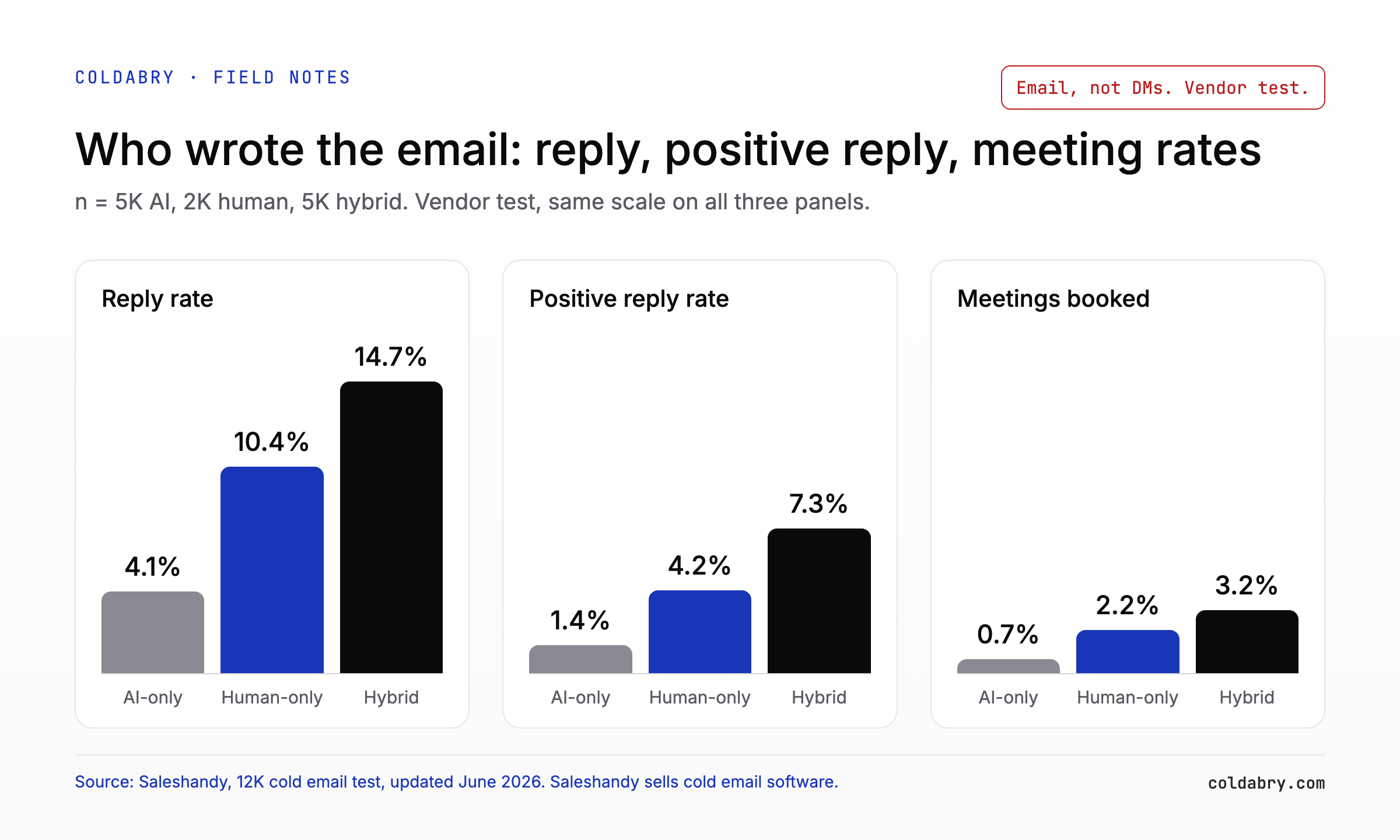
The hybrid arm got about 3.6x the reply rate of AI-only and 1.4x the reply rate of human-only, by Saleshandy's count. Spam flags tell a second story: 7.8% for AI-only, 2.9% for human, 3.1% for hybrid.
The 100K dataset points the same way with a much smaller gap. Something Inc, an SEO agency, reports an analysis by Digital Applied; the original page has since been removed. As reported by Something Inc:
- Reply rate: AI 4.1%, human 5.2%.
- Positive reply rate: AI 1.4%, human 2.1%.
- Meetings booked: AI 0.7%, human 1.1%.
- Spam flags: AI 8%, human 3%.
- Inbox placement on a one-day cadence: AI 71%, human 86%.
- Trend: AI reply rate rose 1.3 points from 2.8% in 2024, while human stayed flat at 5.2%.
So the size of the human lead depends on the study: about 2.5 times the AI reply rate in Saleshandy and about 1.3 times in the 100K data (our arithmetic).
The two also disagree on SaaS. The 100K data reports AI at 6.1% in SaaS, above the human average, and 1.9% in financial services. Saleshandy's B2B SaaS audience had humans ahead 10.4% to 4.1%. We cannot resolve that from public data.
How reliable are AI vs human reply rate studies?
Reliable enough to form a hypothesis, not enough to set a budget. Sampling error is the smallest problem. Our 95% confidence intervals on Saleshandy's reply rates are 3.6% to 4.6% for AI, 9.1% to 11.7% for human and 13.7% to 15.7% for hybrid (our calculation, normal approximation). They do not overlap, but they cover chance only, not bias.
The bias sits in the designs, and one oddity sits in the numbers. Saleshandy's AI-only arm and the AI side of the 100K data show the same reply, positive reply and meeting rates: 4.1%, 1.4% and 0.7%, with spam at 7.8% and 8%. The human sides differ, 10.4% and 5.2%. We do not know why, so we do not count them as two independent results for AI.
| Study | Flaw | Effect on the reading |
|---|---|---|
| Saleshandy | The publisher sells the AI used in the winning arm, and chose an audience it calls one of its ideal targets | Treat the hybrid win as a vendor result until someone else repeats it |
| Saleshandy | Each arm had its own sending domains and accounts | Deliverability differences between domains could move reply rates |
| Saleshandy | The hybrid arm had deeper per-prospect AI research than the AI-only arm, and a location-based P.S. | The test does not isolate who wrote the message as the cause |
| Saleshandy | Saleshandy says the arms ran simultaneously, but also says the hybrid was built after running the first two back to back, and one SDR reportedly wrote 5,000 emails in about 3 days | Timing and how personal the hybrid copy really was are unclear |
| Pin | Recruiters kept hand-written notes for 5,000+ of their highest-conviction targets | Pin itself calls the 2.5x a ceiling, not proof that human sentences persuade better |
| Pin | Some AI drafts were human-reviewed before sending: of 100,000+ routed through an optional review queue, 45% got human eyes | Pin's AI bucket is not all unedited AI, and the data is observational, not a test |
| Pin | Candidates, not buyers, and no Instagram | A job offer is a different ask from a sales pitch |
| 100K data | Aggregated from Smartlead, Instantly, Apollo and proprietary sources; original page removed | Something Inc advises reading the deltas, not the absolute levels; we cannot check the source |
Does cold email data apply to Instagram DMs?
Only partly. At most the ordering transfers, and only as a hypothesis to test. Spam filters, sending domains and inbox placement are email mechanics, so the most striking email findings do not carry over at all.
Pin's data holds the nearest thing to a DM: AI-drafted LinkedIn messages drew 3.4x the replies of AI-drafted cold email. LinkedIn steps were sent by the recruiter, while email sent automatically. That is AI against AI, so it shows a channel effect, not an authorship effect, and it is still not Instagram.
| Email finding | Transfer grade | Why |
|---|---|---|
| Human beats AI overall | Hypothesis | Humans led overall in all three datasets we found, with a SaaS exception in the 100K data, and none measured Instagram |
| Hybrid beats human | Weak hypothesis | One vendor test, one audience, writer not isolated, arm described inconsistently |
| Absolute reply rates (4.1%, 10.4%, 14.7%) | Does not transfer | Different channel, audience and sending method |
| Spam flag rates | Does not transfer | Email filter mechanic |
| Inbox placement (71% vs 86%) | Does not transfer | DMs have a different gate. Meta's developer docs say new conversations from non-followers land in an app user's Requests folder; that describes a business inbox, and we infer, but did not verify, that a cold sender meets something similar |
| Cost per meeting | Does not transfer | Email volume is cheap; a person sending DMs by hand is not |
Does a hybrid of AI and human work beat either one?
In the one test we found, the hybrid arm led on replies, positive replies and meetings, but that test cannot tell us whether editing an AI draft works, because its own description of the arm is inconsistent. Saleshandy also sells that workflow, and the arm had deeper research than the AI-only arm, so we cannot say who wrote the message caused the lift.
Cost changes the picture. Dividing Saleshandy's reported test costs by its reported meetings (our arithmetic, email only):
- AI-only: $200 / 35 meetings = $5.71 per meeting.
- Human-only: $8,000 to $9,000 / 44 meetings = $182 to $205 per meeting.
- Hybrid: $4,000 / 160 meetings = $25 per meeting.
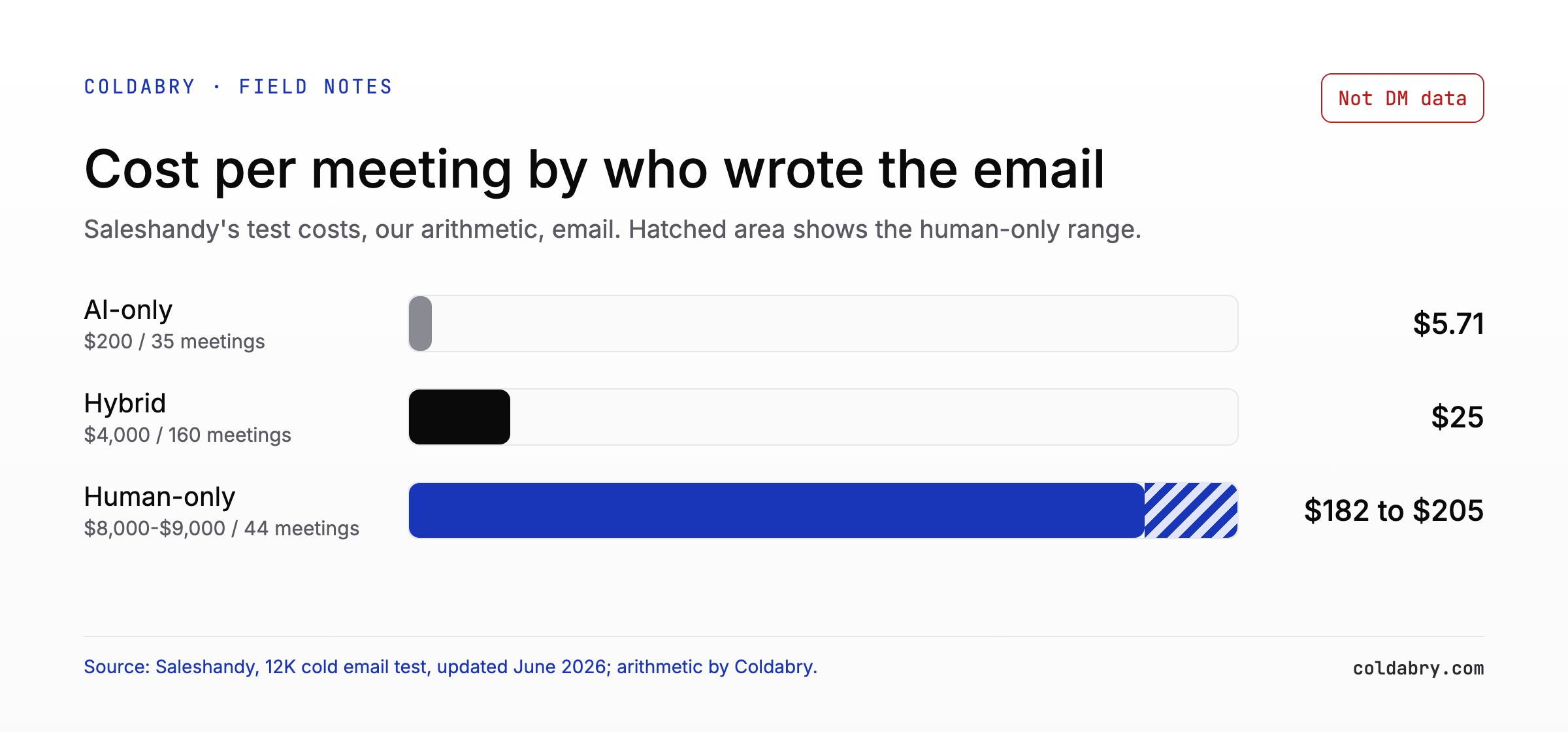
Unedited AI wins on price. It loses on prospects burned: 5,000 sends for 35 meetings is about 143 prospects per meeting, against about 45 for human and 31 for hybrid (our arithmetic). If your list is small, as a creator's or niche founder's usually is, prospects are the scarce input, not writing hours.
Pin makes the opposite case for volume. Its 4 million AI-drafted sends produced more than 300x as many conversations as 5,000 hand-written ones, from about 800 times the sends (our arithmetic). Hand-typed notes won each exchange, and AI volume won the total.
Our read, as judgment rather than data: write by hand for your top targets, and for the rest let AI do the research while a person writes or reviews each message. No test we found measured the reviewed-draft version. If you automate the drafting, AI agents with human escalation and audit trails keep people on the ambiguous cases.
Does using AI for cold DMs break Instagram's rules?
Automating cold DMs does. Writing a draft with AI and sending it yourself is a different question. Here are the two primary sources, checked November 3, 2026.
The Instagram Terms of Use say: "You can't attempt to create accounts or access or collect information in unauthorized ways. This includes creating accounts or accessing or collecting information in an automated way without our express permission, regardless of whether such automated access or collection is undertaken while logged-in to an Instagram account."
The official route does not help either. Meta's Messaging API documentation describes conversations that start when an Instagram user messages your account, so it cannot open a cold conversation. Our guide to what the Instagram Messaging API can and cannot do covers the detail, and ban risk across Instagram cold DM tools compares the third-party options.
Risk: Cold DM automation breaks Instagram's terms. The quoted terms address automated access, not who drafted the text, so AI drafts sent by hand are not what that sentence describes. That does not make them approved. Instagram can still act on an account for other reasons, and no tool or method can promise safety. This is our reading, not legal advice.
How do you run an AI vs human cold DM test?
Randomize one list into arms before anyone writes, have a person send every message by hand, and fix the sample size first. Hand sending matters twice: it keeps automation out of the test, and it removes send method as a variable.
The protocol
- Pick the arms. A: unedited AI. B: human. C: AI draft plus human edit, an arm no test we found clearly measured. If volume is low, run A against C or A against B first.
- Randomize first. Build one prospect list, then assign arms at random before any message is written.
- Give every writer the same research. Use the same notes on each prospect for all arms. This fixes the flaw in both Saleshandy (research depth differed by arm: shallow audience-level AI research for AI-only, per-prospect SDR research for human, per-prospect AI research cards for hybrid) and Pin (best targets went to humans).
- Fix arm A's prompt. Use one prompt and do not edit the output. Our AI prompts for personalizing cold DMs give a starting point.
- Hold these constant: sender account, profile, offer, ask, send method, time of day and follow-up count.
- Alternate arms within each day. A, B, C, A, B, C, so a good Tuesday does not favor one arm.
- Decide the sample size and reply window now. We suggest 7 days after the last send, which is our choice. Pin found 90% of replies landed within about 4 days, in recruiting.
- Do not stop early. Peeking at a lead and quitting inflates false winners.
- Label replies blind. Someone who cannot see the arm marks each reply as positive or not.
- Compare three metrics: reply rate, positive reply rate and booked calls.
Sends you need per arm (our calculation; two-sided 5% significance, 80% power, normal approximation; days assume an example pace of 30 sends a day, which is an assumption, not a safe limit):
| Gap to detect | Basis | Sends per arm | Two-arm total | Days at 30 a day |
|---|---|---|---|---|
| 10% vs 20% | Example | 199 | 398 | 14 |
| 4.1% vs 10.4% | Saleshandy AI vs human, email | 265 | 530 | 18 |
| 5% vs 10% | Example | 435 | 870 | 29 |
| 10% vs 15% | Example | 686 | 1,372 | 46 |
| 10.4% vs 14.7% | Saleshandy human vs hybrid, email | 931 | 1,862 | 63 |
| 4.1% vs 5.2% | 100K data, as reported by Something Inc, email | 5,751 | 11,502 | 384 |
At DM volume you can only see large gaps. If the true difference looks like the 100K data, a hand-sent test is unlikely to find it, and a smaller sample is directional at best. These figures compare two arms; a third arm adds comparisons and sends, so treat them as minimums.
The log (one row per prospect):
| Column | What to record |
|---|---|
| Prospect ID | A code, kept apart from the handle so the labeler stays blind |
| Arm | A, B or C |
| Sent at | Date and time |
| Sender | Account and person who sent it |
| Reply Y/N | Any reply inside the window |
| Positive Y/N | Set by the blind labeler |
| Booked Y/N | Call actually scheduled |
| Minutes spent | Research plus writing plus editing, for your own cost per booked call |
Once the log outgrows a spreadsheet, custom AI automation for outreach reporting can handle the logging and readouts while a person keeps sending.
FAQ
Do AI-written cold messages get fewer replies than human-written ones?
In the public email data we found, yes, overall. Saleshandy, which sells cold email software, reported 4.1% for unedited AI and 10.4% for humans. A 100K-email dataset reported by Something Inc, an SEO agency, showed 4.1% and 5.2%, with AI ahead in SaaS, and its original page has since been removed. Both are email, and the gap varies widely. We found no controlled Instagram test, so treat "humans get more replies" as a hypothesis for DMs, not a finding, and test it on your own list.
Can people tell when a cold message was written by AI?
Not reliably, going by one study. As cited by Pin, a 2025 peer-reviewed study found people correctly spotted AI-written text only 57% of the time, and identified human-written text 64% of the time. We could not open the paper; its listed title says it used excerpts from German theses, not cold messages. If detection is that weak, the reply gap in email tests may come from relevance and specifics, not from readers recognizing a machine. That link is our inference, so check it in your own test.
Is it better to edit AI drafts or write cold DMs from scratch?
We found no clean test of this, so it is a judgment call. In Saleshandy's email test the hybrid arm reached 14.7% replies against 10.4% for human-only, at about $25 per meeting against $182 to $205 (our arithmetic). But its method section says AI did the research and an SDR wrote each email from scratch, so that arm may not be an edited draft at all, and Saleshandy sells that workflow. For your few highest-value prospects, writing from scratch is still reasonable. We found no public test of this on Instagram DMs.
Is using AI to write Instagram DMs against the rules?
Automating cold DMs breaks Instagram's terms, which bar accessing or collecting information in an automated way without express permission, and the official Messaging API cannot open a cold conversation. AI drafts a person sends by hand are a separate matter: the quoted terms address automated access, not who drafted the words. That is not approval, and Instagram can still restrict an account. This is our reading, not legal advice.
How many DMs do you need to test AI against human messages?
It depends on the gap you want to detect. By our calculation, at two-sided 5% significance and 80% power, 10% against 20% takes 199 sends per arm, and 5% against 10% takes 435. Saleshandy's 4.1% and 10.4% would take 265 per arm; the 100K data's 4.1% and 5.2% would take 5,751, out of reach by hand. Fix the size before you start.
Which parts of cold outreach should AI handle?
Research is the best-supported job in the data we found. In Saleshandy's email test, the hybrid arm used AI for prospect research and, by its method section, a person to write each email, and it led on replies and meetings, with the vendor caveat attached. We found no clean test of AI first drafts with human edits. Unedited AI was the cheapest per meeting there, at $5.71 by our arithmetic, but it used about 143 prospects per meeting. For small lists, keep people on the writing and top targets. On Instagram, keep sending itself manual, since automating it breaks the terms.