Instagram Lead Scoring: Rank Profiles by Reply Odds
Instagram lead scoring works when it ranks reply odds, not size: warmth first, then activity, openness and fit. Free weighted template and Meta rules inside.

The profiles most likely to reply to a first DM are people who recently interacted with you, then your followers, then active accounts engaging in your niche; strangers rank last, so useful Instagram lead scoring weights that warmth above follower count or contact data. This applies to creators, coaches and companies working an outreach list by hand. The main caveat: Instagram's Terms of Use prohibit collecting information in an automated way without its permission (Instagram Terms of Use), and Meta's official API cannot send a cold first message (Meta Messaging API docs). The score orders a human queue, it does not feed a bot.
What is Instagram lead scoring (and why fit is not reply odds)?
Lead scoring ranks prospects so you spend time on the ones most likely to convert. On Instagram, two different questions get mixed together:
- Fit: would this person buy, partner or collaborate if the conversation happened?
- Reply probability: will this person answer this specific DM, now?
Most third-party scoring tools answer the first question. The Instagram Lead Finder actor on Apify scores 0 to 100 on seven signals, and 70 of those 100 points come from contact data: email in bio (25), email on website (20), phone in bio (15) and having a website (10). The Instagram Lead Qualifier actor returns a fit score from 0 to 100 against your brand brief, plus a one-sentence reason. The Spider Insta Leads scraper sorts leads into Hot, Warm and Cold buckets.
| Tool (third-party) | What it scores | Main inputs | Measures fit or reply odds? |
|---|---|---|---|
| Instagram Lead Finder | Lead score 0-100, tiers 60-100 / 30-59 / 0-29 | Email in bio 25, email on website 20, phone in bio 15, website 10, engagement 15, follower reach 10, business account 5 | Fit and contactability |
| Instagram Lead Qualifier | Fit score 0-100 plus a fit reason | Niche, account type, brand safety, compared with your brand brief | Fit |
| Spider Insta Leads | Hot / Warm / Cold label | Scraped profile data | Fit |
| Reply-probability score (this article) | 0-100, illustrative weights | Warmth, recent activity, bio openness, past collaborations, engagement band, audience band | Reply odds |
Fit decides who enters the list. Reply probability decides the order you work it in, and none of the tools above model it.
Which Instagram profiles are most likely to reply to a DM?
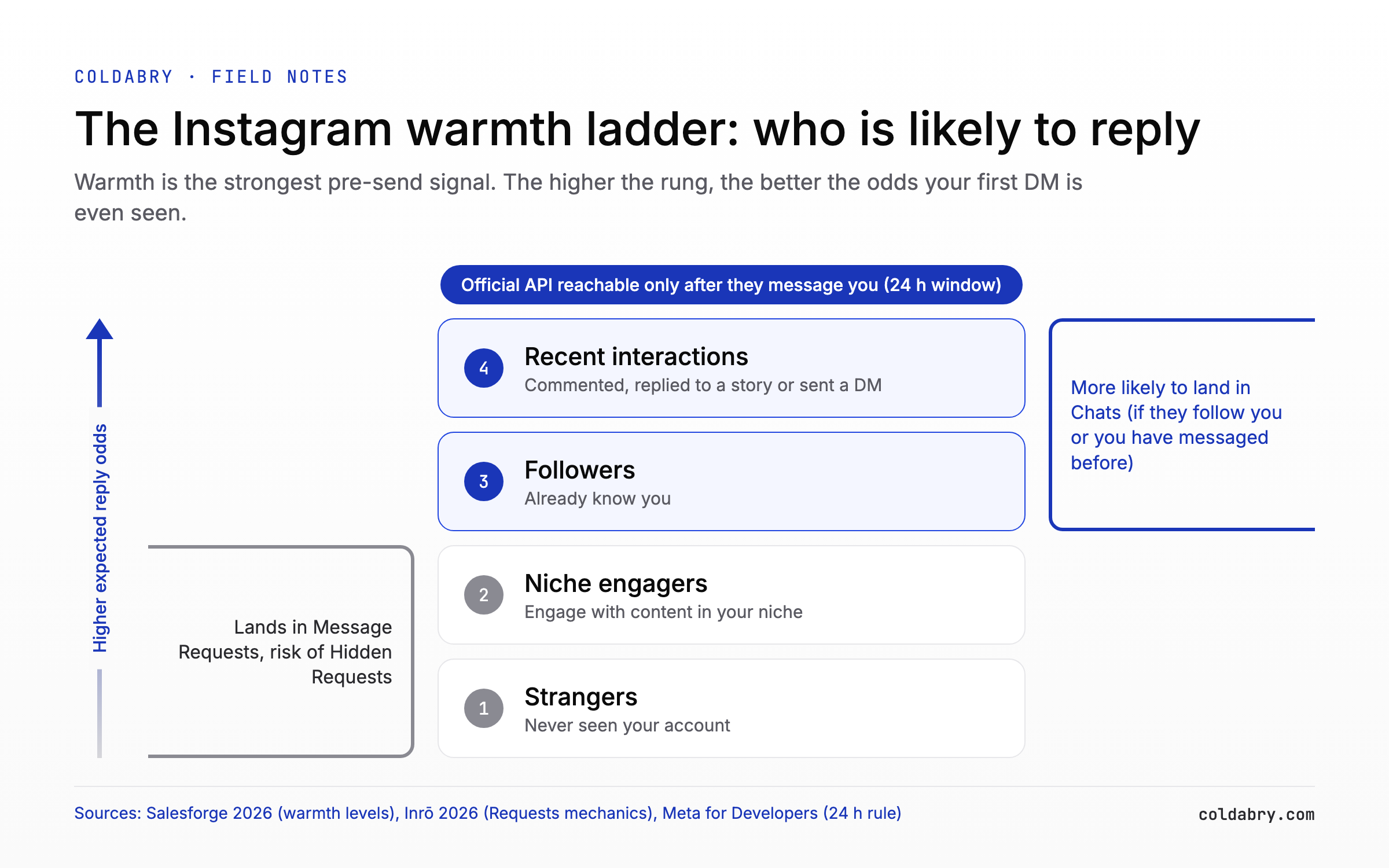
Warmth is the strongest predictor you can see before sending. Salesforge describes four levels of warmth: strangers who have never seen your account, niche engagers who interact with content in your field, followers who already know you, and recent interactions, meaning people who just commented, replied to your story or sent you a DM. The same page quotes the builder of a DM tool saying followers reply far more often than strangers, often by several times. Treat that as a vendor-reported observation, not a measured benchmark.
The mechanics explain why. According to Inrō's deliverability guide, a DM to someone who does not follow you lands in Message Requests, a folder many people never open. Templated or high-volume messages can be filtered into Hidden Requests, which is seen even less. Inrō names no prior interaction as the biggest single factor, while a DM lands in Chats when the recipient follows you or the two of you have messaged before.
There is also a hard platform line. Meta's API lets a professional account message a user only after that user has messaged it first, within a 24-hour window for most actions (Meta Messaging API docs). So only the warmest tier is reachable through official tooling.
Public profile signals that predict a reply
Beyond warmth, a handful of signals you can read on a public profile in under a minute shift the odds. None is a guarantee.
| Signal | How to read it publicly | Direction | Why it matters |
|---|---|---|---|
| Prior interaction with you | Your notifications: comments, story replies, DMs, follows | Strong + | No prior interaction is the biggest single factor for landing in Requests (Inrō) |
| Follows you | Your follower list | + | Followers already know who you are (Salesforge) |
| Recently active | Date of the latest post or story | + | An account that has not posted for weeks is less likely to check its inbox |
| Bio openness phrase | Words such as "DM for", "collabs", "available for", "partnerships" | + | The person has publicly invited contact; these are the bio keywords used in the Lead Finder example input |
| Past brand collaborations | Tagged partnerships, "paid partnership" labels, mentions of brands | + (for partnership pitches) | Favikon recommends filtering first by whether a creator has worked with brands before |
| Engagement rate in a normal band | Likes plus comments on recent posts divided by followers | + in the middle, weak at extremes | Real conversation under posts suggests a person who reads replies; near-zero engagement often means an abandoned or bought audience |
| Business or creator account | Category label under the name | Slight + | The account is set up to be contacted |
| Very large audience | Follower count | - | Big accounts receive far more requests, so a single DM competes with many others |
| Following far more than followers | Following vs follower count | - | Often a follow-for-follow or growth-tool pattern, not an engaged inbox |
Email, phone and website are missing on purpose: they are fit signals and say nothing about whether the person opens a DM.
How to build a reply-probability score (illustrative weights)
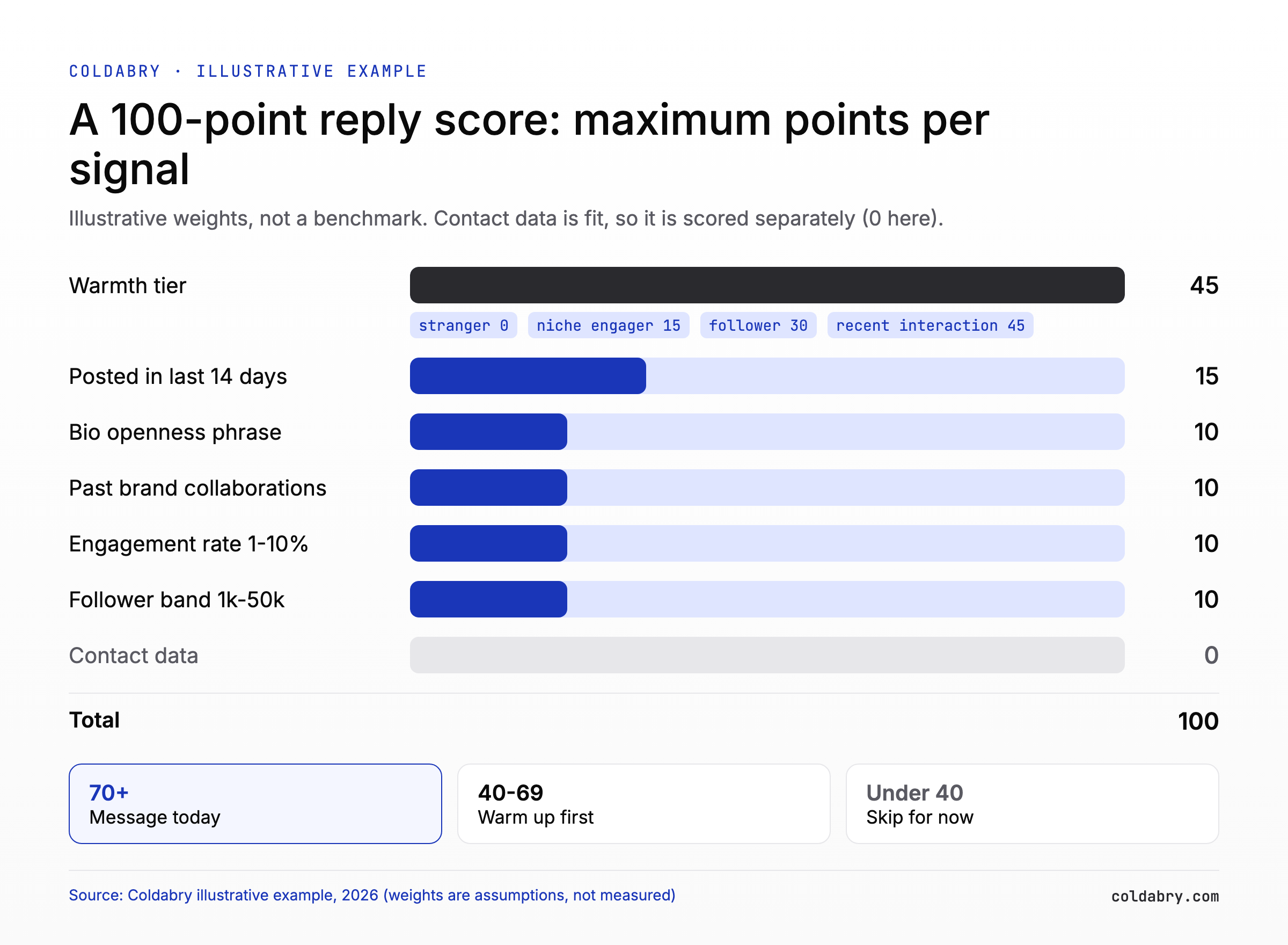
Here is a complete scoring template. The weights and thresholds are an illustrative example based on our assumptions, not a measured benchmark. They encode the order of importance described above: warmth first, then activity, then openness and audience signals. Use them as a starting point and replace them with weights fitted on your own replies (next sections).
| Signal | How to check | Illustrative points |
|---|---|---|
| Warmth tier | Stranger 0, niche engager 15, follower 30, recent interaction 45 | 0 / 15 / 30 / 45 |
| Posted in the last 14 days | Latest post or story date (14 days is our assumption) | +15 |
| Bio openness phrase | "DM for", "collabs", "available for", "partnerships" | +10 |
| Past brand collaborations | Paid partnership labels or brand tags | +10 |
| Engagement rate 1-10% | (likes + comments on last 9 posts) / 9 / followers | +10 |
| Follower band | 1k-50k: +10, 50k-500k: +5, over 500k: 0 | 0 / 5 / 10 |
| Contact data | Email, phone, website | Not scored here (that is fit) |
| Maximum | 100 |
Turn the number into an action, again with illustrative cut-offs:
- 70 and above: message today. Personalize the first line to the interaction or post that made them warm.
- 40 to 69: warm up first. Leave a genuine comment or reply to a story, then rescore in a few days. Favikon cites a practitioner who reports reply rates above 50% when brands warm up via comments before emailing (Favikon); that is one person's claim about email, not a DM benchmark.
- Below 40: skip for now. Keep fit-only leads in a separate list for ads or content instead.
Worked example: ordering a 5-profile queue
The five profiles below are fictional and the numbers are illustrative. For contrast, the last column applies a contact-data score in the style of Lead Finder's published weights: email in bio 25, email on website 20, phone in bio 15, website 10, business or creator account 5, plus our own approximation of its engagement and reach points (engagement rate x 1.5, capped at 15; reach 5 for 1k-10k, 7 for 10k-100k, 9 for 100k-1M, 10 above 1M). It is our approximation, not the tool's actual output.
| Profile (illustrative) | Facts | Reply score arithmetic | Reply score | Contact-style score |
|---|---|---|---|---|
| A: fitness coach, 8k followers | Commented on your post yesterday, posted 3 days ago, bio "DM for collabs", no brand deals, ER 4%, creator account, no email/phone/website | 45 + 15 + 10 + 0 + 10 + 10 | 90 | 0 + 0 + 0 + 0 + 6 + 5 + 5 = 16 |
| B: agency founder, 220k followers | Stranger, posted 2 days ago, no openness phrase, past brand deals, ER 0.8%, email in bio and on site, phone, website, business account | 0 + 15 + 0 + 10 + 0 + 5 | 30 | 25 + 20 + 15 + 10 + 1 + 9 + 5 = 85 |
| C: designer, 3k followers | Follows you, posted 10 days ago, bio "available for projects", no brand deals, ER 6%, email in bio, website, creator account | 30 + 15 + 10 + 0 + 10 + 10 | 75 | 25 + 0 + 0 + 10 + 9 + 5 + 5 = 54 |
| D: nutrition creator, 30k followers | Comments on niche accounts, last post 40 days ago, no openness phrase, past brand deals, ER 2%, email on website, website, creator account | 15 + 0 + 0 + 10 + 10 + 10 | 45 | 0 + 20 + 0 + 10 + 3 + 7 + 5 = 45 |
| E: lifestyle creator, 1.2M followers | Stranger, posted today, bio "for collabs email", past brand deals, ER 0.5%, email in bio and on site, website, creator account | 0 + 15 + 10 + 10 + 0 + 0 | 35 | 25 + 20 + 0 + 10 + 1 + 10 + 5 = 71 |
The two scores produce opposite queues:
| Rank | Reply score order | Contact-style order |
|---|---|---|
| 1 | A (90), message today | B (85) |
| 2 | C (75), message today | E (71) |
| 3 | D (45), warm up first | C (54) |
| 4 | E (35), skip for now | D (45) |
| 5 | B (30), skip for now | A (16) |
The contact-style score puts the two biggest strangers first, both of whom would receive your DM in Message Requests among many others. The reply score puts the person who commented yesterday first, even though that person has no email on the profile.
How to calibrate the weights with your own replies
Illustrative weights are a guess. Your niche, offer and opener change which signals matter, so the honest next step is to measure. Log every first DM you send by hand in a sheet with these columns:
| Column | Example value |
|---|---|
| date_sent | 2026-10-26 |
| profile_id | internal ID, not a handle you publish |
| warmth_tier | 0, 1, 2 or 3 |
| posted_last_14d | 1 or 0 |
| bio_openness | 1 or 0 |
| past_collabs | 1 or 0 |
| engagement_rate | 0.04 |
| followers | 8000 |
| fit_score | your separate fit number |
| reply_score | score at the moment you sent |
| replied_7d | 1 if they replied within 7 days, else 0 |
Once you have a few hundred rows (our rule of thumb, not a sourced threshold), fit a logistic regression with replied_7d as the outcome and the signals as inputs. Logistic regression is a common interpretable baseline for scoring the likelihood that a lead converts (example lead-scoring project): each coefficient tells you how much a signal moves the odds. A linear trendline in a spreadsheet is not the same model, so use Python with statsmodels or scikit-learn, or a no-code ML tool that outputs coefficients.
Then check that the score works. Split your log into score buckets (for example 0-39, 40-69, 70-100) and compare the share of replies in each. If higher buckets do not reply more often, the weights are wrong, whatever their source. Rescale the fitted coefficients to a 0-100 range, update the template and repeat every month or so.
Logging and refitting is tedious, but it can be automated without touching Instagram at all, because the sheet, the model and the queue live on your side. That kind of custom AI automation for outreach ops or a small internal tool built like custom CRMs and lead engines is where software helps, while the DM itself stays human. If you are weighing whether to write your own tooling, see building an outreach bot yourself and picking automation wins with real ROI.
What Instagram allows: scraping, cold DMs and the 24-hour rule
Note: Automating cold first DMs breaks Instagram's terms. Scoring is safest when a person reviews public profiles and sends each message by hand, and the official API is used only for people who messaged you first.
- Scraping. Instagram's Terms of Use prohibit collecting information in an automated way without Instagram's express permission (Terms of Use). Instagram's help center says accounts can be restricted for activity that goes against its Terms, including scraping (Instagram Help Center). Scraping actors that ask for a session cookie, as the Lead Finder example input does, run logged in, on your account.
- Cold DM automation. Even DM-tool vendors advise against it. Inrō says not to automate cold first messages because it causes both the Requests problem and account restrictions, and that sending more when replies are low makes deliverability worse. Instagram does not publish its limits (Salesforge). For a comparison of tools and their risk, see Instagram cold DM tools compared on price and ban risk.
- The official API. Conversations start only when an Instagram user messages the professional account. The standard window is 24 hours, up to 7 days after a click-to-Direct ad, and a human agent tag gives a 7-day window when a person needs more time (Meta Messaging API docs). More in what the Instagram Messaging API can and can't do and click-to-DM ads and the 7-day window.
| Action | Allowed by Meta? | Source |
|---|---|---|
| Reading public profiles and scoring them by hand | Normal use | n/a (manual browsing) |
| Collecting profile data with automated scrapers | No, not without Instagram's permission | Terms of Use, Help Center |
| Sending cold first DMs by hand | Allowed, lands in Requests if no prior interaction | Inrō |
| Automating cold first DMs | No, risks restrictions | Inrō |
| API reply after the user sends you a DM (for example a story reply) | Yes, within 24 hours | Meta docs |
| API reply after a click-to-Direct ad | Yes, up to 7 days | Meta docs |
The practical split: your warmest tier (recent interactions) can be handled through compliant flows where the person messages you first, such as story replies or click-to-Direct ads, where Inrō reports a 60% average reply rate on its own triggered automations (Inrō, vendor-reported, inbound only). Followers and niche engagers get hand-written messages, ordered by score. Strangers below the cut-off get content or ads, not DMs.
FAQ
What is lead scoring on Instagram?
Instagram lead scoring is a way to rank profiles so you contact the most promising ones first. Most tools score fit and contactability: whether the profile has an email, phone, website, large audience and business account. A reply-probability score asks a different question, namely how likely the person is to answer a DM now. It weights warmth (recent interactions, following you), recent posting and openness phrases in the bio. Keeping both scores separate lets you decide who belongs on the list by fit, and in what order to message them by reply odds.
Which Instagram profiles are most likely to reply to a DM?
People who recently interacted with you reply most often: they commented, replied to a story or messaged you. Next come your followers, then accounts that actively engage with content in your niche. Strangers who have never seen your account are least likely to reply, partly because a DM to someone who does not follow you lands in Message Requests, a folder many people never open. Within each tier, accounts that posted recently, invite contact in their bio and have a moderate audience tend to be better bets than dormant or very large accounts.
Why do my Instagram DMs go to message requests?
A DM to someone who does not follow you lands in Message Requests instead of the main Chats inbox. Instagram can also filter templated or high-volume messages into Hidden Requests, which is seen even less. According to Inrō's deliverability guide, the biggest single factor is no prior interaction between you and the recipient. Messages from accounts the recipient follows, or has messaged before, appear in Chats. The fix is to warm up first: comment on posts, reply to stories, or get people to message you through content or ads.
Is scraping Instagram profiles for lead scoring allowed?
No, not in an automated way. Instagram's Terms of Use prohibit collecting information by automated means without Instagram's express permission, and its help center says accounts can be restricted for activity that goes against its Terms, including scraping. Many scraping tools require a logged-in session cookie, which means the activity runs on your account. Reading public profiles yourself and noting a few signals in a spreadsheet is ordinary use. If you need volume, the compliant route is to get people to come to you, through content, flows where the person messages you first, or click-to-message ads, and score those inbound leads instead.
Can the Instagram API send the first message to a lead?
No. Meta's Messaging API documentation says conversations start only when an Instagram user messages the professional account. After that, your app can reply within a standard 24-hour window for most user actions. If the user's first message came from a click-to-Instagram-Direct ad, the window can last up to 7 days, and a human agent tag allows a 7-day window when a person needs more time to answer. Any tool that sends cold first DMs to strangers is working outside the official API.
What score should a profile have before I DM it?
There is no universal threshold, because reply odds depend on your niche, offer and message. In the illustrative model in this article, profiles scoring 70 or more out of 100 get a message today, 40 to 69 get warmed up first with a genuine comment or story reply, and below 40 are skipped for DMs. Treat those cut-offs as a starting point. Log every DM and whether it got a reply within 7 days, then check that higher score buckets really reply more often, and adjust the cut-offs to match your own data.
At Coldabry we build research and outreach agents that keep scoring and logging on your side while the platform-facing step stays inside the rules.