12 AI Prompts for Cold DMs: Copy-Paste Personalization
12 copy-paste AI prompts that turn a prospect's public profile into one grounded first DM line, plus a skip rule, a QA check and the Instagram rules.
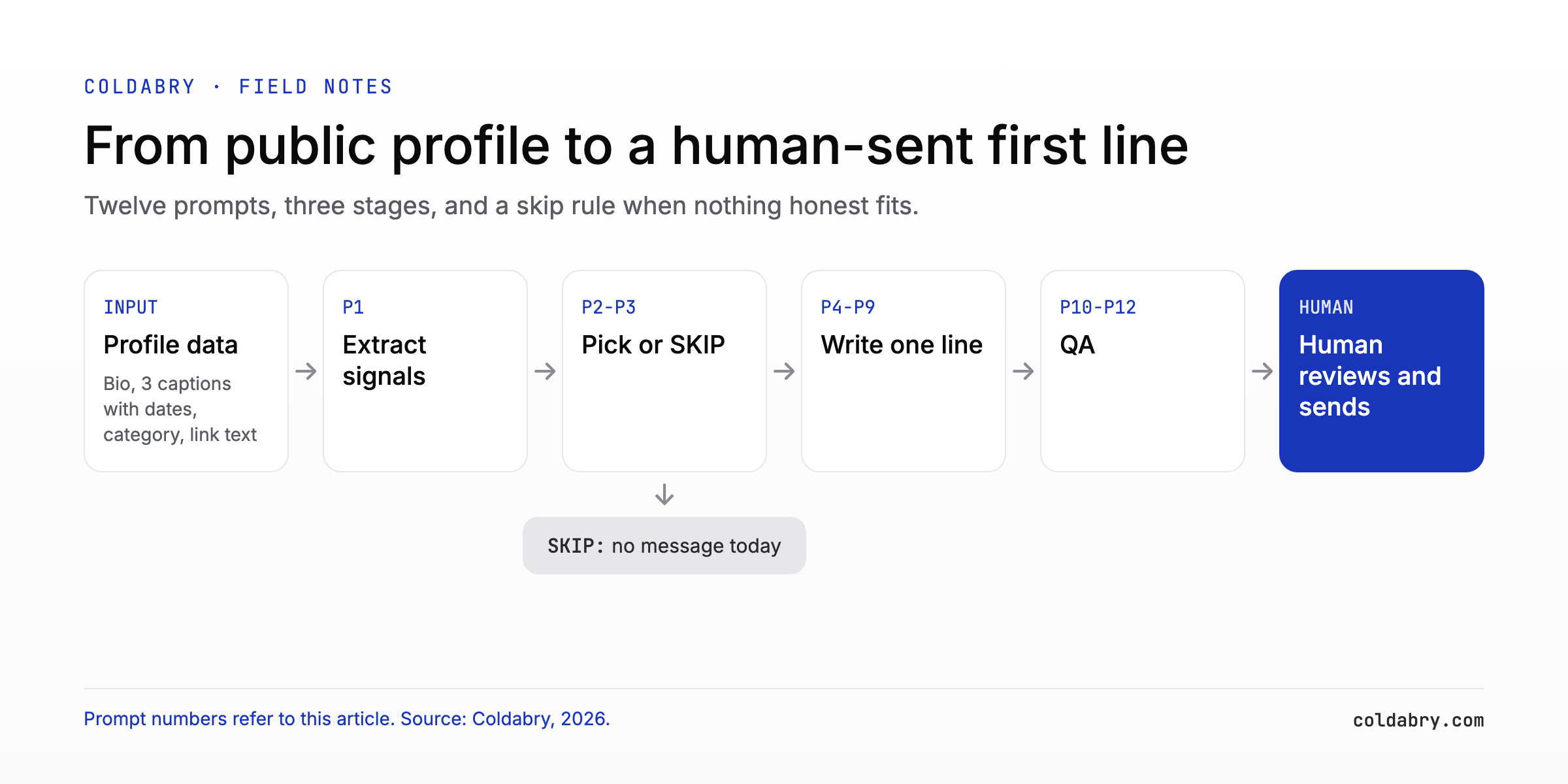
Twelve prompts cover the whole job: three pull a real signal from a public profile, six turn that signal into one first line, and three check the draft before a human sends it. These AI prompts for cold DMs are built for creators and small teams who write Instagram DMs by hand or with light assistance, and want each opener grounded in something the prospect actually posted. Two caveats up front: automated cold DMs break Instagram's Terms, so the prompts are for drafting, not sending, and no prompt rescues a prospect with nothing to say. When there is no honest signal, the right output is SKIP.
Most prompt lists ranking for this topic work at the segment level. A typical example asks for "a creative cold DM idea that will grab the attention of [potential customer profile]" (ClickUp). The set below works per prospect instead: profile data in, one cited signal out, one line, and a QA pass that rejects invented facts.
What makes an AI-written cold DM sound personal?
A personal opener is a sentence that could only go to this person this week. Phantombuster's guide puts it well: "Real personalization is a sentence that could only be sent to one prospect this week. It names something that happened at their account recently and connects it to a problem you actually solve" (Phantombuster).
Its test: cover the prospect's name and reread the line. If it is still true for forty other people, it is a template with a name glued on. A specific but irrelevant detail, like a hobby or an old post, fails too.
Merge fields (name, city, niche) are not personalization. A signal is a recent, public, relevant fact you can quote.
| Merge field (not personal) | Signal (personal) |
|---|---|
| First name | A product launch announced in last week's caption |
| City | A workshop date posted for next month |
| Niche ("fitness coach") | The specific client problem their latest Reel talks about |
| Follower count | A stated goal in the bio ("booking 1:1s for spring") |
| Account category | A new link-in-bio page that replaced the old one |
How to format profile data so the AI can't invent things
Loose input causes fake-sounding DMs: the model fills gaps with plausible guesses. The fix is a tagged input block, so every usable fact sits in a named field.
Anthropic's prompting guide recommends exactly this: "XML tags help Claude parse complex prompts unambiguously, especially when your prompt mixes instructions, context, examples, and variable inputs" (Anthropic). The same page notes that "a few well-crafted examples (known as few-shot or multishot prompting) improve accuracy and consistency," which is why the template includes your own past DMs.
Use this block as the input for every prompt in the set:
<profile>
handle: {handle}
bio: {bio_text}
category: {account_category}
link_in_bio_text: {link_page_title_and_first_line}
captions:
- [{date_1}] {caption_1}
- [{date_2}] {caption_2}
- [{date_3}] {caption_3}
</profile>
<offer>{one sentence: what you do and for whom}</offer>
<voice>
- {your real past DM 1}
- {your real past DM 2}
- {your real past DM 3}
</voice>
<today>{YYYY-MM-DD}</today>
Public data only. Dates matter because the checks reject anything older than 90 days.
Rule of thumb: if a fact is not inside the
<profile>tags, the model is not allowed to use it. Every prompt below repeats that instruction.
Prompts 1-3: find a real reason to write (or skip)
These run before any writing. If you score profiles by reply odds before you write a word, run them only on the profiles that pass your score.
Prompt 1: Signal extractor
Read the <profile> block. List up to 5 signals: recent, specific facts
about this account that a stranger could reasonably mention.
For each signal return:
- signal: one short phrase
- field: which field it came from (bio, caption, category, link_in_bio_text)
- evidence: the exact quoted words from that field
- date: the caption date, or "undated" for bio/category/link
Use only text inside <profile>. Do not infer, guess or generalize.
If there are no usable signals, return: NONE
Prompt 2: Signal ranker
Here are the signals from Prompt 1 and my <offer>.
Rank them by (1) relevance to my offer and (2) recency against <today>.
Discard any signal older than 90 days, any signal about family, health,
appearance or location, and any signal unrelated to my offer.
Return the single best signal with its evidence and a one-sentence reason.
If no signal survives, return: SKIP - {reason}
Prompt 3: Offer-fit check
Using only the chosen signal and its evidence, write one sentence that
explains why this person might care about my <offer> right now.
The sentence must point to the evidence, not to their niche in general.
If you cannot write it without guessing, return: SKIP - {reason}
This sentence is for me, not for the DM.
The skip rule is the part most prompt packs leave out. Phantombuster describes the same discipline for LinkedIn: a contact with a strong fit and high score but no signal "stays on the list and does not get a message today, because there is nothing honest to open with" (Phantombuster).
| Prompt | Input | Output | When to use |
|---|---|---|---|
| P1 Signal extractor | Profile block | Up to 5 signals with quoted evidence, or NONE | Every prospect |
| P2 Signal ranker | P1 signals + offer + today | 1 signal with reason, or SKIP | Every prospect with at least 1 signal |
| P3 Offer-fit check | Chosen signal + offer | 1 internal sentence, or SKIP | Before writing; also a gut check for you |
Prompts 4-9: write the first cold DM line from one signal
Each prompt takes one signal and returns one line. Append these shared constraints to every prompt in this section:
Constraints:
- One sentence, max 25 words.
- Reference the signal using its evidence. Use no other facts.
- No compliments from this list: love, amazing, inspiring, awesome, great work.
- No link, no pitch, no ask in this line.
- No emojis unless my <voice> examples use them.
- If the evidence is missing or unclear, return: SKIP
Prompt 4: Recent-post opener
Write a first DM line that references the caption in the chosen signal.
Mention what the post was about in plain words, then add one observation
that connects it to the problem in my <offer>. Do not praise the post.
Prompt 5: Bio or offer opener
Write a first DM line based on what the account says it sells or is
working toward, using the bio or link_in_bio_text evidence.
Treat their stated goal as the topic. Do not restate their bio back to them.
Prompt 6: Shared-context opener
Write a first DM line based on a context we share, such as the same niche,
event or community. Use it only if the profile states it publicly in the
evidence AND my <offer> states my side of it. Otherwise return: SKIP
Prompt 7: Question opener
Write one specific question about the chosen signal that the person can
answer in a few words. The question must be impossible to send to anyone
else. No pitch, no "quick question", no yes/no question.
Prompt 8: Voice match
Rewrite the line below so it sounds like the messages in <voice>.
Match their length, punctuation, greeting style and emoji use.
Do not add facts. Line: {line_from_P4_to_P7}
Few-shot matters here. Anthropic's guide says examples should mirror your actual use case closely and vary enough that the model "doesn't pick up unintended patterns" (Anthropic).
Prompt 9: Variant generator
Write 3 first-line variants from the same signal, each using a different
angle: (A) observation, (B) question, (C) shared context or stated goal.
Label them A, B, C. All shared constraints apply to each variant.
Use P9 only if you can test with enough volume (see the reply-rate section).
Illustrative example (fictional account, not a real prospect). Input snippet: a ceramics studio with bio "Small-batch tableware. Wholesale waitlist open for spring," and a caption dated 12 days before today: "First glaze test for the restaurant line. 40 plates, 3 colors, 1 kiln disaster." P2 picks the caption (recent, relevant to an offer about order-intake automation for makers). P4 returns: "Forty plates in three glazes for a restaurant line is a big jump from small-batch, how are you handling wholesale orders right now?"
| Generic line (illustrative) | Grounded line (illustrative) |
|---|---|
| Love your content, your work is amazing! | Your Tuesday Reel on clients skipping week-two check-ins hit a real problem. |
| Hey, I help coaches grow their business. | Saw the bio says 1:1 spots open for spring, are those filled from DMs or a form? |
| Fellow creator here, would love to connect! | We were both on the speaker list for the same online craft summit in September. |
| Quick question about your brand. | The new link page lists three programs instead of one, which one gets the most questions? |
Prompts 10-12: check every draft before it goes out
AI drafts fail in two ways: invented facts, or real facts that feel invasive. Run both checks on every line.
Prompt 10: Creepiness and privacy filter
Review this draft DM line against the <profile> block.
REJECT if it mentions: family, children, health, body or appearance,
home or current location, relationships, money troubles, any post older
than 90 days from <today>, or anything not present in <profile>.
REJECT if it would feel like being watched rather than noticed.
Return: PASS, or REJECT - {which rule} - {offending words}
Line: {draft_line}
Prompt 11: Grounding check
For each factual claim in the draft line, find the exact supporting text
in <profile>. Return a table: claim | supporting quote | field.
If any claim has no supporting quote, return FAIL and the failing span.
Otherwise return PASS.
Line: {draft_line}
Prompt 12: Batch JSON system prompt for pipelines
You draft first-line Instagram DMs for human review. For each <profile>
in the input, run: extract signals, pick one or skip, write one line,
self-check grounding and privacy. Use only text inside <profile>.
Return one JSON object per profile, nothing else:
{"handle": "", "signal": "", "evidence": "", "line": "",
 "confidence": "high|medium|low", "skip_reason": ""}
If skipping, leave "line" empty and fill "skip_reason".
Never output a line with confidence "low"; skip instead.
The JSON keys map to spreadsheet columns for review. If you want the drafting step automated, an n8n workflow that drafts lines into a review queue is where P12 plugs in, and teams that need it built properly often look at custom AI automation for outreach operations. After sending, classify the replies with an LLM to close the loop.
| Check | Fail example (illustrative) | Fix |
|---|---|---|
| Grounded (P11) | "Congrats on the new studio" when no caption mentions a studio | Rewrite from quoted evidence or SKIP |
| Recent | References a post from 8 months ago | Discard signals older than 90 days |
| Not invasive (P10) | Mentions their kids or the city they are visiting | Use work-related signals only |
| Relevant | Comments on their dog in a pitch about booking software | Pick a signal tied to the offer |
| Short | Three sentences in the opener | One line, max 25 words |
| No hidden pitch | Line one already asks for a call | Ask later, after a reply |
Keep a human in the loop: P12 drafts, a person approves and sends. This is the same design principle behind AI agents with human review and escalation: the model proposes, low-confidence cases go to a human.
Does AI personalization actually raise reply rates?
We found no independent controlled study that isolates AI-written openers against human-written ones; the published figures we saw in our 2026-10-30 search came from vendors selling outreach tools, so we do not quote them. The honest answer is that you have to measure it on your own list, and the volume needed is larger than most people expect.
Here is our own calculation for a two-variant test (two-proportion test, alpha 0.05 two-sided, power 80%). The baselines are assumed examples, not benchmarks:
| Assumed reply rate A | Assumed reply rate B | Arithmetic | DMs needed per variant |
|---|---|---|---|
| 3% | 5% | 7.84 x (0.0291 + 0.0475) / 0.0004 | about 1,501 |
| 3% | 4% | 7.84 x (0.0291 + 0.0384) / 0.0001 | about 5,292 |
| 5% | 10% | 7.84 x (0.0475 + 0.09) / 0.0025 | about 431 |
The formula: n per variant = (1.96 + 0.84)² x (p1(1 - p1) + p2(1 - p2)) / (p2 - p1)². The 7.84 is (1.96 + 0.84)², the z-values for 95% confidence and 80% power.
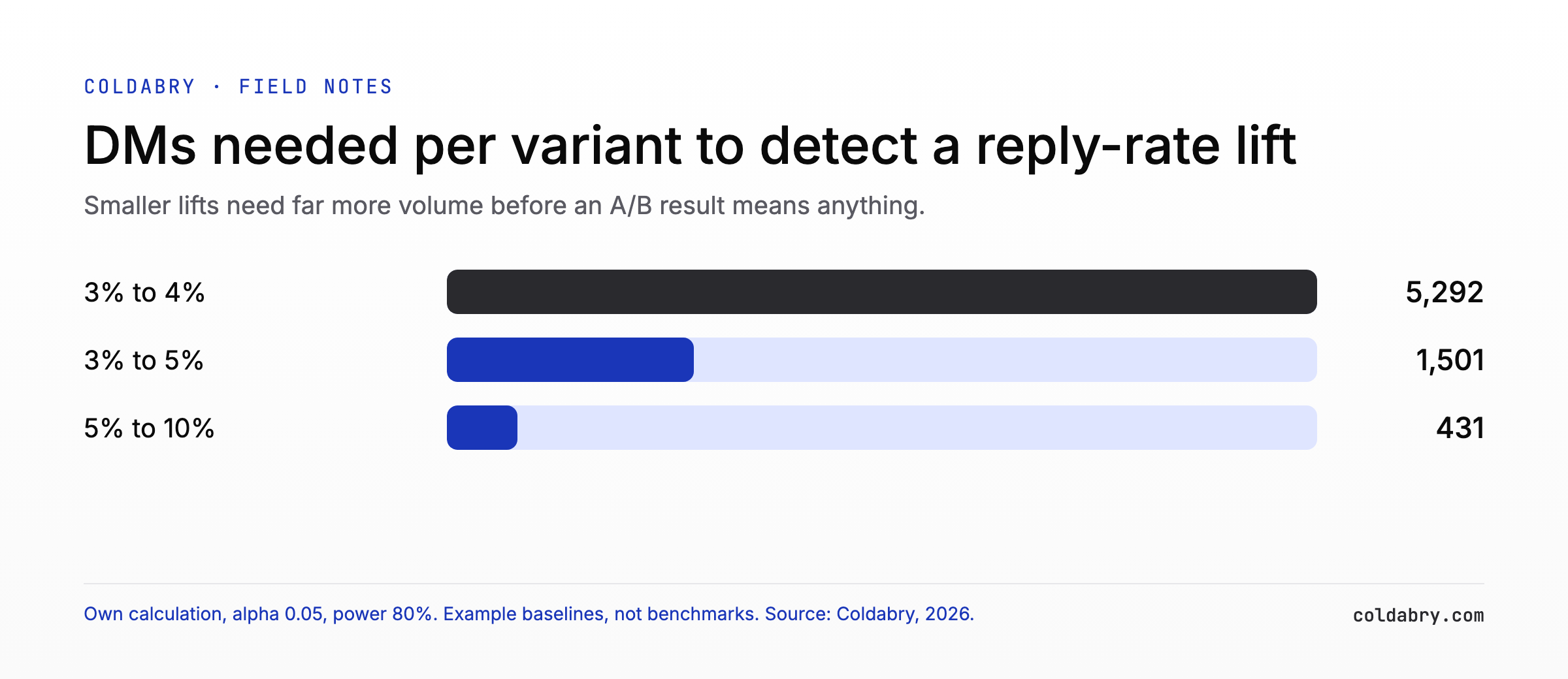
So a claim like "tested on 50 DMs, version B won" is noise. At 50 per variant, the difference between a 3% and 5% reply rate is one or two replies. Meanwhile, judge prompts on quality: the share of drafts that pass P10 and P11 first time, and the share of profiles that SKIP.
Is it against Instagram's rules to send AI cold DMs?
Drafting with AI is fine; automated sending is the problem. Meta's Messaging API only lets an app message an Instagram user after that user has messaged the business account first, within the standard 24-hour window, or up to 7 days when the first message follows a click on a click-to-Direct ad (Meta for Developers, updated September 2026). The official API cannot open a cold conversation, so any tool that sends cold first DMs works outside it.
Instagram's Terms of Use prohibit collecting information or accessing the service in an automated way without Meta's permission (Instagram Terms of Use, checked 2026-10-30). Scraping profiles at scale and auto-sending DMs both fall under that, and no tool can promise an account will not be restricted. We cover the tradeoffs in how cold DM tools compare on ban risk.
Note: the practical stance is simple. Use these prompts to draft. Have a person read each line, open the profile, and send it manually at a human pace. If you want volume without breaking the rules, click-to-DM ads open a 7-day messaging window where automation through the API is allowed.
| Method | Can start a cold conversation? | Within Instagram's rules? |
|---|---|---|
| Official Messaging API | No, only after the user messages first | Yes |
| Manual DM, AI-drafted, human-sent | Yes | Yes, at human pace |
| Third-party automation sending cold DMs | Yes | No, automated access without permission |
| Click-to-Direct ad, then API replies | User starts it | Yes, window up to 7 days |
These prompts are the drafting layer of an outreach process; our pricing page shows how we scope custom AI work built around it.
FAQ
Can ChatGPT or Claude write cold DMs for Instagram?
Yes, both can draft a good first line if you give them structured input. Paste the prospect's public bio, last three captions with dates, category and link-in-bio text inside tags, add one sentence about your offer and three of your own past DMs, then ask for one line under 25 words that quotes a specific signal. Always run a grounding check and have a person send the message, since automated sending breaks Instagram's Terms.
Is sending cold DMs on Instagram against the rules?
Sending a cold DM manually is allowed. Automating it is not. Meta's Messaging API only lets businesses message users who wrote to them first, within 24 hours, or up to 7 days after a click-to-Direct ad. Instagram's Terms of Use prohibit accessing the service or collecting information in an automated way without Meta's permission. Tools that scrape profiles or auto-send cold DMs operate outside those rules. AI drafting plus human sending stays within the rules.
How long should a first cold DM be?
Keep the opener to one sentence of about 25 words or fewer, and the whole first message to two or three short sentences. Most Instagram DMs are read on a phone, so a long block of text gets skimmed or ignored. The first line should reference one specific, recent, public signal from the prospect's profile. Save the pitch and links for after they reply.
How do I stop AI-written DMs sounding generic?
Give the model one signal with quoted evidence instead of a whole profile, and tell it to use no other facts. Add three of your own past DMs as examples so it copies your voice, not a sales template, and ban stock compliments like "amazing". Most important, let it return SKIP when nothing honest fits: a generic line usually means there was no real signal.
Does AI personalization increase reply rates?
We found no independent controlled study that isolates AI-written openers against human-written ones. The figures that circulate come from vendors selling outreach tools. You can measure it yourself, but it takes volume: by our calculation, detecting a change from an assumed 3% to 5% reply rate needs about 1,501 DMs per variant at 95% confidence and 80% power. Track draft quality, such as grounding pass rate, while reply data builds up.
What profile data should I give the AI?
Only public data that is visible on the profile: the bio, the last three captions with their dates, the account category and the link-in-bio page title. Dates let the model reject stale posts older than about 90 days. Never include private data, information from other sites you were not given permission to use, or personal details such as family, health or location. Gather it by hand for each prospect you plan to message.