Instagram Ban Wave 2026: What Happened and Who Got Hit
Instagram's 2026 ban wave is really three events. We separate the June 2025 AI bans, the May 2026 follower purge and the integrity suspensions, with sources.
The Instagram ban wave 2026 was not one event but three distinct ones: an AI-moderation mass ban in June 2025, an automated follower cleanup in May 2026, and a run of account integrity suspensions through mid-2026. No single coordinated purge of 15 million creators has been confirmed by Meta.
It hits the people who can least afford it: small businesses, solo creators, and anyone whose income depends on a single account. The main caveat worth stating up front is that Meta has issued no official statement tying the suspensions to a deliberate wave (Vaizle, 2026), so most of what circulates online describes symptoms, not a confirmed cause. Below we separate the three events, correct the viral 15 million figure, and give a checklist for teams running outreach on the platform.
What was the Instagram ban wave 2026?
Three things happened across 2025 and 2026, and almost every inflammatory blog post about the "great purge" collapses them into one. They are different events with different causes and very different levels of confirmation.
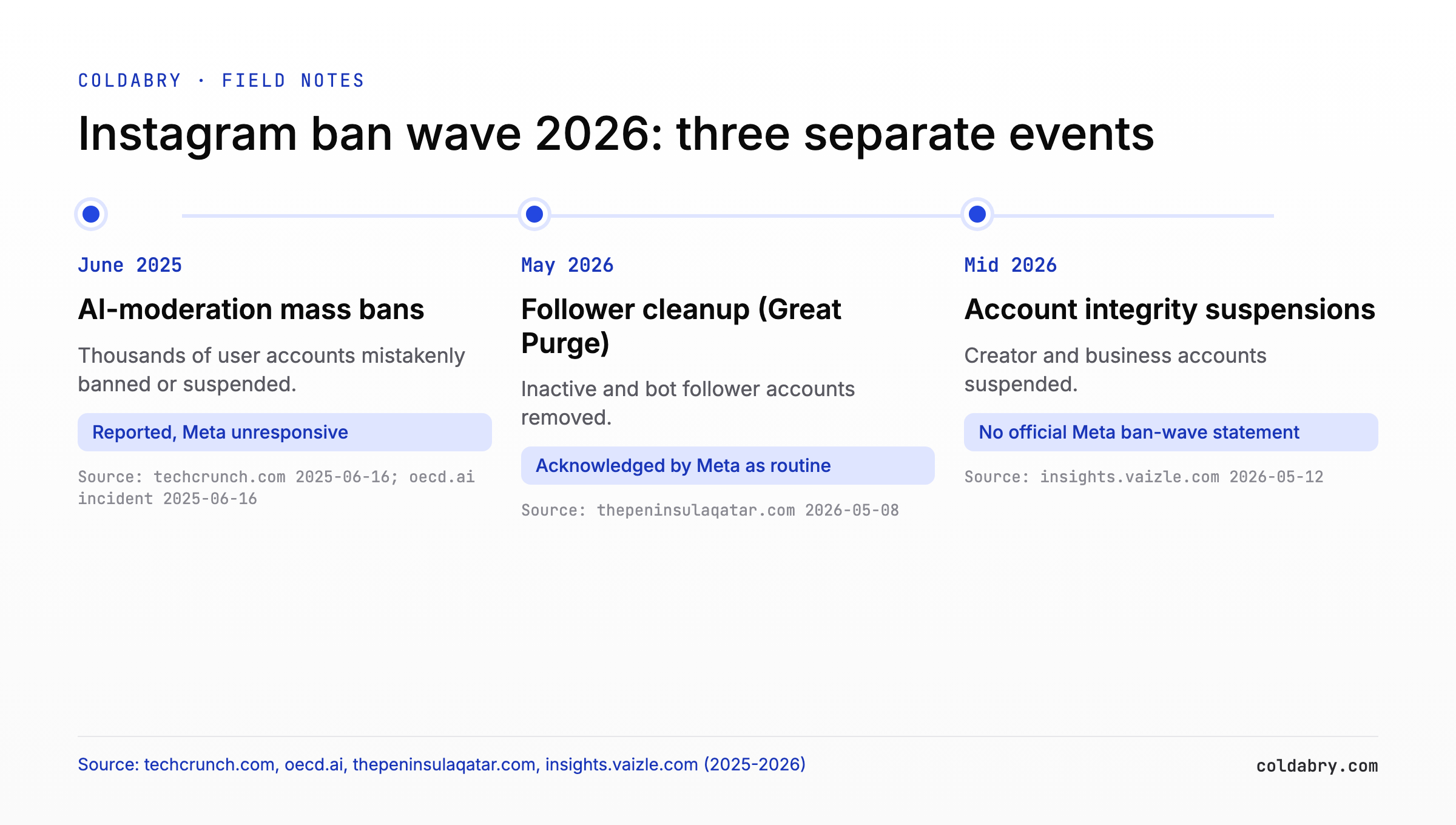
The short version: one event in 2025 was about accounts being wrongly disabled, one event in 2026 was about follower counts dropping, and a third running through 2026 is about suspensions that Meta has never formally labelled a wave. Treating a follower-count drop as a "ban" is the single biggest source of confusion, and it is where the 15 million figure comes from.
What caused the June 2025 Instagram mass bans?
Users blamed Instagram's AI moderation, and Meta stayed quiet. TechCrunch reported in June 2025 that "Instagram users have for weeks complained about a significant increase in accounts being mistakenly banned or suspended," with a Change.org petition that "has more than 4,000 signatures" at the time of writing (TechCrunch, 2025). The OECD.AI incident record, an authoritative aggregator, framed it as "Instagram's AI-powered moderation system has mistakenly banned or suspended thousands of user accounts" (OECD.AI, 2025).
Note the gap between what is reported and what is confirmed. The scale is given only as "thousands of accounts," never an exact count, and the claim that the same AI also reviews the appeals is an allegation repeated across forums, not a Meta statement. The table below keeps the two apart.
| Claim circulating | What the source actually supports |
|---|---|
| "Millions banned overnight" | "Thousands of user accounts" mistakenly banned or suspended, no exact figure (OECD.AI, 2025) |
| "27,000 people signed a petition" | The petition "has more than 4,000 signatures" as reported; it grew over time, but 4,000 is the sourced number (TechCrunch, 2025) |
| "Meta admitted the error" | "Meta has not publicly acknowledged the issue" and "has so far not offered an on-record statement" (TechCrunch, 2025) |
| "The AI reviews your appeal and doubles down" | Allegation repeated across blogs and Reddit, not confirmed by Meta. Label it a claim. |
One Reddit user quoted by TechCrunch summed up the appeal experience: "I've already submitted multiple appeals, uploaded my ID, and tried reaching out to Meta through all the official channels" (TechCrunch, 2025). That loop, not a confirmed policy, is what most people are describing when they say "ban wave."
Did Instagram ban 15 million creators in 2026?
No. There is no confirmed ban of 15 million creator accounts. The 15 million figure is Kylie Jenner's lost follower count from the May 2026 inactive-account cleanup, not a count of banned creators (The Peninsula, 2026). The viral "15M purge" framing on X takes a follower-count drop and relabels it as mass suspensions.
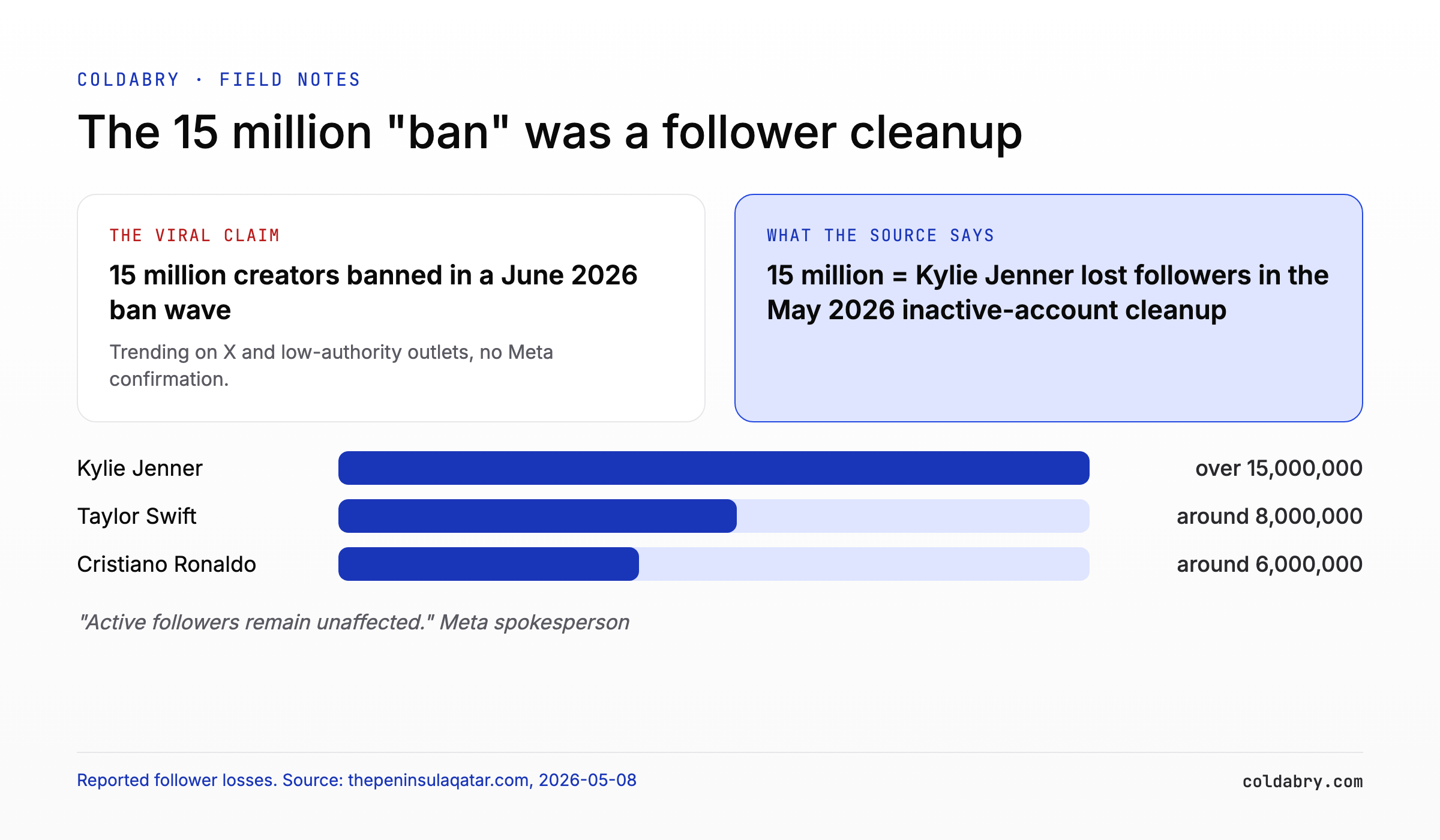
The May 2026 cleanup swept inactive and bot accounts off follower lists across the platform, which is why the drops clustered on the biggest accounts. The Peninsula reported losses of "over 15 million" for Kylie Jenner, "around 8 million" for Taylor Swift, and "around 6 million" for Cristiano Ronaldo, with a Meta spokesperson calling it "part of a routine process to remove inactive accounts" and stating that "active followers remain unaffected" (The Peninsula, 2026). Losing ghost followers is not the same as losing your account.
Who got hit, and why appeals failed
The people hardest hit were those running a business or livelihood off a single account, the same group that found the appeal process slow and circular. The pattern reported in 2025 was an automated flag, an in-app appeal, an ID upload, and then silence, with Meta "largely unresponsive to complaints and appeals" (OECD.AI, 2025).
False flags were a recurring theme. Press coverage in mid-2025 included a beautician whose account was caught by a child-safety filter with no basis, the kind of error an automated system makes at scale and a human reviewer would catch. A public comment filed with Meta's Oversight Board put a number on the error rate, though from a self-selected sample.
On record (confidence: medium, re-verify before publish): The National Coalition Against Censorship told Meta's Oversight Board that "in half the cases that have come to us, these accounts have been erroneously disabled," while noting its sample is limited to cases reported to it (NCAC, 2026).
Read that carefully. "Half the cases that came to NCAC" is not "half of all suspensions." It is still a strong signal that the automated enforcement was disabling accounts it should not have, which is the complaint at the center of the whole episode. If your account depends on nobody at Meta ever making an automated mistake, you are carrying a risk you do not control. Our own view, from building custom AI automation that owns its own account hygiene, is that the recovery path matters more than the flag itself.
Is Meta's AI moderation to blame?
Partly, and only for the part Meta has acknowledged. The follower cleanup is acknowledged and described as routine; the suspensions are not acknowledged as a wave at all. Keeping those two straight is the whole point.
Vaizle's explainer reported that Meta is "tightening several enforcement systems at the same time," naming "spam detection, account integrity checks, child-safety reviews, age verification, scam detection, and AI-led moderation," while stressing that "there is no official Meta statement saying it has launched a new 'ban wave'" (Vaizle, 2026).
Meta's position: The company has publicly described only the follower cleanup, calling it "part of a routine process to remove inactive accounts" (The Peninsula, 2026). It has not confirmed a deliberate suspension wave, and in 2025 it did not publicly acknowledge the mass bans at all (TechCrunch, 2025).
So "AI is to blame" is a reasonable hypothesis for the wrongful suspensions and a confirmed description of the follower sweep. The honest answer is that automated systems clearly drove both, but only one of them has a Meta label on it.
How to reduce ban risk if you run outreach on Instagram
You cannot make an account immune to suspension, and no tool or agency can promise that. What you can do is make a single suspension survivable and avoid the behavior that enforcement systems target. The checklist below is built for teams running outreach or automation on Instagram.
| # | Action | Why it matters |
|---|---|---|
| 1 | Keep a verified recovery email and phone on the account, plus a saved photo of the ID you would upload | The appeal flow asks for ID; having it ready cuts recovery time when an automated flag hits (TechCrunch, 2025) |
| 2 | Avoid unauthorized third-party growth and follower services | The May 2026 sweep removed exactly these kinds of inactive and bot accounts from follower lists (The Peninsula, 2026) |
| 3 | Warm new accounts slowly before any outreach volume | Sudden high-volume activity on a cold account is a classic integrity-check trigger; Meta is tightening these checks (Vaizle, 2026) |
| 4 | Do not run cold-DM automation at volume | Automated cold DMs break Instagram's terms of use. Say so plainly to your team; the risk is real and it is yours, not the platform's |
| 5 | Keep content clear of child-safety and scam tripwires | False positives on these filters disabled legitimate accounts, including a beautician flagged for child abuse (OECD.AI, 2025) |
| 6 | Export contacts, conversations and content on a schedule | If one account is suspended and appeals loop, your pipeline survives because the data lives outside the account |
| 7 | Do not depend on one account for income | The hardest-hit group in 2025 was people whose livelihood ran through a single profile with no backup (OECD.AI, 2025) |
Honest-risk note: none of this guarantees you will not be suspended. Automated enforcement makes mistakes, as the Oversight Board comment shows, and a wrongful flag can hit an account that followed every rule. The goal is resilience, not immunity. When we design systems we have built for outreach and ops, account-ban risk is a first-class constraint, which means recovery paths, slow warm-up, data export, and never a single point of failure.
FAQ
Why was my Instagram account suspended for no reason?
Most "no reason" suspensions are automated enforcement false positives. Instagram runs integrity, spam, scam and child-safety systems that flag accounts at scale, and human review does not always catch the errors first. A public comment to Meta's Oversight Board reported that in the cases brought to one censorship group, half the accounts had been "erroneously disabled" (NCAC, 2026). File an in-app appeal, upload your ID, and keep a record. Our step-by-step on how to appeal an Instagram suspension step by step covers the full process.
Is the Instagram ban wave caused by AI?
AI moderation has been blamed since June 2025, when users reported "thousands" of mistaken bans and Meta stayed silent (TechCrunch, 2025). Meta has acknowledged only the May 2026 follower cleanup, not a suspension wave (Vaizle, 2026). The common allegation that the same AI reviews your appeal and doubles down is not confirmed by Meta, so treat it as a claim, not a fact.
Did Instagram delete 15 million accounts in 2026?
No confirmed deletion of 15 million creator accounts exists. The 15 million figure is Kylie Jenner's lost followers in the May 2026 inactive-account cleanup, which also cut Taylor Swift by around 8 million and Cristiano Ronaldo by around 6 million (The Peninsula, 2026). Meta said active followers remain unaffected. The viral "15M banned" framing conflates a follower-count drop with mass suspensions.
How do I appeal an Instagram account ban?
Use the in-app appeal that appears when you open the suspended account, then follow the prompt to upload a government ID. If that route fails, the Meta Oversight Board process exists for eligible cases. Expect it to be slow and sometimes looping; the 2025 reports describe users submitting multiple appeals and uploading ID with no response (TechCrunch, 2025). Keep screenshots of every step in case you need to escalate.
Can using third-party Instagram tools get you banned?
Yes. The May 2026 cleanup specifically targeted accounts tied to unauthorized follower and growth services (The Peninsula, 2026). Cold-DM automation at volume breaks Instagram's terms of use and can trigger spam and integrity enforcement. We cover the trade-offs in our review of the ban risk of Instagram cold DM tools. If a tool promises zero risk, it is lying.
Will I get my followers back after the purge?
Generally no. The follower-count drops came from removing inactive and bot accounts, and those are not restored because they were not real engaged followers. That is different from a suspended account: if your own account is wrongly disabled and later reinstated, its followers are counted again. The cleanup touched follower lists, not account ownership (The Peninsula, 2026).
Sources
- TechCrunch, "Instagram users complain of mass bans, pointing finger at AI," 2025-06-16: techcrunch.com. Checked 2026-10-18.
- OECD.AI Incident Database, "Instagram AI Moderation Triggers Mass Account Bans and User Outcry," 2025-06-16: oecd.ai. Checked 2026-10-18.
- Vaizle, "Why is my Instagram account suspended? Meta's recent account ban wave explained," 2026-05-12: insights.vaizle.com. Checked 2026-10-18.
- The Peninsula, "Instagram's automated cleanup causes follower drops," 2026-05-08: thepeninsulaqatar.com. Checked 2026-10-18.
- National Coalition Against Censorship, public comment to Meta's Oversight Board, filed 2026-01: oversightboard.com. Checked 2026-10-18.