Are Cold DMs Dead? The 2026 Debate, With Numbers
Cold DMs are not dead, but one-shot requests to strangers mostly go unseen. Here is what the numbers behind each 2026 camp actually show.
Cold DMs are not dead in 2026, but a cold Instagram DM gets exactly one text-only message before the stranger has to accept it, so mass outreach mostly lands in a folder people rarely open (Engadget, 2023; Inrō, July 2026). This applies to Instagram-first creators, coaches and small companies asking whether the cold DM still pays. Two caveats before any number: automating DMs to strangers breaks Instagram's terms, and nearly every reply-rate figure in this debate is published by a company that sells one side of it.
The short version per camp: inbound comment-to-DM has the most data, but all of it is vendor-reported. Heavy manual personalization has real reply numbers, but they come from LinkedIn and email, not Instagram. The DIY AI setter has the loudest claims and the weakest evidence, plus the highest account risk.
Are cold DMs dead in 2026? The short verdict
Creators on X and YouTube argue this in three camps. One says cold DMs are dead and you should only message people who raised their hand. One says DMs "print money" if each one is researched and personal. One says an AI setter can qualify and book strangers at scale. These are claims, not measured results, so the table scores each camp on the best evidence we could find and who published it.
| Camp | Core claim | Best evidence that exists | Who published it | Verdict |
|---|---|---|---|---|
| Inbound comment-to-DM | Cold is dead, trigger DMs from comments | 798,041 conversations; 92.25% delivery on 57,052 attempts | Inrō and Creator Lane (both sell DM automation) | Strongest signal, not proof |
| Heavy personalization | Researched, signal-based DMs still get replies | 10.3% social DM reply rate | Expandi (sells LinkedIn automation), via Prospeo | Plausible, but the data is LinkedIn |
| DIY AI setter | AI qualifies and books strangers at scale | No public dataset found | Creator claims only | Unproven, high account risk |
So, are cold DMs dead? Only the lazy version is: identical messages sent to strangers in volume. A cold DM to a short, researched list is alive, and the inbound model is where the measurable action is.
Why cold Instagram DMs go unseen: requests, hidden requests, one message
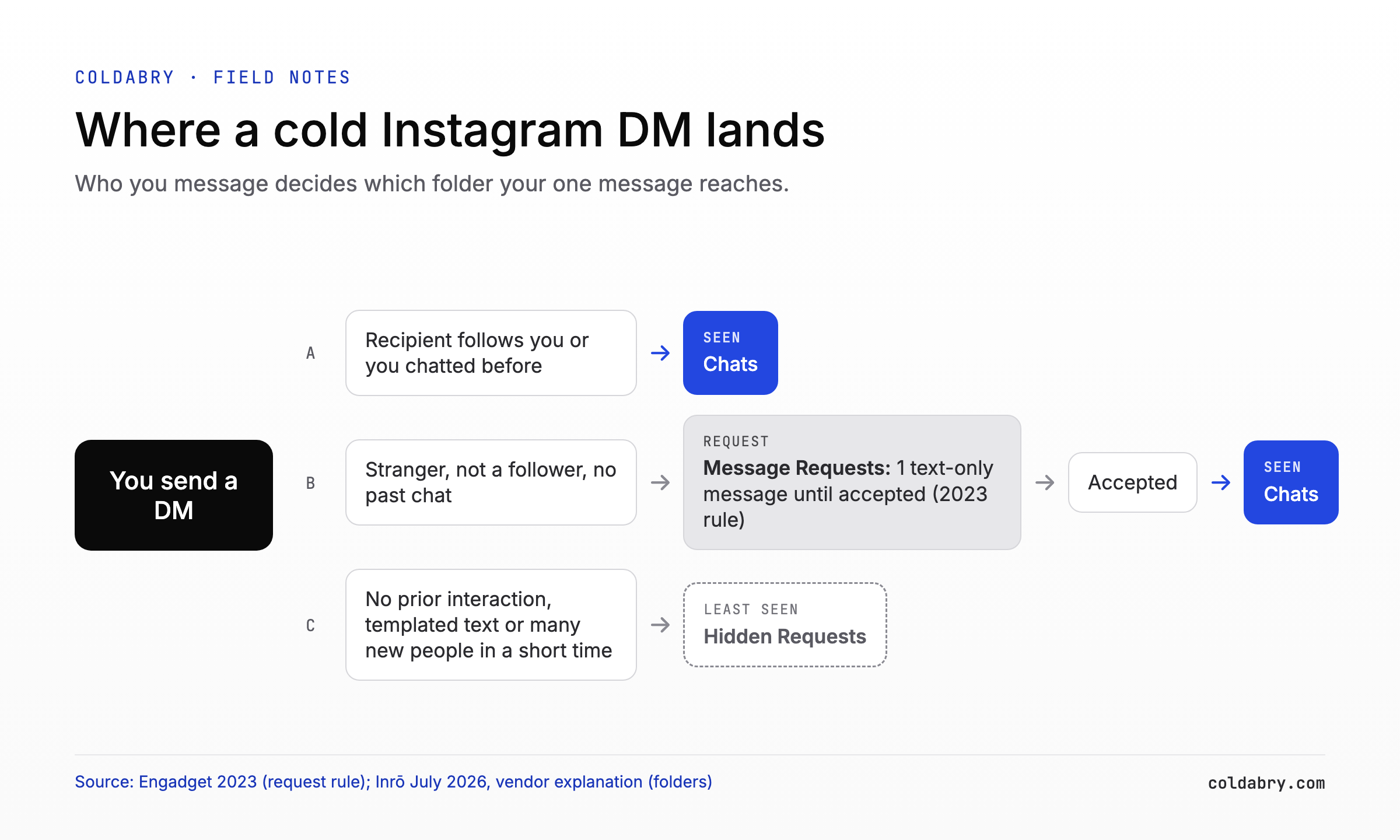
The debate starts with a platform rule most hot takes skip. In 2023 Instagram rolled out stricter DM request rules that limit senders to a single message to people who do not follow them, and the recipient must accept the request before anything more arrives. Requests are also limited to text (Engadget, August 2023).
Where that one message lands is the second filter. According to Inrō, a vendor of inbound DM automation, a DM to a non-follower goes to Message Requests, a folder "that many people never open." Templated or high-volume messages are filtered further into Hidden Requests, an even less-seen sub-folder. Inrō says messages tend to land there when there is no prior interaction, the text looks templated, or the sender is messaging many new people in a short time (Inrō, July 2026). Once a request is accepted, later messages route to Chats normally.
What this means in practice: a cold DM is a one-shot pitch with no image, no follow-up and a real chance of never being opened. Any reply rate quoted for "DMs" in general mixes this case with warm chats, which behave completely differently.
That is the mechanism. It also explains why the reply rates in the rest of this article diverge so much: they measure different folders.
Camp 1: is comment-to-DM better than cold DMs?
This camp's slogan is "cold DMs are dead, go inbound." The pitch: stop messaging strangers, post content with a keyword call to action, and let automation DM everyone who comments. The reader asked for the message, so it lands in Chats instead of Requests.
It has the biggest datasets, and Planoly's review of them is honest about the catch: "almost all of it comes from the companies selling the tools, so treat it as a strong signal, not proof" (Planoly, 2026). The numbers Planoly summarizes:
- Inrō, 798,041 conversations across 753 automations over 90 days. A link in the second message converted at 42% versus 29% when it came first. A first message under 120 characters converted at 39% versus 22% for messages over 320 characters. One button converted at 32% versus 2% with three buttons. Median conversion came 65 seconds after the trigger (Inrō guide, as summarized by Planoly).
- Creator Lane, 57,052 delivery attempts. 52,633 delivered, a 92.25% delivery rate, and 99.23% of them came from comment triggers (Creator Lane, as summarized by Planoly).
- Inrō's own averages on its warm, triggered DMs: a 90% open rate, 60% reply rate and 28% click-through rate (Inrō, vendor self-reported). This is warm traffic only, never a cold DM benchmark.
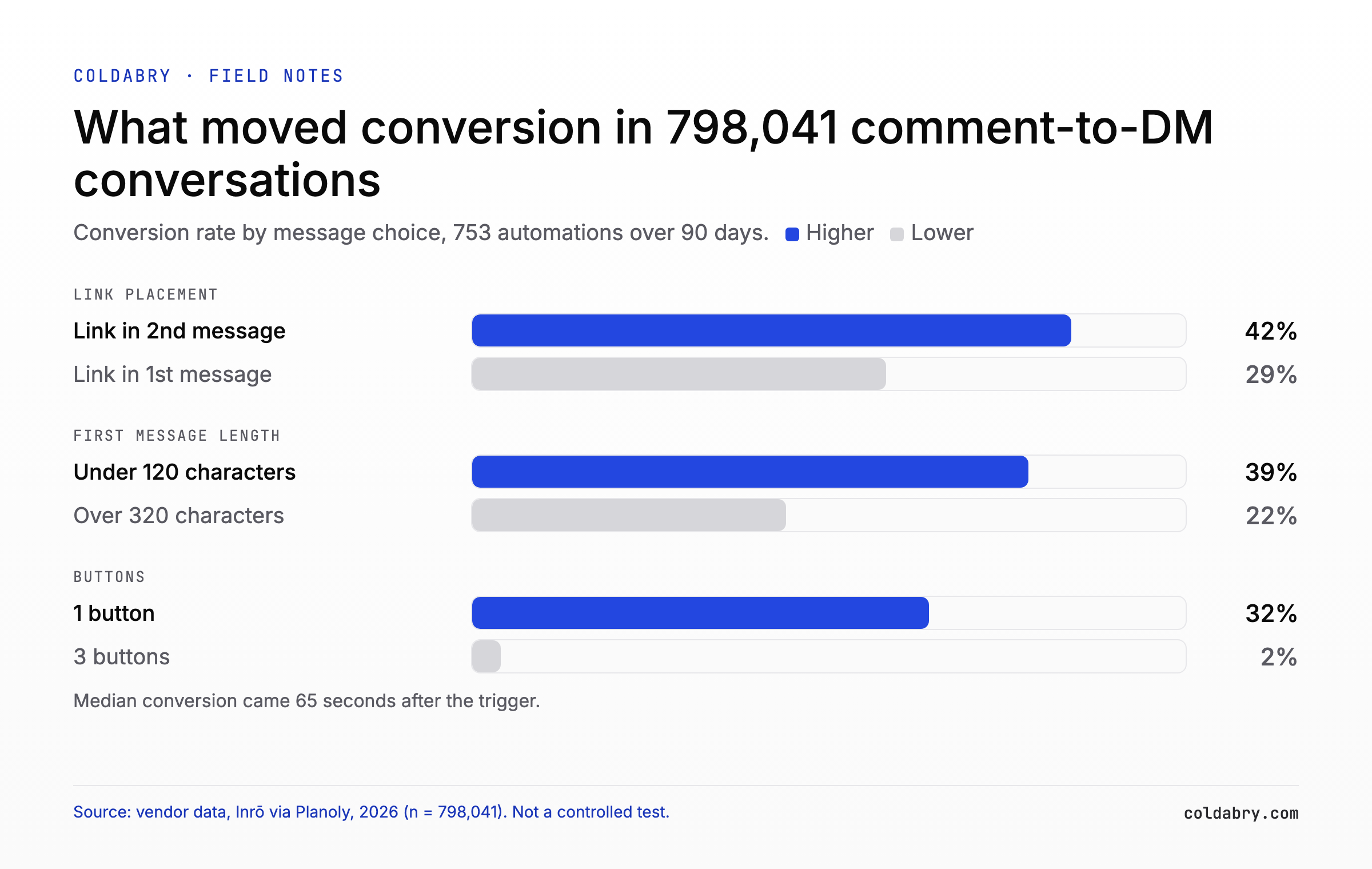
Limits of the evidence: Planoly notes the data is "not controlled," with no dataset comparing the same post with and without automation, and when asked whether independent data exists, its answer is "Not on comment-to-DM directly" (Planoly, 2026).
There is also an operational trap. In a ManyChat Community thread, a user reports that out of about 1,000 comments on a viral Reel, the automation triggered for only around 150 users. The reply from the community explains why: the automation fires only for comments made after it is switched on (ManyChat Community, user report). Inbound only works if the trigger is live before the post takes off.
Speed matters too: Inrō's median conversion came 65 seconds after the trigger, and Sprout Social's 2025 Index (as summarized by Planoly) found 73% of consumers expect a reply within 24 hours. If you are choosing a tool for this camp, our breakdown of ManyChat pricing and alternatives covers the cost side.
Camp 2: do personalized cold DMs still get replies?
This camp's slogan is "DMs print money if you personalize." It agrees that spray-and-pray is dead but argues that a researched, signal-based message still gets answered. The message references something specific (a post, a launch, a hire), asks one small question and never pastes a template.
The numbers people cite for this camp are real, but read the fine print. Prospeo, which sells email data, reports a 3.43% average cold email reply rate from Instantly and a 10.3% reply rate for social DMs from Expandi, which analyzed 70,130 campaigns (Prospeo, 2026). That Expandi figure comes from its LinkedIn outreach report for the first half of 2025 (per the report's title as linked by Prospeo), not Instagram. Both figures are as reported by Prospeo.
| Figure | Channel it measures | Publisher | What the publisher sells |
|---|---|---|---|
| 10.3% reply | LinkedIn DMs, H1 2025 | Expandi, via Prospeo | LinkedIn automation |
| 3.43% reply | Cold email | Instantly, via Prospeo | Cold email software |
| 60% reply | Warm, triggered Instagram DMs | Inrō | Inbound DM automation |
| 42% vs 29% conversion | Comment-to-DM flows on Instagram | Inrō, via Planoly | Inbound DM automation |
| None published | Cold Instagram DMs to strangers | No one we found | n/a |
The last row is the point. Nobody we found publishes a cold Instagram DM reply rate with a stated method. Prospeo itself admits the bias on both sides: "cold outreach is dead" articles come from companies selling the replacement, and "cold outreach works great" articles come from companies selling cold email tools (Prospeo, 2026).
The cost of this camp is time. Each message needs research, and on Instagram it still enters Message Requests with one text-only shot. For how message length changes replies, see how cold DM length changes reply rate, and for drafting help without sounding templated, our AI prompts for cold DMs.
Camp 3: does a DIY AI setter work or get you banned?
The third camp claims an AI "setter" can open conversations with strangers, qualify them and book calls without a human. We found no public dataset behind that claim, only creator testimony, so treat every figure you see as a claim.
The account risk, though, is concrete. Instagram does not publish a daily DM limit at all. Widely reported figures put established accounts around 50 to 100 a day, but Inrō argues the count matters less than the pattern: "there is no volume at which it becomes safe" for a stream of outbound messages to strangers (Inrō, July 2026). That is a vendor's reading, not an Instagram statement, but it matches how the request filters above work.
Risk: automating DMs to strangers breaks Instagram's terms. No tool can make bulk outbound safe, and a setter that sends templated openers to new people at volume fits every Hidden Requests trigger described above.
| Use of an AI setter | Who started the chat | Risk level |
|---|---|---|
| Answering comment-triggered or inbound DMs | The user | Lower: the user opened the conversation |
| Drafting replies a human approves | Either | Lower: human pace, human judgment |
| Bulk first messages to scraped strangers | The bot | High: breaks the terms, matches spam patterns |
Whether AI-written DMs land as well as human ones is a separate question we covered in AI vs human cold DM reply data. Meta also offers its own business assistant for inbound replies; how it compares with third-party setters is in Meta Business Agent vs AI DM setters. For what happens when accounts push the pattern too far, read about the 2026 Instagram ban wave.
Cold DM vs inbound DM: run the numbers on your own account
Because no one publishes a clean cold Instagram benchmark, the honest move is to test the claim on your own account. Below is a fill-in calculator with a worked example. Every rate marked "assumption" is ours and is there to show the arithmetic; replace it with your own numbers after a two-week test.
| Step | Cold requests | Inbound, trigger live before posting | Inbound, trigger switched on late |
|---|---|---|---|
| Starting contacts | 1,000 strangers messaged | 1,000 commenters | 1,000 commenters |
| Reached | 1,000 requests sent | 920 delivered (92%, Creator Lane rate, vendor) | 150 triggered (15%, ManyChat user report) x 92% = 138 delivered |
| Opened or seen | 300 (30%, assumption, replace with yours) | Counted as delivered (warm chat) | Counted as delivered (warm chat) |
| Replied or clicked | 300 x 10% = 30 replies (10% of opened, assumption, not the LinkedIn 10.3% figure) | 920 x 28% = about 258 clicks (28%, Inrō average, vendor) | 138 x 28% = about 39 clicks (28%, Inrō average, vendor) |
| Your numbers | ____ x ____% x ____% = ____ | ____ x ____% x ____% = ____ | ____ x ____% x ____% = ____ |
How to read the example: with these assumptions, switching the trigger on late loses about 219 of 258 clicks and leaves inbound only slightly ahead of cold (about 39 clicks versus 30 replies). Replies and clicks are not the same result, so compare them only as a rough guide. The cold column's 30 replies also hide time: researching 1,000 strangers at Camp 2 quality is weeks of work.
How to fill it in:
- Pick one offer and one two-week window.
- Cold column: send researched DMs to a fixed list (for example 50 accounts) by hand, and log how many requests were accepted and replied to.
- Inbound column: post with a keyword call to action, with the automation switched on before publishing, and log comments, delivered DMs and link clicks.
- Compare replies or clicks per hour spent, not per message.
If you would rather pay to start warm conversations, our breakdown of Click-to-DM ads versus cold DMs makes the same comparison for the paid route.
Which camp fits you: a decision checklist
Use the first row that matches your situation.
| Your situation | Pick | Why |
|---|---|---|
| You have an audience and post at least weekly | Inbound comment-to-DM | The largest datasets favor it, and the DM lands in Chats |
| You sell high-ticket to a short list, for example 50 named accounts | Manual personalization | Few messages, each researched, sent by hand |
| You have no audience yet and a short list | Manual personalization plus content | Interact with posts first so your DM has prior interaction |
| You want volume to strangers fast | None of the three: no safe option | Bulk automated first messages break Instagram's terms; use inbound or a short manual list instead |
| You already get more DMs than you can answer | AI on inbound replies | Speed matters, and the user started the chat |
Checklist before you send anything:
- The automation trigger is live before the post goes up.
- The first message is under 120 characters, with one button and the link in the second message (Inrō vendor pattern above).
- Cold messages go to a short, researched list, never a scraped bulk list.
- Each cold DM references something specific about the recipient.
- You log accepted requests, replies and clicks for two weeks before deciding.
- You know which numbers you quote are vendor-reported, and from which channel.
If you are comparing software for the outbound side, see Instagram cold DM tools compared by ban risk. For the inbound side, the realistic options are off-the-shelf flow builders or custom AI automation for inbound DM flows, and once volume grows, AI agents that qualify inbound replies before a human steps in.
Coldabry builds custom inbound DM and reply-handling automation that creators and companies own outright.
FAQ
Do cold DMs still work on Instagram in 2026?
They work in a narrow form. Since 2023, a DM to someone who does not follow you is limited to one text-only message until they accept the request (Engadget), and it lands in Message Requests, which many people never open. A short, researched message to a small list can still get replies. Mass templated outreach mostly lands unseen and risks your account. No one we found publishes a reliable cold Instagram reply rate, so test on your own account before trusting a creator's number.
How many cold DMs can you send per day on Instagram?
Instagram does not publish a daily DM limit. Widely reported figures put established accounts at roughly 50 to 100 messages a day, but that number varies by account and is not official (Inrō, July 2026). Inrō, a vendor, argues the pattern matters more than the count: a steady stream of outbound messages to strangers reads as spam at any volume. Sending fewer, personal messages to people you have interacted with is the lower-risk approach.
Why do my DMs go to message requests or hidden requests?
A DM to someone who does not follow you goes to Message Requests until they accept it. According to Inrō, a vendor of DM automation, messages are filtered further into Hidden Requests when there is no prior interaction, the text looks templated, or you are messaging many new people in a short time (Inrō, July 2026). Interacting with someone's posts first, writing a specific message and keeping volume low all reduce the chance of landing there.
Is comment-to-DM automation better than cold outreach?
On the available data, comment-to-DM performs better, because the person asked for the message and it lands in Chats. Creator Lane reports 92.25% delivery on 57,052 attempts, and Inrō reports conversion patterns across 798,041 conversations, as summarized by Planoly. Both are vendors and neither ran a controlled test. The approach also needs an audience that comments, and the trigger must be live before the post spreads, or older comments get no DM.
Can an AI DM setter get my account banned?
Yes, if it sends first messages to strangers. Automating DMs to people who did not contact you breaks Instagram's terms, and templated openers at volume match the patterns that push messages into Hidden Requests or trigger blocks. No tool can make bulk outbound safe. Using AI to reply to inbound or comment-triggered messages, or drafting replies a human approves, carries less risk because the user started the conversation.