Mobile Proxy vs Residential Proxy: Which One for Social Media?
Mobile or residential proxies for social media accounts? How CGNAT and sticky sessions work, 2026 prices per account, the NetNut takedown, and a decision table.

A typical case: an agency runs ten social accounts, its own and its clients', through one mobile proxy, because a dedicated line per account costs more than most of them earn. Replies slow, logins ask for codes, and the founder must choose between ten mobile lines and residential IPs.
In a mobile proxy vs residential proxy comparison, the core difference is the network behind the IP. Mobile IPs come from carrier networks where, as Cloudflare puts it, "a single IPv4 address may represent hundreds or even thousands of users." Residential IPs map to home connections and are far cheaper to hold as a dedicated IP: $2.90 a month at Decodo against $130 or more for a dedicated mobile line at IPRoyal. They are also easier to keep fixed: up to 7 days on a pooled plan, or for as long as you pay on a static one. For logged-in social accounts, the type matters less than whether each account keeps one stable, geo-matched proxy that no other account uses.
The practical answer: default to a dedicated static residential IP per account, and pay for dedicated mobile only for high-value accounts, for creating and warming TikTok and Instagram accounts, or where several accounts must share an IP. Buy only from providers that can show how their IPs are sourced: in 2026 Google moved against two of the largest residential networks (Google, January; Google, July). And no proxy makes automation compliant: Instagram's terms ban creating accounts or collecting information "in an automated way without our express permission."
What is a mobile proxy, and how is it different from a residential IP?
A residential proxy routes your traffic through an IP a home broadband provider assigned. In commercial pools, the exit is usually a consumer device running the provider's software; Decodo says rotating residential proxies "draw from a peer-to-peer network and change IPs per request" (Decodo). A static residential (ISP) proxy is an ISP-registered IP hosted with "datacenter-grade speed and uptime" and kept fixed for one buyer (same page).
A mobile proxy routes traffic through a 3G, 4G or 5G carrier IP. Carriers put many subscribers behind one public address with carrier-grade NAT (CGNAT), which Cloudflare calls "common in mobile networks." The carrier side uses the shared range 100.64.0.0/10, reserved in RFC 6598 in 2012.
That sharing is the sales pitch for mobile: blocking one carrier IP risks blocking every real customer behind it.
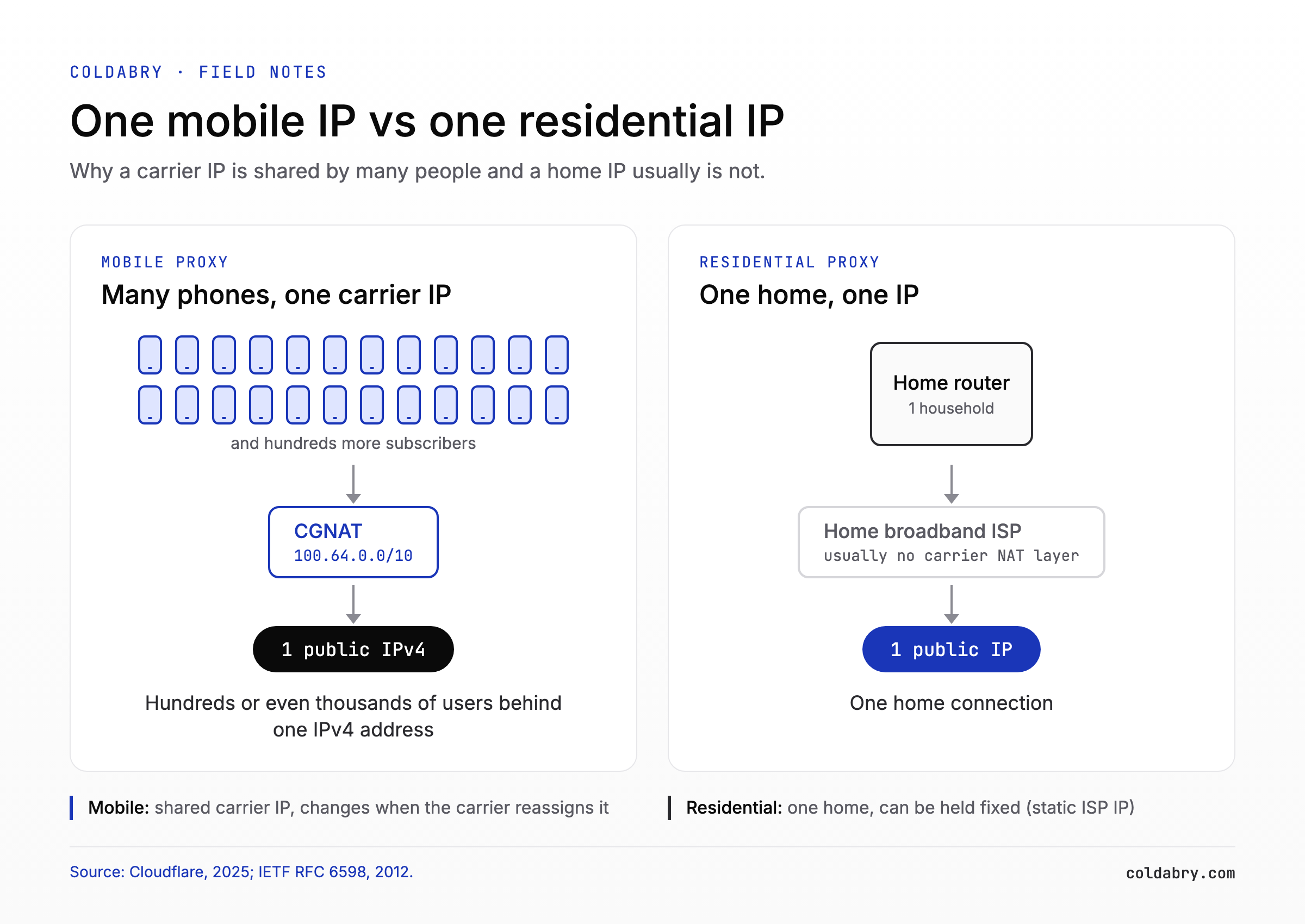
In plain words: an ASN (autonomous system number) is the network an IP belongs to: a mobile carrier, a home broadband provider or a hosting company. Anyone can look it up, so it is the first clue to an account's connection type.
Mobile proxy vs residential proxy: what actually differs
The labels hide six practical questions, one per row.
| Factor | Mobile | Residential (pooled) | Static residential (ISP) |
|---|---|---|---|
| Source of the IP | Carrier network, shared through CGNAT | Home broadband, via a peer-to-peer device network | ISP-registered IP in a datacenter |
| Who else uses it | Many subscribers, plus other buyers if pooled | The device owner and other pool buyers | Only you, if dedicated |
| Holding one IP | Dedicated: one reserved phone and SIM; its IP can still change (IPRoyal: "Auto-rotation and instant IP change"). Pooled: sticky "for a configurable duration" (Decodo) | Sticky sessions of minutes to days (see next section) | Fixed while you pay |
| Speed | "Slower than residential proxies in some cases because of cellular network speeds" (Oxylabs) | Depends on the peer device's home line | "Datacenter-grade speed and uptime" (Decodo) |
| Billing | Per GB, or per line per day or month | Per GB | Per IP per month |
| Failure mode | You inherit everyone's behavior (see rate-limiting below) | Session ends and the account appears on a new IP; the pool can be taken down | If the one address goes bad, every session carries it |
Read across the rows and the session model beats the type: a residential IP held for months is closer to a dedicated mobile line than to a pooled session that changes every 30 minutes. For an Instagram-only deep dive, including datacenter IPs, see the proxy buyer's guide on instaoutreach.com.
Sticky or rotating: which proxy session do social media accounts need?
Rotating proxies hand out a new IP per request: fine for public data, but a logged-in account on one looks like a person appearing from many places within minutes.
Sticky windows vary by provider: 30 minutes at Decodo, up to 120 minutes at Databay, up to 7 days at IPRoyal. An account needs the same IP for weeks or months. Only a static residential IP keeps one address by design; a dedicated mobile line keeps one phone and carrier, but its IP can change inside the carrier's pool.
Whatever the type, geo-match the IP to the account's language, phone number and timezone. An account should never answer from a second country.
Rule of thumb: one account, one proxy (one static IP or one mobile line), one country, for as long as the account lives. Rotation is for scraping, not for logins.
How much do mobile and residential proxies cost in 2026?
Prices from each provider's pricing page, checked October 9, 2026; where a promotion ran, both list and promotional prices are given. Prices change.
| Provider | Type | Listed price |
|---|---|---|
| Decodo | Residential, pooled | $3.75/GB (3 GB), $3.50/GB (10 GB, $35/mo) to $2.75/GB (100 GB); pay as you go $4/GB (source) |
| Decodo | Mobile, pooled | List $7.50 to $5.50/GB, shown at $3.75 to $2.75/GB with 50% off; pay as you go $4/GB (list $8/GB) (source) |
| Decodo | Static residential, dedicated | $3.33/IP (3 IPs), $2.90/IP (10 IPs, $29/mo) to $2.60/IP (100 IPs) per month (source) |
| IPRoyal | Residential, pooled | $7.00/GB (1 GB) to $5.25/GB (10 GB) (source) |
| IPRoyal | Mobile, pooled | $6.80/GB (2 GB), $6.00/GB (10 GB) to $5.20/GB (100 GB) (source) |
| IPRoyal | Mobile, dedicated line | From $10.11/day; from $130/month (30 days), $117/month (90 days) (source) |
| Oxylabs | Residential, pooled | $6/GB (up to 5 GB) to $2.50/GB (1,000+ GB) (source) |
| Bright Data | Mobile, pooled | Pay as you go: list $8/GB, $4/GB with the coupon shown (source) |
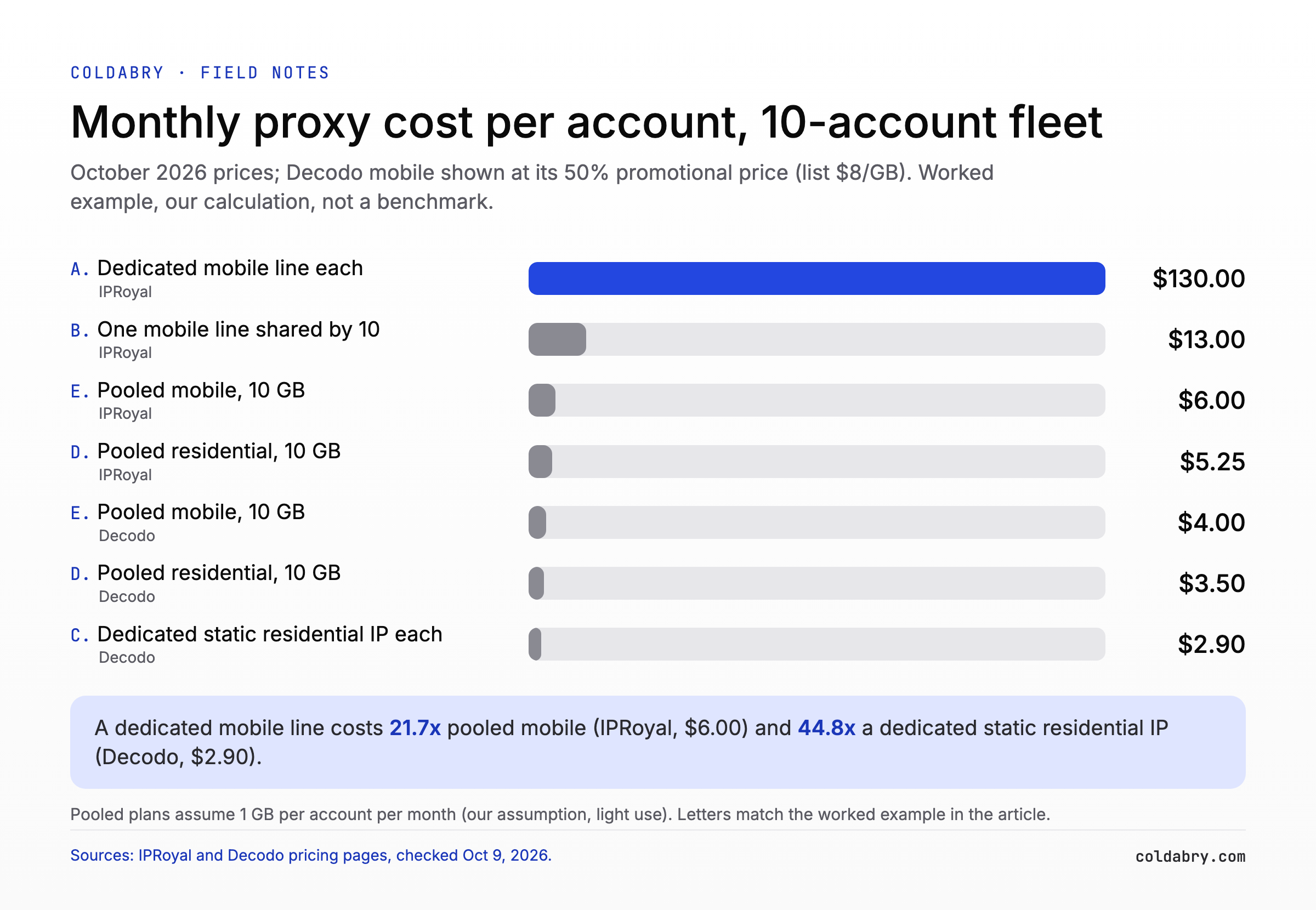
Worked example (our calculation, not a benchmark): ten accounts, one month. Pooled plans assume 1 GB per account per month, light use for logins, posting and messaging; video-heavy use can be many times more.
- A. Dedicated mobile line per account: 10 x $130 = $1,300, so $130 per account (IPRoyal).
- B. One mobile line shared by all ten: $130 / 10 = $13 per account.
- C. Dedicated static residential IP each: Decodo's 10-IP plan, $29, so $2.90 per account (Decodo).
- D. Pooled residential, 10 GB: Decodo's 10 GB plan at $3.50/GB = $35, so $3.50 per account; IPRoyal 10 x $5.25 = $52.50, so $5.25.
- E. Pooled mobile, 10 GB: Decodo pay-as-you-go at its current 50% discount, 10 x $4 = $40 (list price $80), so $4 per account; IPRoyal 10 x $6.00 (10 GB tier) = $60, so $6.
Here pooled mobile costs under a dollar per account more than pooled residential at the same provider. The jump is to a dedicated mobile line: about 22 times IPRoyal's pooled mobile ($130 / $6) and about 45 times a static residential IP ($130 / $2.90). Whether that premium earns its keep is the same test as any automation that pays back: what one account earns per month.
How many social media accounts can you run on one mobile proxy?
No platform publishes an accounts-per-IP limit, so any "safe number" online is a guess.
Meta's Account Integrity standard lets it restrict accounts that show "close linkage with a network of accounts or other entities that violate or evade our policies." Meta does not say how it draws that linkage, but a shared IP is the simplest link, and a shared browser profile, device, phone number or recovery email links accounts just as easily. Keep all of them separate per account. If an account is already restricted, start with how to appeal an Instagram suspension.
CGNAT also cuts both ways. In Cloudflare's data, CGNAT IPs are rate-limited "three times more often than non-CGNAT IPs," even when bot scores point to human users (Cloudflare; The Register's write-up). So a carrier IP buys tolerance against outright blocks, not immunity: expect more slowdowns and checks, another reason to rent a dedicated line rather than a pooled one.
One operator's report (claim, not data): in a January 2025 post on r/agency, an anonymous operator said they ran 10 Instagram accounts on one mobile IP, sending 500 DMs a day manually from a phone. Replies held near 25% for three months, then fell to 1% (they blamed hidden requests); fresh test accounts got about 15%. Volume, account age and content also changed, so the IP is not isolated as the cause.
Our recommendation, an opinion rather than a measured rule: one account per IP by default. If budget forces sharing a dedicated mobile line, keep it to one brand, never mix clients, and stagger activity. Per-account proxies are also a dividing line in our comparison of Instagram cold DM tools by ban risk.
Are residential proxies safe after the IPIDEA and NetNut takedowns?
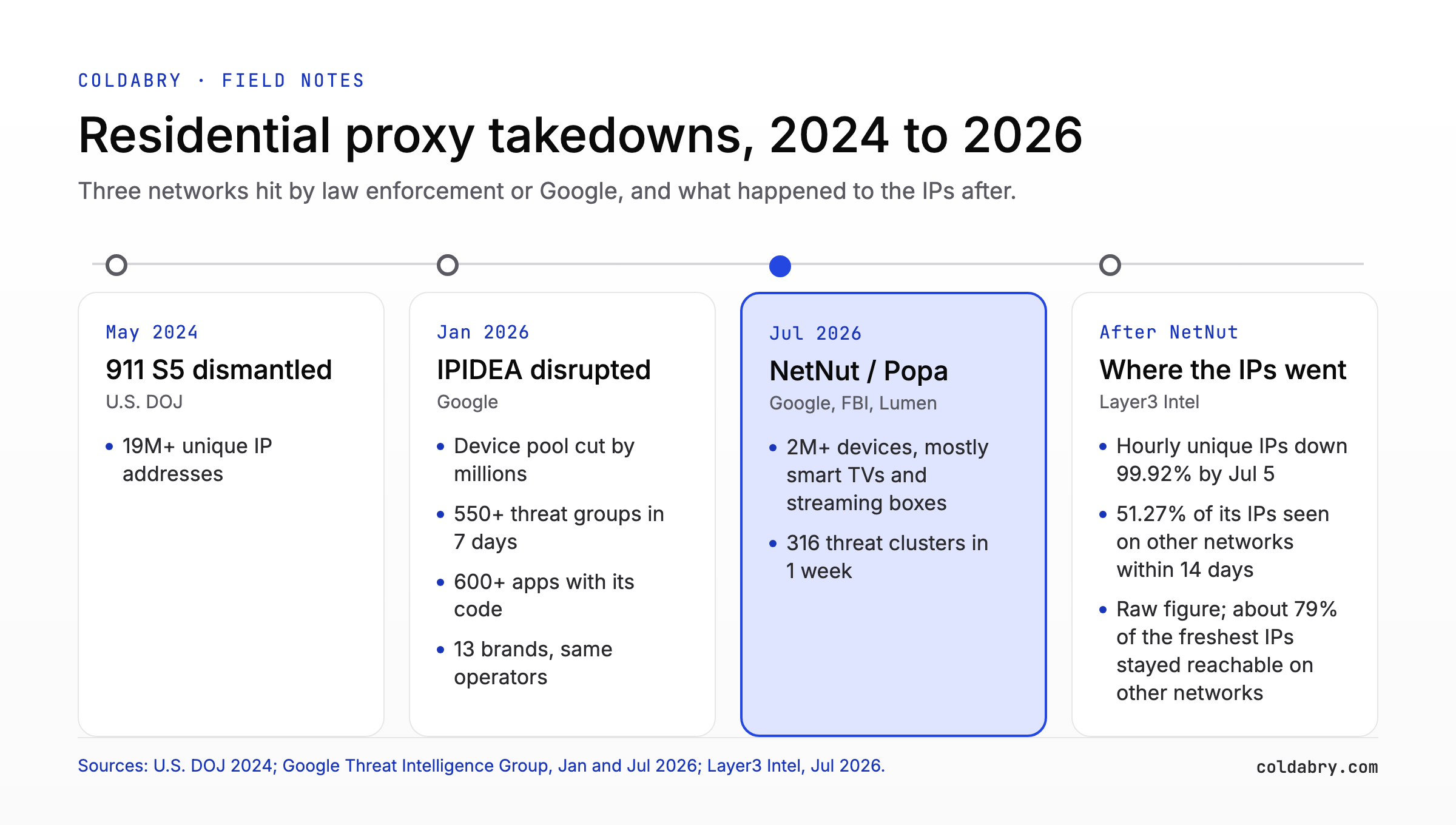
Three takedowns in two years have turned sourcing from an ethics footnote into an operational risk:
- May 2024: the DOJ dismantled 911 S5, a botnet of infected residential Windows computers tied to "more than 19 million unique IP addresses."
- January 28, 2026: Google disrupted IPIDEA, cutting its device pool "by millions." In one week it saw over 550 threat groups using its exit nodes; it also found over 600 apps carrying its code and 13 proxy and VPN brands run by the same actors.
- July 2, 2026: Google, the FBI, Lumen and others moved against NetNut and the Popa botnet behind it, estimated at "at least 2 million devices," mostly smart TVs and streaming boxes, with 316 threat clusters seen in one June week (The Register, The Hacker News). The FBI seized hundreds of its domains (KrebsOnSecurity). These are allegations, not court findings.
- July 2 to 5, 2026: Layer3 Intel measured NetNut's hourly unique IPs falling 99.92%; 51.27% of its IPs from the prior 30 days reappeared elsewhere within 14 days. Layer3 calls that raw figure misleading: older IPs drop out through normal churn anyway, and about 79% of the freshest IPs stayed reachable on competing networks.
What it means for client accounts (our analysis):
- The brand on your invoice may not be the network. Google has "high confidence that many popular residential proxy brands are in fact whitelabeling the NetNut botnet."
- A pool can vanish in days, taking every sticky session with it. Plan how you would move accounts.
- Abused IPs carry other people's history. Device owners "can have their legitimate traffic flagged as suspicious," Google writes, and your account rides the same IP.
- The owner often never agreed. Google says "ethical sourcing" claims "must be backed by transparent, auditable proof of user consent."
Mobile is not automatically cleaner: NetNut itself sold "mobile and datacenter proxies" (The Register). A line you rent alone avoids the shared pool, not the sourcing question.
In practice, "ethically sourced" means a vendor can answer these six questions before you buy.
| Question | Good answer | Red flag |
|---|---|---|
| How are your IPs sourced? | Named app or SDK, consent screen you can see | "Ethically sourced," no proof (Google) |
| Own network or resold? | Own, or a named upstream | Vague; white-label risk (Google) |
| Can I keep one IP or one line, in one country, for weeks? | Yes: a static IP, or a dedicated line that never leaves its country | Only 30-minute sticky sessions |
| Country, carrier or ISP, and ASN per exit? | Shown before you buy | "Random pool" |
| What if your upstream is taken down? | Written replacement policy | No answer (Layer3) |
| Do you pay people for "unused bandwidth"? | Disclosed, consented program | Hidden bandwidth-sharing SDKs |
Which proxy should you use for each social media job?
Match the proxy to the job, not to the account count. Each pick below assumes one account per IP.
| Job | Pick | Why |
|---|---|---|
| Creating and warming Instagram or TikTok accounts | Dedicated mobile line, one per account, budget allowing | Our recommendation: blocking one CGNAT carrier IP can "block or throttle large groups of users" (Cloudflare), so IP-only blocks cost the platform; a dedicated line is a phone and SIM reserved for you alone (IPRoyal) |
| High-value client account | Dedicated mobile or static residential, never pooled | Pools can drain in days (Layer3) |
| Outreach fleet of 5 to 20 accounts on a budget | Dedicated static residential IP each | $2.90 vs $130+ per account per month (Decodo, IPRoyal) |
| Test accounts you can afford to lose | Pooled, longest sticky window | Per-GB pricing (Decodo) |
| Public-data research | Pooled residential, rotating | Fits stateless requests, but terms restrict scraping (below) |
| Your own login; a proxy does not help | One account per person, real name (LinkedIn); see LinkedIn's weekly connection limit | |
| Any of the above | Vendors that pass the checklist | Sourcing claims "often incorrect or overstated" (Google) |
Is multi-account automation allowed if you use proxies?
A proxy changes the IP the platform sees, not the rules. Automating multiple accounts breaks Instagram's terms on any IP.
| Platform | What its own terms say |
|---|---|
| No "creating accounts or accessing or collecting information in an automated way without our express permission" (Terms of Use) | |
| Meta (Facebook, Instagram) | May restrict accounts with "close linkage with a network of accounts" that break its policies (Account Integrity) |
| TikTok | No "inauthentic commercial behaviors, such as by operating spam or impersonation accounts" (Terms, 3.4) |
| "You will only have one LinkedIn account, which must be in your real name"; no bots (User Agreement, 2.1 and 8.2) |
Renting lines versus running your own modems (a 'mobile proxy farm': SIM cards in 4G/5G modems you host yourself) is a build vs buy decision: rent until owning the hardware is cheaper and easier to audit. When we built InstaOutreach, we gave every account one sticky proxy and one fixed device fingerprint, and the engine measures what each proxy really is from its exit IP instead of trusting its label.
FAQ
Are mobile proxies better than residential proxies for Instagram?
Mobile proxies are the better pick for creating and warming Instagram accounts, in our view, but not always needed for established ones. Carrier IPs are shared by many real users through CGNAT, so blocking one can "block or throttle large groups of users" (Cloudflare).
For an established account, a dedicated residential IP is often enough at a fraction of the cost: $2.90 a month at Decodo against $130 or more for a dedicated mobile line at IPRoyal. The same Cloudflare research found shared carrier IPs are rate-limited three times more often on its network. Instagram's terms ban automated account creation either way.
Can I use residential proxies for TikTok or Instagram accounts?
Yes, if the IP stays fixed and sits in the account's country. Use a dedicated static residential IP, or the longest sticky session your provider offers: 30 minutes at Decodo, up to 7 days at IPRoyal.
Avoid per-request rotation, which makes one logged-in account appear in many places. Check how the provider sources its IPs first, given the 2026 IPIDEA and NetNut takedowns.
How many accounts can I run on one mobile proxy?
No platform publishes a limit, so any number online is a guess. Meta can restrict accounts showing "close linkage with a network of accounts" that break its rules (Meta), and a shared IP is an easy link to draw.
One anonymous operator reported a reply-rate collapse with 10 Instagram accounts on one mobile IP, a single claim rather than a measured effect. Default to one account per IP. If you must share, keep it to one brand and never mix clients.
Should I mix mobile and residential proxies on one account?
No, not on one account. An account that logs in through a carrier IP one day and a home broadband IP the next looks like it keeps switching networks.
Keep one type per account for its whole life. Mixing types across a fleet is fine, for example mobile lines for accounts still warming and static residential IPs for established ones. Geo-match every IP to its account's country.
Why are mobile proxies so expensive?
A dedicated mobile proxy is a carrier line rented to you alone and priced per line: from $130 a month on a 30-day term at IPRoyal. Pooled mobile billed per GB is now close to residential: at Decodo, both pooled mobile (with its current 50% discount) and pooled residential run from $3.75 to $2.75 per GB on monthly plans. The premium pays for exclusivity (nobody else on the line), not for the word "mobile."
Are residential proxies legal?
Using a proxy is generally legal, and residential proxy networks "are not illegal, although they are often abused for cybercrime," The Register reported. The risk sits in sourcing: Google found many apps enrolled devices into the IPIDEA network without disclosing it, and the FBI seized NetNut's domains in July 2026. Those are allegations, not court rulings. This is not legal advice, and platform terms still apply.