How Coaches Get Clients on Instagram: Cost per Client
Coaches get clients on Instagram through content, DMs and ads. Here is what each channel costs per signed client, with worked math and the Meta rules.
For most coaches, warm DMs (people who commented, replied to a Story or messaged first) produce the cheapest signed clients, content is what creates those warm DMs, and paid ads are the only channel that scales on demand, at roughly $28 to $53 per lead before a single call is booked. That is the short answer to how coaches get clients on Instagram if you sell 1:1 or group coaching through a sales call. The caveat: your own hours are the hidden cost of content and DMs, and automating cold DMs breaks Instagram's terms.
Below we put all four routes (organic content, warm DMs, cold DMs, ads) on one scale: cost per signed client. Every ad number comes from an independent benchmark; every funnel rate is an assumption we state and you can replace with your own. The calculator at the end does the arithmetic for you.
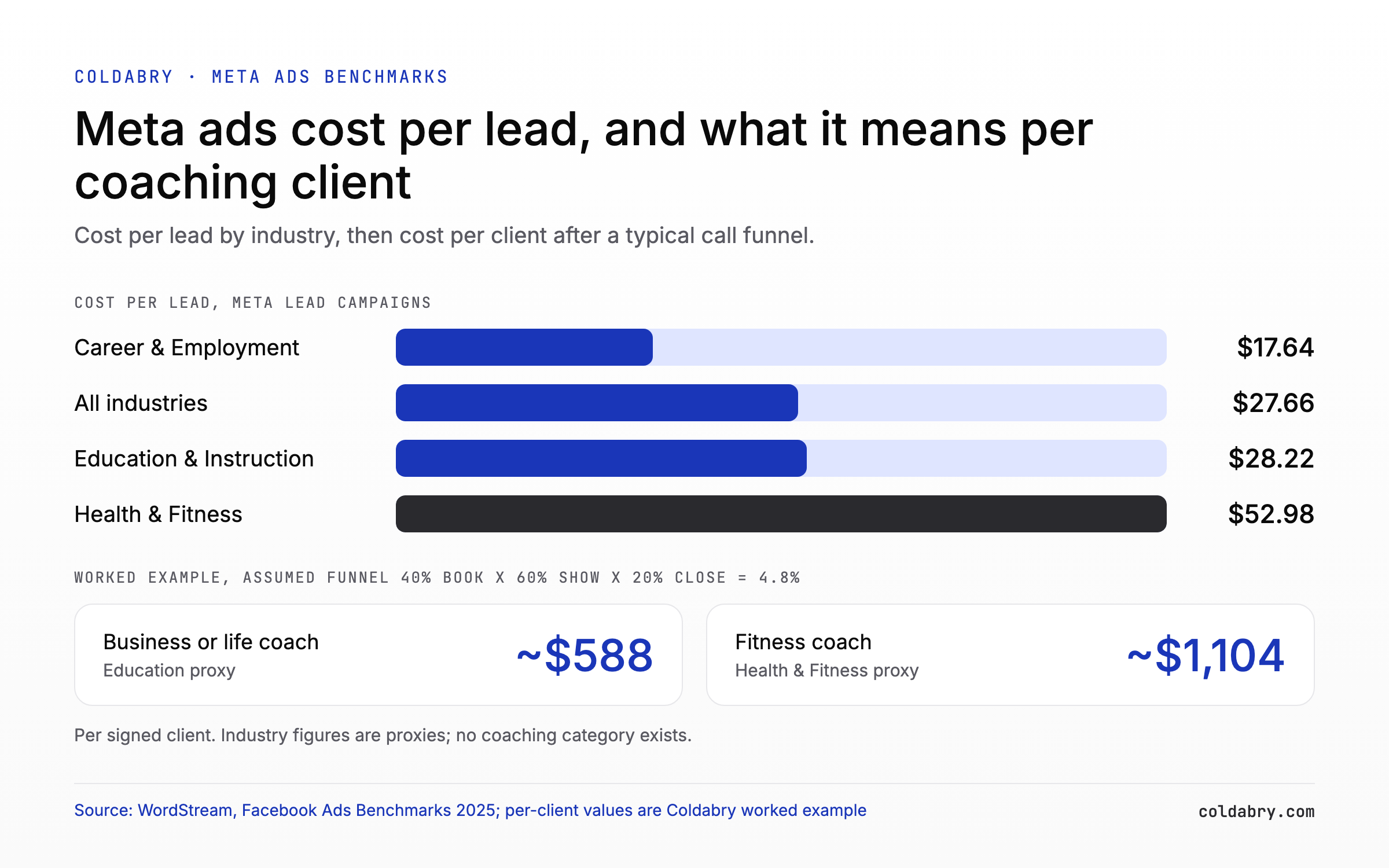
How coaches get clients on Instagram: three channels, one funnel
Most top-ranking guides on this question are written by DM automation vendors, and they end in the same place: automate your DMs. Coachway puts the core problem well: coaches collect likes and then wonder why followers never become clients, because the funnel is missing, not the likes.
The funnel is short and the same for every coach:
- Content creates attention. Reels, carousels and Stories get people to notice you and decide you know your topic.
- DMs convert attention into conversations. A comment trigger, a Story reply or a direct question turns a viewer into a lead you can talk to.
- The call converts the conversation into a client. Almost every coaching sale above a few hundred dollars still closes on a call.
- Ads buy attention when content is slow. A click-to-Direct ad drops a stranger straight into your DMs, skipping the months it takes content to build trust.
Two DM types matter. A warm DM is one the prospect started or invited: they commented a keyword, replied to a Story or messaged you. A cold DM is one you send to someone who never interacted with you. They look the same in the inbox, but they cost and convert very differently, which is why we price them separately below.
What does a coaching client cost from Instagram ads?
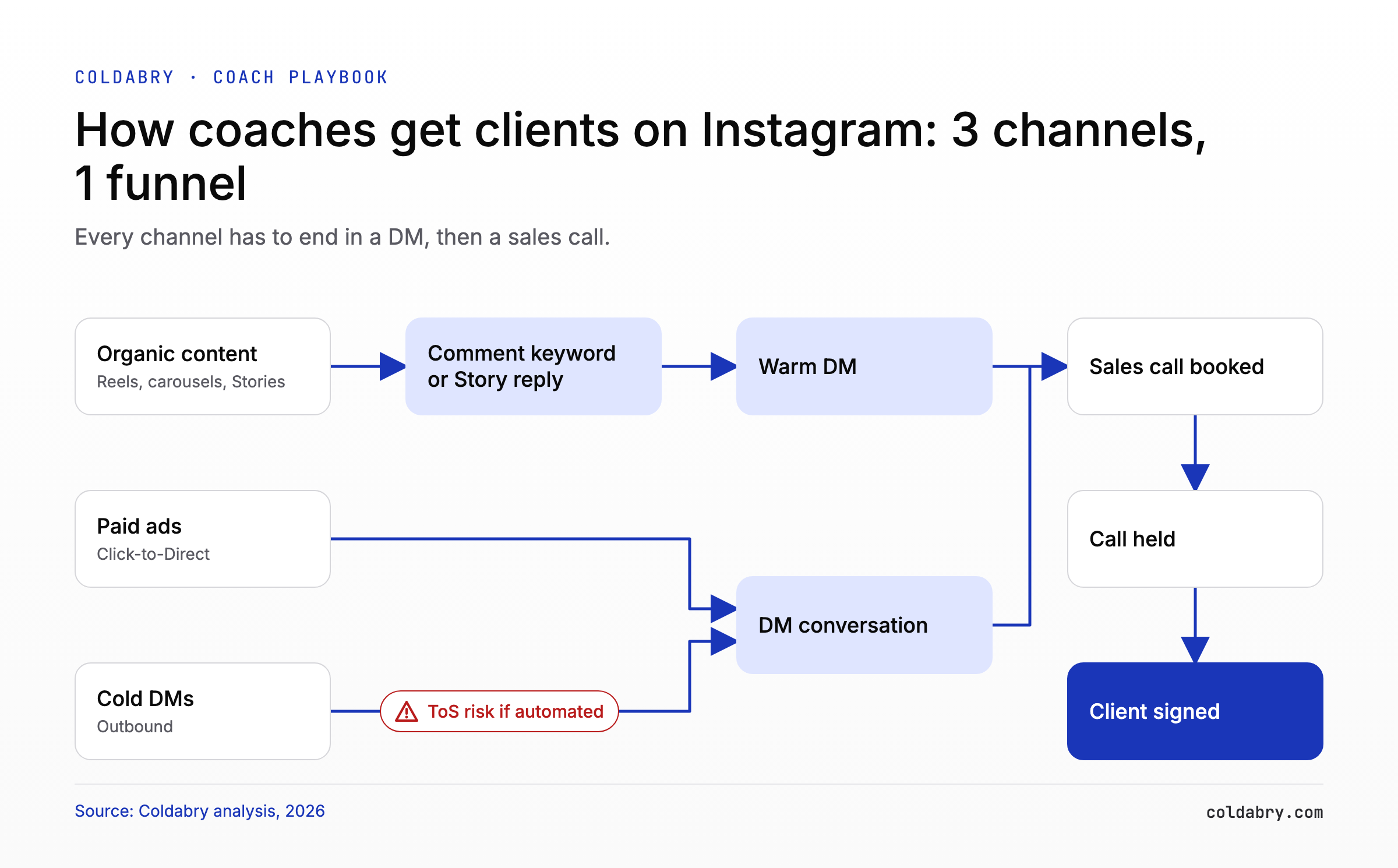
There is no "coaching" category in the main public benchmark, so we use the closest proxies. WordStream's 2025 Facebook ads benchmarks, built from more than 1,000 campaigns, report these lead costs for leads campaigns:
- All industries: $27.66 per lead, up from $22.87 the year before.
- Education & Instruction (our proxy for business and life coaches): $28.22.
- Health & Fitness (proxy for fitness and nutrition coaches): $52.98, one of the three most expensive industries in the report.
- Career & Employment (proxy for career coaches): $17.64.
A lead is not a client. To get from one to the other you need a funnel, so here is ours.
Example, assumed rates: 40% of leads book a call, 60% of booked calls show up, 20% of held calls sign. That is 0.40 x 0.60 x 0.20 = 4.8% lead-to-client, or about 20.8 leads per client (1 / 0.048).
- Business or life coach: $28.22 x 20.83 = about $588 per client.
- Fitness coach: $52.98 x 20.83 = about $1,104 per client.
- Career coach: $17.64 x 20.83 = about $368 per client.
Change any rate and the result moves a lot. If your close rate is 30% instead of 20%, the business coach figure drops to about $392. If only 30% of leads book, it rises to about $784. The useful point is not the exact figure but the order of magnitude: ad-sourced coaching clients typically cost hundreds of dollars, so a program priced under that does not survive paid acquisition.
What does organic content cost per client?
Content looks free because you do not pay Meta for it. It is paid for in hours. The honest way to price it is hours per month multiplied by what an hour of your time is worth.
Example, assumed rates: you publish 4 Reels a week, which matches the 3 to 5 Reels a week that SetSmart recommends (vendor guidance, not a measured benchmark). Each Reel takes 2 hours from idea to posting. That is 8 hours a week, or about 34.7 hours a month (8 x 52 / 12). At $50 an hour, content costs about $1,733 a month.
What that means per client depends entirely on how many clients the content produces:
| Clients per month from content | Monthly content cost (example) | Cost per client |
|---|---|---|
| 1 | $1,733 | $1,733 |
| 2 | $1,733 | $867 |
| 3 | $1,733 | $578 |
| 5 | $1,733 | $347 |
Two things follow. First, in the early months, when content produces zero or one client, it is the most expensive channel on this page. Second, content gets cheaper the moment it reliably triggers conversations, because its real job is not to sell. Its job is to feed warm DMs. A Reel that ends with "comment PLAN and I'll send you the checklist" is doing acquisition work; a Reel that ends with nothing is doing brand work, which is fine, just slower.
Are warm DMs the cheapest way for coaches to get clients?
Usually, yes. The prospect already raised their hand, so you skip the most expensive step of every other channel: getting attention.
The two common warm entry points are the comment-to-DM flow (someone comments a keyword, you send them a DM) and Story replies. The only conversion data published on these comes from vendors measuring their own customer accounts, so treat it as directional. Inrō reports (vendor-reported, on its own accounts) that the first message in a comment-to-DM flow is clicked 40 to 70% of the time, against 0.5 to 2% for link-in-bio traffic from the same post, and that those warm leads convert to customers at about 5 to 8%, against roughly 0.5% for a passive link in bio. SetSmart reports (vendor-reported, its own analysis) that a single follow-up message more than doubles qualification (+112%).
Example, assumed rates: 30 warm conversations a month, 50% book a call, 70% show, 30% close. That is 30 x 0.50 x 0.70 x 0.30 = about 3.2 clients. If handling those conversations takes 10 hours a month at $50 an hour, DM time costs $500, or about $159 per client. Add the content that created those conversations and the full cost is higher, which is why content and warm DMs should be judged together.
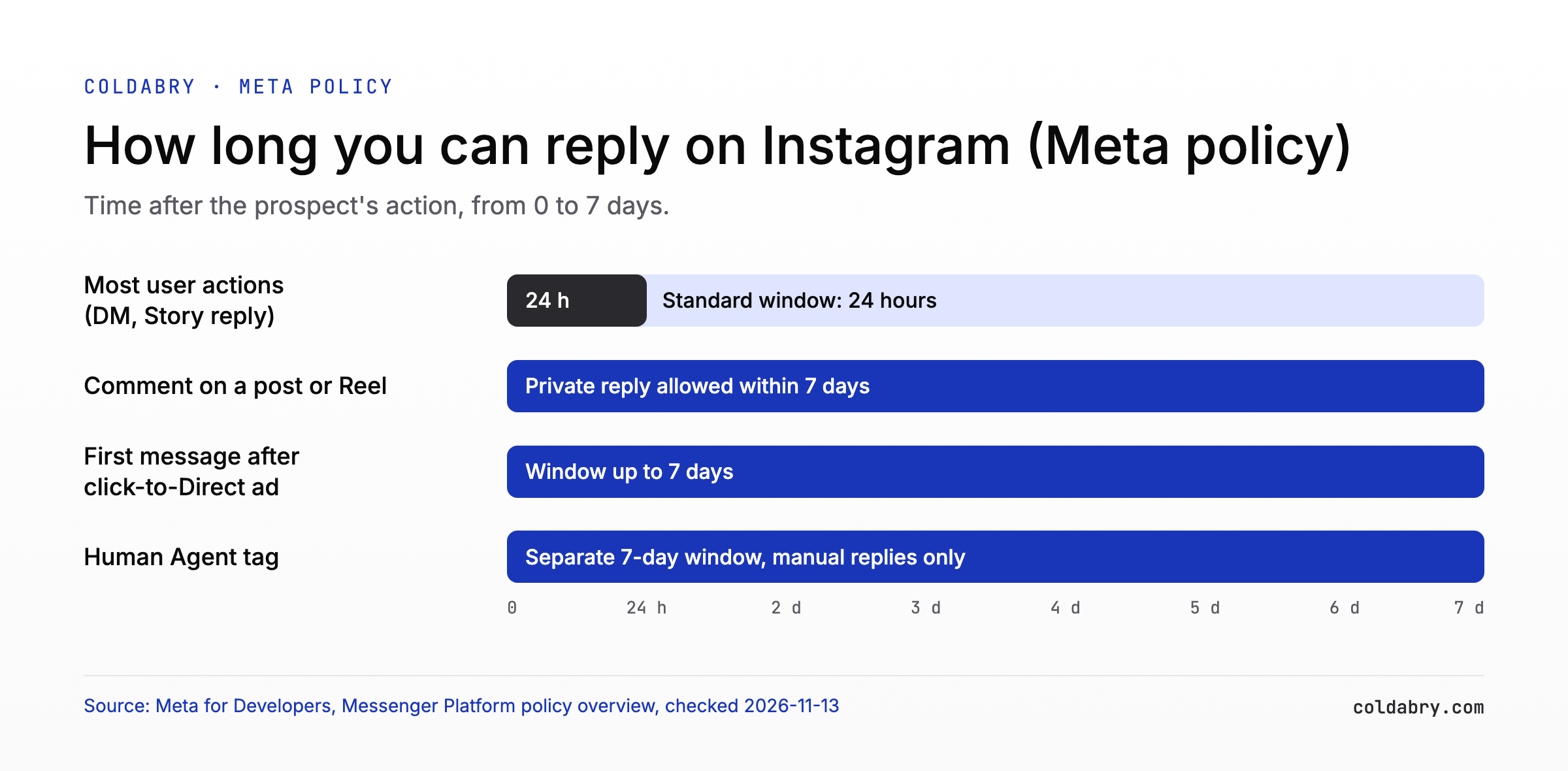
Timing is set by Meta, not by you. According to the Meta Messenger Platform policy (checked 2026-11-13, our paraphrase), businesses can reply within a standard window of 24 hours after most user actions. Private replies to a comment are currently allowed within seven days of that comment. A Human Agent tag gives a separate 7-day window for manual replies by a person. If you reply to Story replies two days late, a tool may not be allowed to send that message at all.
If you want the path from DM reply to booked call to run without you, we covered automating the path from DM reply to booked call step by step, and AI agents that qualify DM leads are one way to cover the 24-hour window when you are on calls all day.
Do cold DMs still work for coaches?
On paper, cold DMs look competitive. In practice the cost that matters most is not on the spreadsheet.
Example, assumed rates: you send 40 cold DMs a day, 22 working days a month, so 880 messages. 3% book a call (about 26 calls), 60% show (about 16), 20% close (about 3.2 clients). Sending, personalizing and following up takes 1.5 hours a day, 33 hours a month, which at $50 an hour is $1,650. Divided by 3.2 clients, that is about $521 per client, close to the ad-sourced business coach figure.
The catch is volume and risk. Done by hand, 40 a day is a ceiling for most solo coaches, so cold DMs do not scale with money. Done by automation, they break Instagram's terms, and accounts get restricted. We looked at whether cold DMs still work in 2026 and at the 2026 Instagram ban wave in detail; the short version is that a coach's account is also their storefront, so the downside of a restriction is far larger than one month of leads.
Note: Automating cold DMs to strangers breaks Instagram's terms of use and can get your account restricted or removed. No tool can promise a safe sending volume. If you test cold outreach at all, keep it manual, personal and small, and never risk the account that holds your audience.
Instagram DMs vs content vs ads: which is cheapest per client?
Here are the four channels on one scale. Every cost per client is from the worked examples above, with the same $50 an hour and the same kind of call funnel. Replace them with your own numbers before deciding.
| Channel | Main cost | Example cost per client | Speed to first client | Scales with money? | Main risk |
|---|---|---|---|---|---|
| Warm DMs (comments, Story replies) | Your time in the inbox | About $159 (DM time only) | Fast, once content triggers them | No, limited by content reach | Missing the 24-hour window |
| Organic content | Your time making it | $347 to $1,733 (1 to 5 clients a month) | Slow, usually months | Partly, via editing help | Posting without a DM trigger |
| Cold DMs (manual) | Your time sending | About $521 | Fast | No, capped by hours | Account restriction if automated |
| Meta ads (click-to-Direct or lead ads) | Ad spend | About $368 to $1,104 (niche proxies) | Fast, days | Yes | Lead quality, rising lead costs |
The ranking is clear enough to act on. Warm DMs are cheapest but cannot be bought. Content is expensive until it works, then it feeds the cheapest channel. Cold DMs cost about the same as ads but carry the most risk and do not scale. Ads are the only line you can turn up on a Monday and see results by Friday.
The strongest setup for most coaches is a hybrid: ads that open a conversation in Instagram Direct instead of sending people to a form. Under Meta's policy, the first message after a click-to-Direct ad opens a window of up to 7 days, so the paid lead lands in the same inbox where your warm DM skills already work. We compared that route in Instagram DM ads vs cold DMs and the 7-day window.
How to calculate your own cost per client (calculator)
Every number above is an example. Yours will differ, and the formula is simple enough to run in a spreadsheet each month:
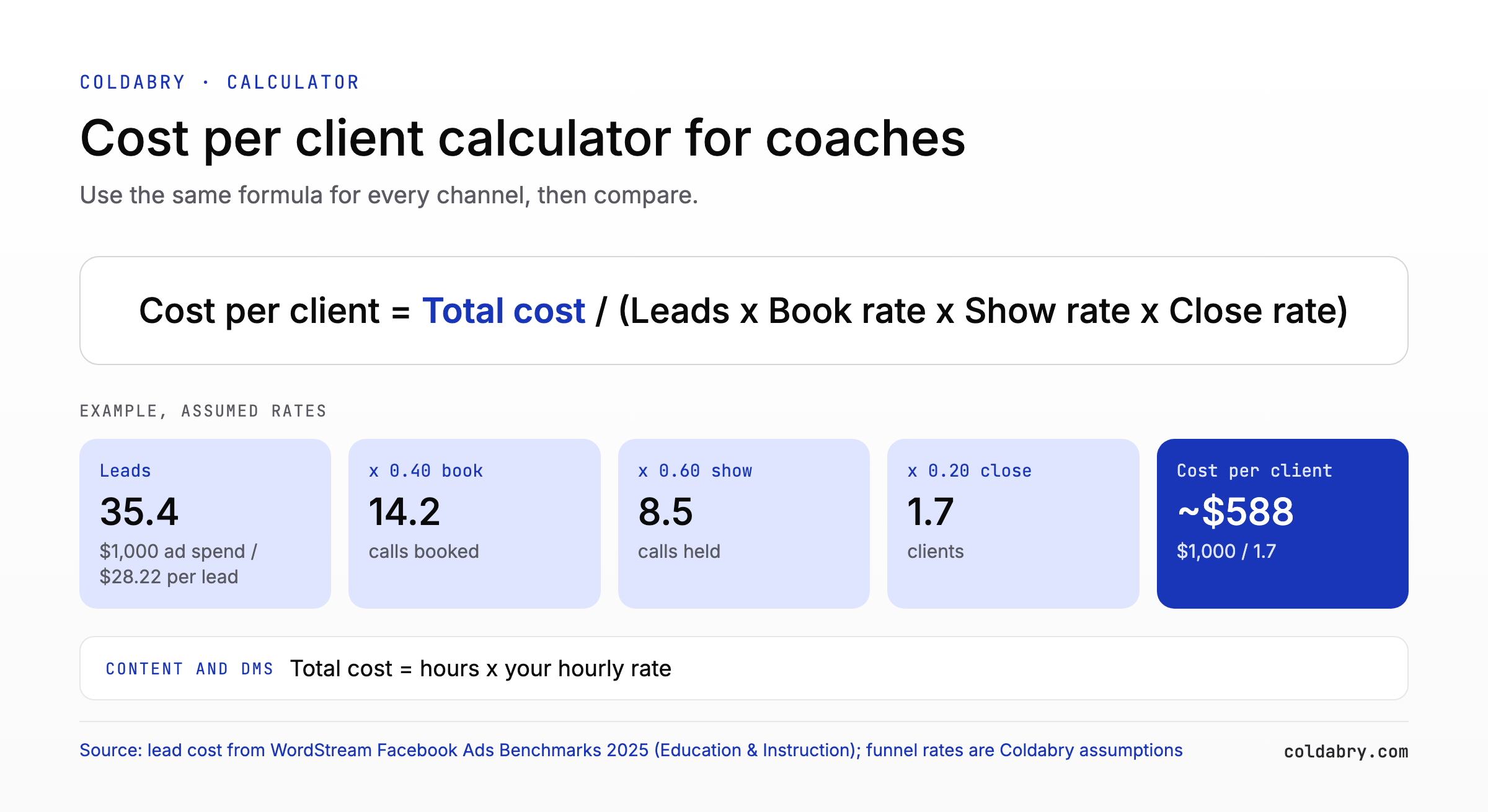
Cost per client = total cost / (leads x book rate x show rate x close rate)
Total cost is ad spend for ads, and hours x your hourly rate for content and DMs. Leads are form leads or new conversations. Use rates as decimals (40% = 0.40). Fill one row per channel:
| Input | Ads | Content | Warm DMs | Cold DMs | Worked example (ads, business coach) |
|---|---|---|---|---|---|
| Spend this month ($) | $1,000 | ||||
| Hours this month | 0 | ||||
| Your hourly rate ($) | $50 | ||||
| Total cost = spend + hours x rate | $1,000 | ||||
| Leads or new conversations | 35.4 ($1,000 / $28.22) | ||||
| Book rate | 0.40 | ||||
| Show rate | 0.60 | ||||
| Close rate | 0.20 | ||||
| Clients = leads x book x show x close | 1.7 | ||||
| Cost per client = total cost / clients | About $588 |
Three checks keep the calculator honest:
- Count your hours for content and DMs, even if you do not pay yourself. Otherwise content always "wins" on paper.
- Track each stage separately. A high cost per client is usually one weak rate (often show rate), and the fix is different for each.
- Compare against what a client pays you. If cost per client is above a third of your program price, the channel needs a better funnel before it gets more budget.
Coaches who already have an audience and a repeatable method have another lever: raising what each client is worth, for example with a custom AI app built on your coaching method that clients use between sessions. A higher price per client makes every channel in this table cheaper in relative terms.
Coldabry builds custom AI apps and agents that coaches own and sell to their own audience; see how we price custom builds if that is your next step.
FAQ
How do I get my first coaching client on Instagram?
Start with warm conversations, not ads. Post content that ends with a clear trigger, such as "comment PLAN and I'll send you the checklist", then reply to every comment and Story reply within 24 hours, which is the standard window under Meta's messaging policy. Ask one or two questions about the person's situation before offering a call. Your first client usually comes from someone who already follows you or was referred, so tell your existing audience plainly what you offer and who it is for. Ads make more sense once you know your call close rate, because then you can predict what a client will cost.
How much do Facebook and Instagram ads cost per lead for coaches?
There is no coaching category in the main public benchmark, so you have to use proxies. WordStream's 2025 report on Meta leads campaigns gives $28.22 per lead for Education & Instruction (closest to business and life coaching), $52.98 for Health & Fitness (fitness and nutrition coaching), $17.64 for Career & Employment, and $27.66 across all industries. These are averages from more than 1,000 campaigns, not quotes. With an assumed 4.8% lead-to-client rate, that means roughly $368 to $1,104 per signed client depending on niche. Your own numbers after a month of spend matter more than any benchmark.
Do cold DMs still work for coaches in 2026?
Manual, personal cold DMs can still book calls, and in our worked example they cost about $521 per client, similar to ads. The problems are scale and risk. A solo coach can only send a few dozen thoughtful messages a day, so the channel does not grow with budget. Automating cold DMs to strangers breaks Instagram's terms and can get the account restricted, and for a coach that account is the storefront. If you use cold outreach at all, keep it small and manual, and spend most effort turning content viewers into warm DMs instead.
Can I book sales calls directly from Instagram DMs?
Yes, and for most coaches it works better than sending people to a link in bio. A typical flow is: the prospect comments or replies to a Story, you send a DM, ask two or three qualifying questions, then share a booking link. Timing matters because Meta's policy allows replies within 24 hours for most user actions, and private replies to comments within seven days. Vendor-reported data from Inrō shows comment-to-DM messages being clicked far more often than link-in-bio traffic. You can handle this by hand at low volume or use a compliant tool that only replies to people who messaged first.
How many hours a week does Instagram content take to get clients?
There is no reliable published benchmark, so treat any figure as an example. If you post 4 Reels a week at 2 hours each, that is 8 hours a week, about 34.7 hours a month. At an assumed $50 an hour, that is about $1,733 a month of your time. If that content produces 3 clients a month, each one costs about $578; if it produces 1, the cost is $1,733. The hours pay off faster when every post includes a comment or Story trigger that starts a DM conversation, because that turns views into leads.