Self-Hosted Instagram Automation: VPS Cost and Stack
Self-hosted Instagram automation runs about $12 a month on the official API, and $22 to $1,350 a month with browser automation, proxies and 1-10 accounts.

Self-hosted Instagram automation costs about $12 a month on Meta's official API and roughly $22 to $1,350 a month for a browser-automation setup running 1 to 10 accounts, based on DigitalOcean, Decodo and IPRoyal list prices checked in October and November 2026. This applies to creators, coaches and small teams weighing a DIY self hosted Instagram automation setup instead of a subscription. The main caveat: the server is cheap and nearly fixed, while the per-account proxy is the line that scales. And automated cold DMs from a logged-in account break Instagram's Terms of Use no matter whose server they run on.
This post covers only the running bill and the stack. Deciding whether to build at all? Read our build vs buy break-even for an Instagram outreach bot. Choosing a proxy type? See mobile vs residential proxies for social accounts.
How much does self hosted Instagram automation cost per month?
The total depends on one decision more than any other: do you use Meta's official API (inbound automation such as comment-to-DM and replies) or a browser bot that logs into accounts and sends outbound DMs? The API route needs no proxy. The browser route needs a sticky proxy per account, and that line dominates the bill once you pick mobile IPs.
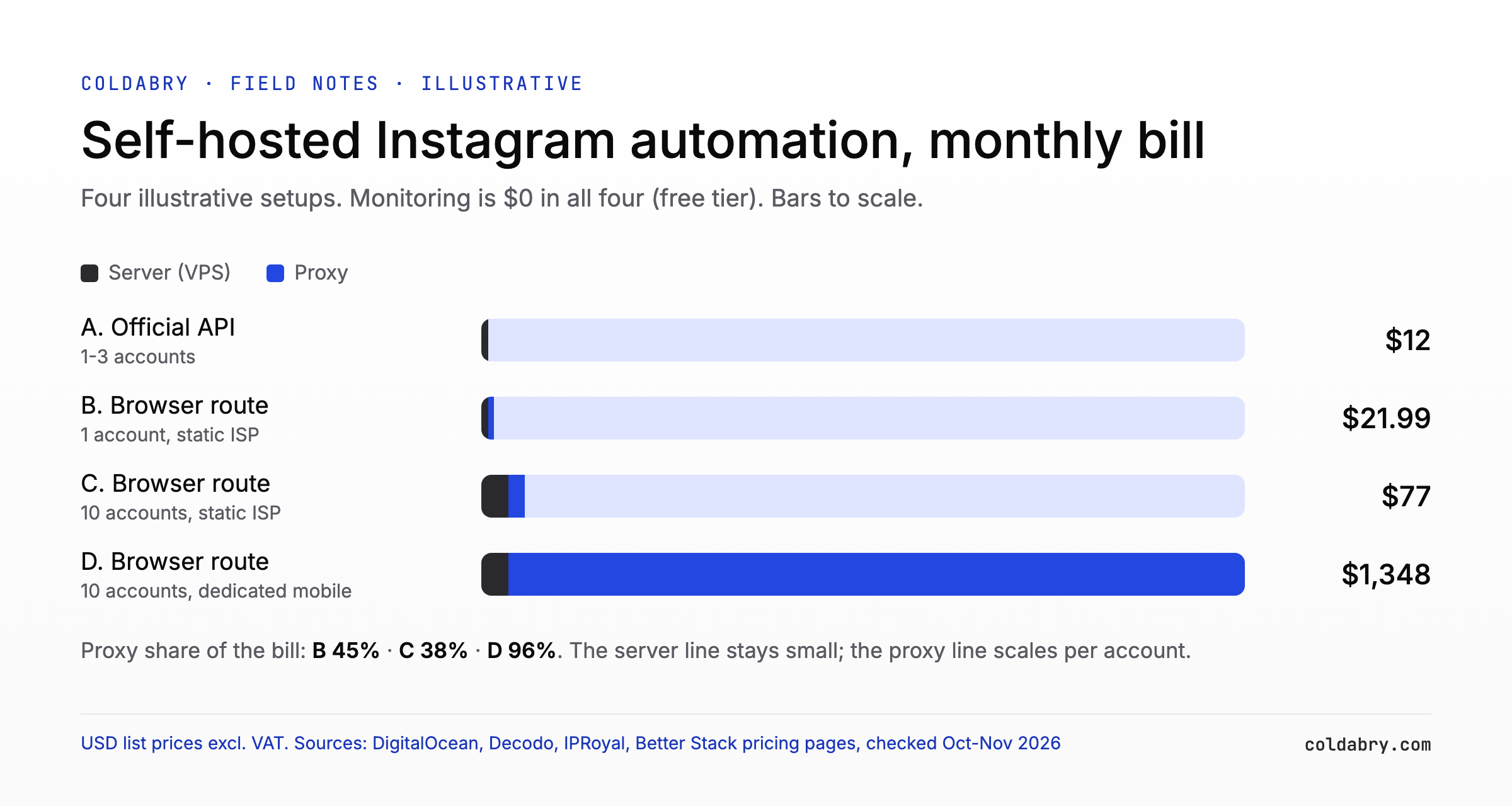
The four bills below are illustrative worked examples, not measurements. They use USD list prices excluding VAT: DigitalOcean Basic Droplets (checked November 2026), Decodo static ISP proxies (checked October 2026), IPRoyal dedicated mobile proxies (checked October 2026) and the Better Stack free tier (checked November 2026).
| Example scenario | Server | Proxy | Monitoring | Total / month |
|---|---|---|---|---|
| A. Official API, 1-3 accounts (web app, worker, Postgres, Redis on one box) | DigitalOcean 2 GiB, $12.00 | None needed | Better Stack free, $0 | $12.00 |
| B. Browser route, 1 account | DigitalOcean 2 GiB, $12.00 | Decodo 3 static IPs (smallest pack), $9.99 | $0 | $21.99 |
| C. Browser route, 10 accounts, static ISP | DigitalOcean 8 GiB, $48.00 | Decodo 10 IPs, $29.00 | $0 (10 heartbeats = free limit) | $77.00 |
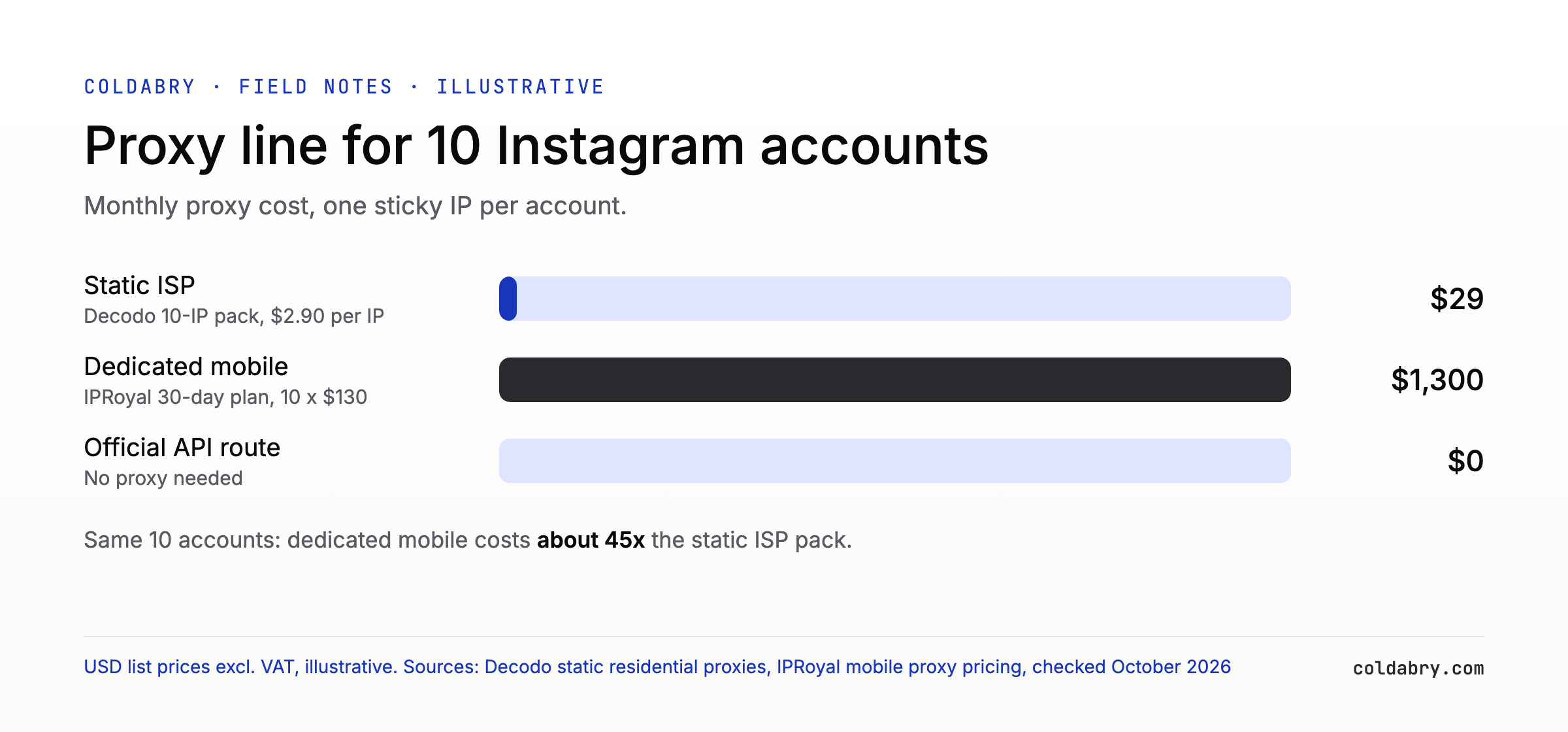
| D. Browser route, 10 accounts, dedicated mobile | DigitalOcean 8 GiB, $48.00 | IPRoyal 10 x $130 = $1,300.00 | $0 | $1,348.00 |
Assumptions behind the examples: 8 GiB for 10 accounts assumes roughly one concurrent browser per GiB with sessions staggered (an assumption, not a benchmark); one heartbeat monitor per account and no separate worker monitor (adding one pushes examples C and D past Better Stack's free 10); no paid managed database. Backups, a domain, VAT, CAPTCHA services and your own time are excluded.
In example B the proxy is 45% of the bill ($9.99 / $21.99). In C it is 38% ($29 / $77). In D it is 96% ($1,300 / $1,348). Moving from static ISP to dedicated mobile IPs multiplies the 10-account bill by about 17.5x while the server line stays the same.
What stack do you need to run Instagram automation on a VPS?
The two routes share a database and a queue, and differ in almost everything else. The open-source projects that publish their architecture describe the API route well. OpenReply says a working instance needs "your deployed fork, a public HTTPS URL, PostgreSQL, Redis, a running worker, and an Instagram connection." Its web app "receives the webhook and serves the dashboard," while "a separate worker process does the sending, because the send has to survive rate limits and retries."
The n8n Instagram template on Railway follows the same pattern: n8n in queue mode with PostgreSQL and Redis, using the Graph API, and requires an Instagram Business or Creator account linked to a Facebook Page, a Meta developer app and a long-lived access token. InstaAuto is a Next.js app on Supabase and Vercel built on the same official-API idea.
The browser route swaps the webhook receiver for a headless browser runtime: libraries such as Mashya Instagram API use Playwright to automate login, posting, liking and commenting. It is an example of the route the terms prohibit, not a recommendation. Use the table below as a reference stack checklist.
| Component | Job | API route | Browser route | Cost line |
|---|---|---|---|---|
| Web app + public HTTPS | Receives Meta webhooks, serves the dashboard | Required | Optional (dashboard only) | Fixed, on the server |
| Always-on worker | Sends replies, retries, respects rate limits | Required | Required (drives the browsers) | Fixed, on the server |
| PostgreSQL | Accounts, rules, message log | Required | Required | Fixed (self-hosted in Docker) |
| Redis / job queue | Queues sends, holds overflow | Required | Required | Fixed |
| Playwright + Chromium runtime | Runs a logged-in browser per account | Not used | Required | RAM per concurrent session |
| Persistent browser profile | Keeps cookies and device state per account | Not used | One per account | Disk per account |
| Sticky proxy | One stable IP per account | Not used | One per account | Per account, largest line |
| Secrets store | Access tokens or account credentials, 2FA seeds | Tokens | Passwords + 2FA | Fixed |
| Uptime + heartbeat monitoring | Alerts when the worker or a session stops | 1-2 monitors | 1 heartbeat per account | Free up to 10, then paid |
| Backups | Database dump and browser profiles off the box | Recommended | Recommended | Small fixed line (excluded above) |
OpenReply's quick start shows how light the data layer can be: docker-compose up -d "starts Postgres and Redis" on the same machine (OpenReply README). You do not need a managed database for a handful of accounts.
Which VPS for Instagram automation: Hetzner, DigitalOcean or Contabo?
Any mainstream VPS can run the API route. Browsers hold memory and CPU for as long as a session is open; both vendors below describe their cheap shared plans as built for variable or bursty use.
Hetzner writes that shared cloud plans "are designed for variable usage patterns rather than sustained high workloads." DigitalOcean describes Basic Droplets as "ideal for bursty applications that can handle variable levels of CPU." For the API route that is fine. For several always-on browsers, budget for a bigger shared box or a dedicated vCPU plan.
| Provider and plan | Starting price / month | CPU type | Checked |
|---|---|---|---|
| Hetzner Cloud, Cost-Optimized | from €5.99 excl. VAT | Shared | November 2026 |
| Hetzner Cloud, Regular Performance | from €6.49 excl. VAT | Shared | November 2026 |
| Hetzner Cloud, General Purpose | from €43.49 excl. VAT | Dedicated | November 2026 |
| DigitalOcean Basic, 1 GiB / 1 vCPU | $6.00 | Shared | November 2026 |
| DigitalOcean Basic, 2 GiB / 1 vCPU | $12.00 | Shared | November 2026 |
| DigitalOcean Basic, 4 GiB / 2 vCPUs | $24.00 | Shared | November 2026 |
| DigitalOcean Basic, 8 GiB / 4 vCPUs | $48.00 | Shared | November 2026 |
| DigitalOcean Basic, 16 GiB / 8 vCPUs | $96.00 | Shared | November 2026 |
| DigitalOcean CPU-Optimized, 4 GiB / 2 vCPUs | $42.00 | Dedicated | November 2026 |
| Contabo VPS | Check the live page | Not captured | Not captured |
Older comparisons need care. Hetzner announced that "starting on 15 June 2026, updated pricing for cloud servers will apply to new orders and rescales" (Hetzner docs), so blog posts quoting earlier Hetzner prices are stale. Contabo's page returned a security check on our check date, so check Contabo's VPS page yourself before comparing.
The worked examples use DigitalOcean to keep one currency per total. Hetzner's Cost-Optimized plans start from €5.99 excl. VAT; check that your plan has the 2 GiB example A assumes.
Do you need a proxy for every Instagram account?
On the API route, no: Meta's servers talk to your webhook and your worker calls Meta's API, so there is no logged-in session to protect. On the browser route, the common practice is one sticky IP per account, and the vendor that writes most carefully about it refuses to give a ratio. Databay states: "There is no platform-approved account-to-IP ratio, and inventing one turns a security design into folklore." It also warns: "Do not rotate an authenticated Instagram session per request."
For cost planning, here are the three price shapes you will meet. Which type fits your accounts is covered in mobile vs residential proxies for social accounts.
| Proxy type | Billing | List price | Source, checked October 2026 |
|---|---|---|---|
| Static ISP (dedicated IP) | Per IP per month | $3.33/IP (3 IPs, $9.99) down to $2.60/IP (100 IPs, $260) | Decodo |
| Dedicated mobile | Per proxy per month | from $130 (30 days), $123.50 (60 days), $117 (90 days) | IPRoyal |
| Rotating residential | Per GB | $3.75/GB (3 GB) to $2.75/GB (100 GB) | Decodo |
| Rotating residential | Per GB | $7.00/GB (1 GB) to $5.25/GB (10 GB), PAYG $7.35/GB | IPRoyal |
| Rotating mobile | Per GB | $6.80/GB (2 GB) to $5.20/GB (100 GB) | IPRoyal |
Per-GB plans look cheap until you price browser traffic: Databay advises you to "measure the transferred bytes for the approved actions" and notes that "media-heavy pages can consume far more traffic than text responses, so do not extrapolate API traffic to browser sessions" (Databay). Run a small test for a week, read the byte count, then budget.
What grows per account and what stays fixed?
Fixed lines are paid once for the whole setup. Per-account lines multiply.
| Line | Fixed or per account | What drives it | Example price |
|---|---|---|---|
| Base server (OS, web app, worker) | Fixed | Always on, small | $12/mo, DigitalOcean 2 GiB |
| PostgreSQL | Fixed | Self-hosted on the same box | $0 extra |
| Redis / queue | Fixed | Self-hosted on the same box | $0 extra |
| Monitoring plan | Fixed until the free limit | Better Stack free covers "10 monitors & heartbeats" | $0, then paid |
| Backups | Fixed | Database size plus profiles | Excluded in examples |
| Proxy IP | Per account | One sticky IP each (browser route) | $2.60 to $130 per account (Decodo static ISP to IPRoyal dedicated mobile) |
| Concurrent browser RAM | Per concurrent session | How many accounts run at once | Assumed 1 GiB each, measure yours |
| Browser profile storage | Per account | Cookies, cache, local storage | Disk on the server |
| 2FA and recovery contact | Per account | A phone or email per account | Not priced here |
| Heartbeat monitor | Per account | Alert when a session dies | Counts toward the free 10 |
Two thresholds matter. Monitoring is free on Better Stack up to "10 monitors & heartbeats," so with one heartbeat per account plus a worker monitor you pass the free limit at account 10. Paid plans start around $29-$34 per responder per month (Better Stack pricing, checked November 2026).
The second threshold is RAM. We found no public, sourced figure for memory per Instagram browser session, so the 1 GiB per session in our examples is an explicit assumption. Measure it on your own box: open one session, read docker stats or free -m, multiply by the number of accounts you run at the same time, and add headroom. Staggering sessions is the cheapest way to keep the server line flat.
Example: going from 1 to 10 accounts on static ISP proxies moves the bill from $21.99 to $77 (illustrative example B to C). The server line grows 4x ($12 to $48) because of browser RAM, while the proxy line grows about 2.9x ($9.99 to $29) because Decodo's per-IP price falls with volume.
Is self hosted Instagram automation against Instagram's terms?
Self-hosting changes the bill, not the risk. Instagram's Terms of Use (effective 1 January 2025, checked October 2026) say: "You can't attempt to create accounts or access or collect information in unauthorized ways. This includes creating accounts or accessing or collecting information in an automated way without our express permission, regardless of whether such automated access or collection is undertaken while logged-in to an Instagram account."
Meta's Account Integrity standard lists as a violation "creating or using an account or other entity through automated means, such as scripting (unless the scripting activity occurs through authorized routes and does not otherwise violate our policies)." Put plainly: automated cold DMs sent by a browser bot from a logged-in account break the terms, whether the bot runs on a laptop, a $6 VPS or a dedicated server. A proxy does not change that. Databay says a proxy "cannot authorize scraping, fake accounts, unsolicited bulk messages, manufactured engagement, impersonation, or any other activity prohibited by Meta's terms" (Databay).
The sanctioned route is the official API for inbound automation: replies to comments, DMs from people who wrote to you first. It has its own limits. OpenReply notes that "Instagram's policies, permissions, messaging windows, and rate limits still apply," and its README says it stays under "Meta's documented cap of 750 private replies per hour" (OpenReply).
| Question | Official API route | Browser route |
|---|---|---|
| Allowed under Meta's rules? | Yes, within permissions, messaging windows and rate limits | No, automated access to a logged-in account without permission |
| Cold outbound DMs? | No, inbound and opted-in conversations | Yes, which is what breaks the terms |
| Needs a proxy? | No | Yes, one sticky IP per account in common practice |
| Needs a password? | No, OAuth access token | Yes, plus 2FA handling |
| Illustrative monthly cost | $12 (example A) | $21.99 to $1,348 (examples B-D) |
Note: no hosting choice, proxy type or tool can promise an account will not be restricted. Budget for the possibility that a browser-route account gets locked, and keep anything you cannot afford to lose on the API route.
When is self-hosting cheaper than a subscription?
On the running bill alone, self-hosting is cheap at small scale: $12 a month for an API setup or $77 for 10 browser accounts on static IPs (examples A and C). Compare that with the subscription price of any hosted tool you are considering. The comparison changes once you add the cost of building and maintaining the code, and once mobile proxies push the bill past $1,000. That trade-off, with break-even math, lives in our build vs buy break-even for an Instagram outreach bot.
| Example | Monthly hosting bill | Biggest line | What it leaves out |
|---|---|---|---|
| A. Official API, 1-3 accounts | $12.00 | Server (100%) | Build time, backups, VAT |
| B. Browser, 1 account | $21.99 | Server (55%) | Build time, CAPTCHA, ToS risk |
| C. Browser, 10 accounts, static ISP | $77.00 | Server (62%) | Build time, CAPTCHA, ToS risk |
| D. Browser, 10 accounts, dedicated mobile | $1,348.00 | Proxy (96%) | Build time, CAPTCHA, ToS risk |
If you want automation that stays inside Meta's rules, the API stack from example A is the one to build, and it can sit inside a product you already sell. That is the kind of work behind custom AI automation built on official APIs and custom apps you own and host yourself, with ranges on what a custom build costs.
FAQ
Can you self-host Instagram automation?
Yes. Open-source projects such as OpenReply run on your own infrastructure and need a public HTTPS URL, PostgreSQL, Redis, a running worker and an Instagram connection. They use Meta's official API for comment-to-DM and replies, so they need no password and no proxy. A 2 GiB DigitalOcean Droplet at $12 a month (checked November 2026) is enough for an illustrative 1-3 account setup. You can also self-host a browser bot with Playwright, but that route automates a logged-in account, which Instagram's Terms of Use prohibit without express permission.
How much does it cost to run an Instagram bot on a VPS?
In our illustrative examples, about $12 a month on the official API, $21.99 for one browser-automated account with a static ISP proxy, $77 for 10 accounts on static ISP proxies, and $1,348 for 10 accounts on dedicated mobile proxies. List prices excl. VAT, checked October-November 2026. The server is the small, mostly fixed part. The proxy line grows with every account and becomes 96% of the bill once you choose dedicated mobile IPs.
Do I need a separate proxy for each Instagram account?
Only on the browser route. If you use Meta's official API, there is no logged-in browser session and no proxy. For browser automation, common practice is one sticky IP per account, but proxy vendor Databay states there is no platform-approved account-to-IP ratio and warns against rotating an authenticated session per request or switching addresses after a challenge. For pricing, a static ISP IP from Decodo runs $2.60 to $3.33 a month and a dedicated mobile proxy from IPRoyal starts at $117 to $130 a month (checked October 2026). A proxy does not make a prohibited activity allowed.
Is automating Instagram DMs against the terms of service?
Automated cold DMs sent from a logged-in account are. Instagram's Terms of Use (effective 1 January 2025) prohibit accessing or collecting information in an automated way without express permission, whether or not you are logged in. Meta's Account Integrity standard also lists using an account through automated means such as scripting, unless it happens through authorized routes. The authorized route is the official API, which supports replies to comments and to people who messaged you, within messaging windows and rate limits.
What is the cheapest VPS for Instagram automation?
Among the providers we checked in November 2026, Hetzner Cloud's Cost-Optimized plans start from €5.99 a month excluding VAT, and DigitalOcean's smallest Basic Droplet is $6 a month for 1 GiB of RAM. Hetzner repriced cloud servers for new orders from 15 June 2026, so older comparisons are out of date. Contabo's page could not be captured on our check date, so verify it live. Cheap shared plans suit the API route. Several always-on browsers need more RAM or dedicated vCPUs, since both Hetzner and DigitalOcean describe shared plans as built for variable or bursty use.
Can I run Playwright in Docker for Instagram automation?
Technically yes. Playwright publishes official Docker images, and Playwright-based libraries such as Mashya Instagram API point to them for running a headless browser on a server. Each logged-in account then needs its own persistent browser profile, a sticky proxy and enough RAM for its session, which you should measure rather than guess. The catch is not technical: driving a logged-in Instagram account with a browser bot is the route Instagram's terms prohibit without express permission. For durable automation, build on the official API instead.