Train AI on Sales Conversations: RAG or Fine-Tuning (2026)
To train AI on sales conversations, put cleaned, outcome-labeled DMs into a retrieval index first. Fine-tune only for voice, and OpenAI is winding that down.

For most creators, coaches and small sales teams, the right way to train AI on sales conversations is not fine-tuning: clean and anonymize your DM history, label each thread by outcome, and load the winning threads into a retrieval (RAG) index that the model reads at answer time. Fine-tuning is an optional later step for tone only, and OpenAI's own pricing page now says it is "winding down the fine-tuning platform", which is closed to new users. The main caveat: if your buyers are in the EU or UK, this is a GDPR processing job, and pseudonymized chats are still personal data.
Below is the pipeline, with ready tables for export, redaction, labeling, testing and cost.
How do you train AI on sales conversations?
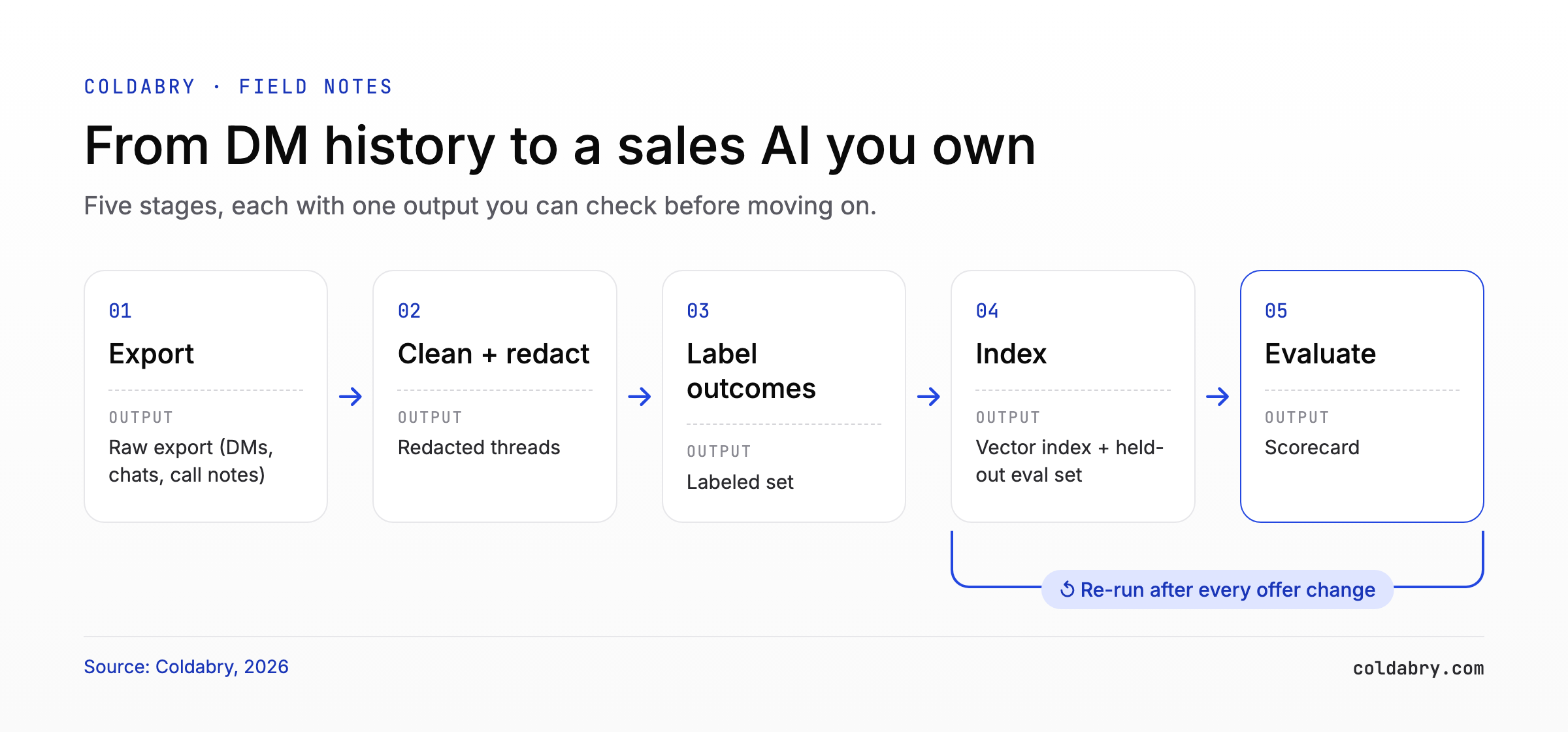
You run five stages, and each one produces a file the next stage consumes. Skip one and the bot quotes last year's price or leaks a phone number.
- Export. Pull full threads from every channel where selling happens. Output: a raw export.
- Clean and redact. Drop junk threads and stale offers, replace personal data with tokens. Output: redacted threads.
- Label outcomes. Tag each thread with what happened in the end. Output: a labeled set.
- Index. Embed the winning threads plus your current offer sheet into a vector store, and set aside a held-out test set. Output: a vector index and an eval set.
- Evaluate. Replay real buyer messages and score the answers. Output: a scorecard you re-run after every change.
What to export from your DMs and sales chats (and what to drop)
Export from every place a buyer talked to you: Instagram and WhatsApp DMs, LinkedIn messages, email threads, CRM notes and call transcripts. Use each platform's own data-download tool rather than copy-pasting, so you keep timestamps and sender labels. If your Instagram conversations already flow into a CRM, that is the cleanest source; we covered the setup in syncing Instagram DMs into your CRM.
What you keep is the full thread, not isolated messages. A sales AI needs to see the order of events: the question, the objection, the answer that moved things forward, and the final outcome.
| Keep or drop | Item | Why |
|---|---|---|
| Keep | Full threads with timestamps | Order of messages shows what moved the buyer |
| Keep | Who spoke (seller vs buyer) | The model must learn your side, not imitate the buyer |
| Keep | Final outcome (bought, booked, ghosted, lost) | Needed for labeling in stage 3 |
| Keep | Current offer sheet and price list | The single source of truth for facts |
| Drop | One-word and greeting-only threads | No signal, only noise in retrieval |
| Drop | Spam, bots, giveaway replies | Teaches nothing about selling |
| Drop | Threads below a minimum length you set (for example, under 4 messages) | Too short to show a sales path |
| Drop or rewrite | Threads quoting old offers or prices | The biggest risk: the AI will quote them as current |
Stale prices need extra care: retrieval will surface an old number as happily as a new one. Strip prices from old threads or exclude them, and let the offer sheet answer price questions.
How to anonymize chat logs before AI training
Replace every piece of personal data with a consistent, numbered token, so the conversation still reads naturally but nobody can be identified from the text. "Hi Anna, your call is Tuesday at 5" becomes "Hi [CUSTOMER_1], your call is [DATE_1]". Consistent numbering matters: if the same person appears three times, they stay [CUSTOMER_1] all three times, and the model can still follow who said what.
Use two passes. Structured fields (phones, emails, URLs, order IDs) are caught reliably with regular expressions, which are text-matching patterns. Names, places and free-text health details need a named-entity pass, an NLP model that spots names in sentences. Then a human reads a random sample of redacted threads, because both passes miss things.
| PII type | Example | Replacement token | Method |
|---|---|---|---|
| Customer name | Anna Kowalski | [CUSTOMER_1] | Named-entity pass |
| Social handle | @anna.fit | [HANDLE_1] | Regex |
| Phone number | +44 7700 900123 | [PHONE] | Regex |
| Email address | anna@example.com | [EMAIL] | Regex |
| Street address | 12 Baker Street | [ADDRESS] | Named-entity pass + manual check |
| Order or invoice ID | INV-20931 | [ORDER_ID] | Regex |
| Health or personal detail | "after my second pregnancy" | [PERSONAL_DETAIL] | Manual review |
| Third parties mentioned | "my husband Tom" | [PERSON_2] | Named-entity pass |
Why this matters even if you never publish the dataset: a model that sees personal details can repeat them. With retrieval, a raw phone number sitting in a chunk can be pasted straight into an answer to a different buyer. With fine-tuning, details can be memorized into the model weights, where you cannot easily find or remove them. Redaction is the step to automate first; it is the kind of job our AI automation for export and redaction pipelines work covers.
Is it legal under GDPR to train AI on customer chats?
It can be, but only on a documented legal basis, and redaction alone does not take the data out of GDPR. Recital 26 of the GDPR says pseudonymized data that "could be attributed to a natural person by the use of additional information" is still information on an identifiable person. Only data "rendered anonymous in such a manner that the data subject is not or no longer identifiable" falls outside the rules, judged against "all the means reasonably likely to be used, such as singling out". If you keep a lookup table from [CUSTOMER_1] back to Anna, your data is pseudonymized, not anonymous.
The European Data Protection Board addressed this in Opinion 28/2024, announced on 18 December 2024. It names a conversational agent as an example of a service that can rely on legitimate interest, "but only if the processing is shown to be strictly necessary and the balancing of rights is respected". Whether buyers would reasonably expect the use depends on factors the EDPB lists, including "the nature of the relationship between the individual and the controller" and "the context in which the personal data was collected". It also warns that a model developed with unlawfully processed data can affect "the lawfulness of its deployment, unless the model has been duly anonymised".
Note: This is not legal advice. Practical steps most teams take: update the privacy notice to mention AI assistance, write down a legitimate interest assessment (why it is necessary, why it does not override buyers' rights), set a retention period, and check the plan with your DPO or counsel before the first export.
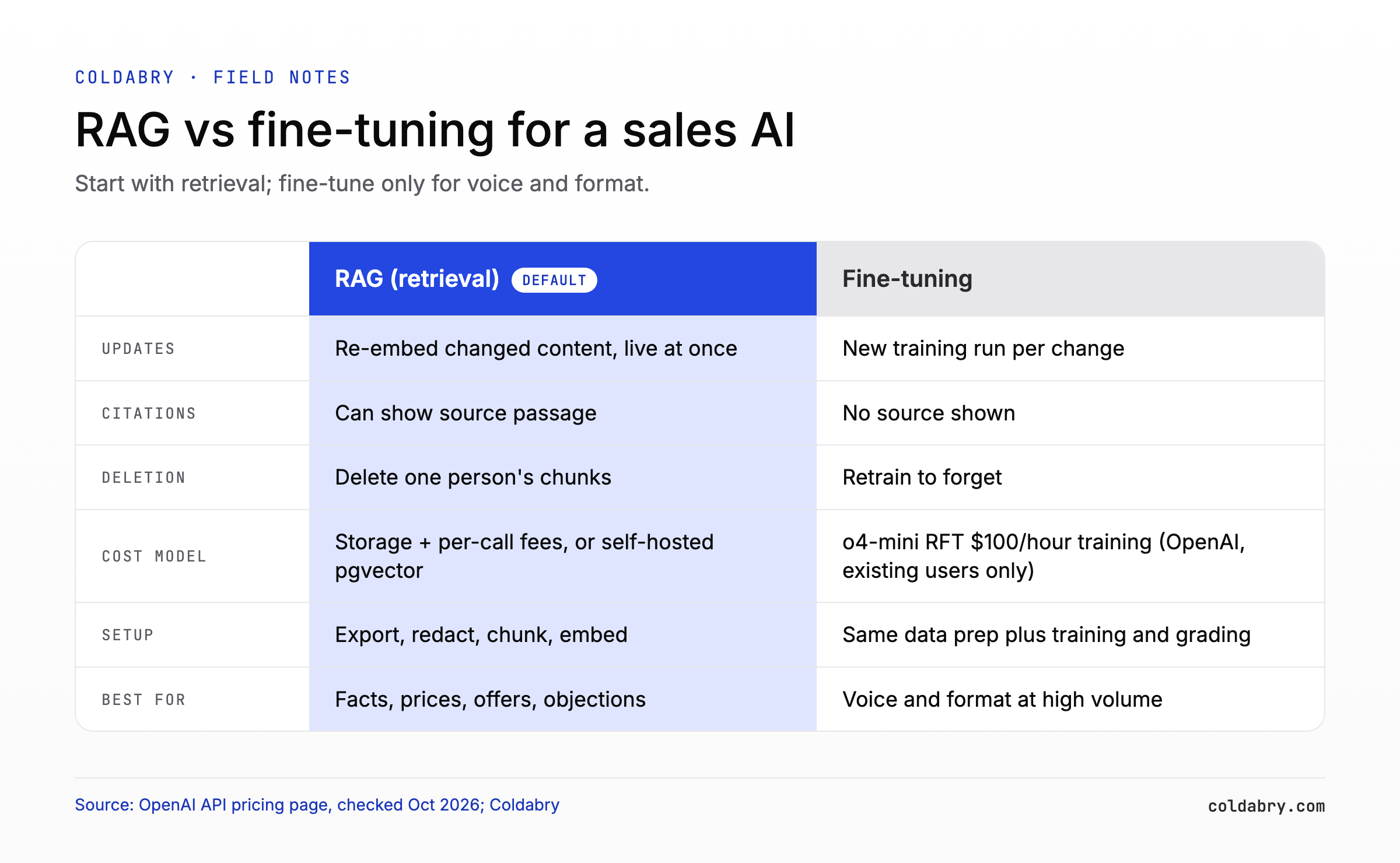
The architecture choice changes how hard compliance is. Deletion requests are the clearest case.
| Requirement | RAG index | Fine-tuned model |
|---|---|---|
| Erase one person on request | Delete their chunks, done | Person is mixed into the weights; retraining is the only clean fix |
| Access control | Filter chunks per user or region | Everything the model learned is available to everyone |
| Audit trail | Each answer can log which chunks it used | No record of which example shaped an answer |
How to label sales conversations by outcome
Label each whole thread, not each message. Reply-level tags such as "interested" or "objection" are a different job, covered in our guide to labeling individual replies by intent. Here the question is simpler and more useful for a knowledge set: how did this conversation end, and what happened on the way?
Use this record schema for every thread. It is small enough to fill by hand for a few hundred threads, and structured enough to filter on later.
| Field | Type | Example value |
|---|---|---|
| thread_id | text | ig-000412 |
| channel | enum: instagram, whatsapp, linkedin, email, call | |
| outcome | enum: bought, booked_call, ghosted, lost_price, lost_fit | booked_call |
| offer | text (current offer name) | 12-week coaching program |
| stage_reached | enum: first_reply, qualified, offer_sent, call, paid | call |
| objections | list: price, timing, trust, fit, partner | price, timing |
| objection_resolved | boolean | true |
| revenue_band | enum, optional: none, low, mid, high | mid |
| price_current | boolean (does the thread quote today's price?) | true |
| use_as | enum: retrieval_example, eval_case, exclude | retrieval_example |
Winning threads (bought, booked_call) with a resolved objection become retrieval examples: when a new buyer raises the same objection, the AI reads how you handled it before. Losing threads are still useful. They become "what not to say" notes and test cases, because a good sales AI should handle the price objection better than the thread that lost on price.
RAG vs fine-tuning for a sales AI: which wins?
RAG wins for almost everything a sales AI must get right: prices, offer details, availability, citations and deletion. Retrieval means the model answers from passages fetched at question time instead of from memory. In the vector knowledge base we built for a skincare brand, the model "never answers from its own memory", it is told to "answer using only this material, and if it does not contain the answer, say so", and when content changes "the affected passages are re-chunked and re-embedded". That case used brand content, not chat history, but the pattern carries over directly: change the price sheet, re-embed it, and the next answer is correct.
Fine-tuning changes the model's weights with your examples. Its real strength is voice and format at high volume, not facts. One vendor, Robylon, notes that fine-tuned models still make things up, only more convincingly because they have learned your style, and recommends starting with RAG and adding fine-tuning "only for the specific gaps RAG cannot fill". The same vendor puts retrieval latency at 200 to 500 ms, which it calls negligible for chat.
The provider landscape also moved. OpenAI's pricing page states the fine-tuning platform "is no longer accessible to new users", existing users can still create jobs "for the coming months", and the only training row listed is o4-mini reinforcement fine-tuning at $100.00 per hour. Older guides telling you to "fine-tune GPT on your transcripts" are out of date for anyone starting now. Other clouds and open models offer fine-tuning, but price it with their own current pages before you plan around it.
If you want a sales agent that answers from your own threads and offer sheet, that is the shape of custom AI sales agents grounded in your own data.
How to evaluate a sales AI before it talks to buyers
Hold back part of your labeled threads before indexing anything, so the AI is tested on conversations it has never seen. We set aside 10 to 20 percent as a rule of thumb, weighted toward threads with objections. Then replay each buyer message from those threads, one turn at a time, and score the AI's answer against what a good seller would have said.
| Criterion | Pass rule | How to check |
|---|---|---|
| Factual | Price, offer and dates match today's offer sheet | Automatic string match against the offer sheet |
| Grounded | Answer cites or logs at least one retrieved chunk | Check the retrieval log per answer |
| Refuses unknowns | Says it does not know instead of guessing | Include test questions with no answer in the data |
| Next step asked | Ends with a clear next step (call, link, question) | Human review or a grading prompt |
| On voice | Reads like your past winning replies | Human review of a sample |
| No PII leak | No phone, email or name from another buyer | Regex scan of every answer |
Re-run the full set after every change to the offer sheet, the prompt or the index; one new chunk can outrank the right one.
What it costs to run (worked example)
Running a retrieval-based sales AI at small-business scale costs tens of dollars a month in retrieval fees, plus model tokens. Here is a worked example using OpenAI's published file search prices: storage at "$0.10 / GB per day (1 GB free)" and tool calls at "$2.50 / 1k calls", which apply to the Responses API only.
Example assumptions (not real client data): 5,000 past threads after cleaning, about 1,500 tokens each; about 4 characters per token; 3,000 buyer chats a month; 5 retrieval turns per chat; the index stays under the 1 GB free tier.
| Line item | Arithmetic | Result |
|---|---|---|
| Dataset size | 5,000 threads x 1,500 tokens | 7.5M tokens |
| Raw text size | 7.5M tokens x 4 characters | About 30 MB |
| File search storage | Under 1 GB free tier | $0 per month |
| Retrieval calls | 3,000 chats x 5 turns | 15,000 calls per month |
| Tool call fees | 15,000 / 1,000 x $2.50 | $37.50 per month |
| Model tokens | Depends on the model you pick | Not computed here |
| Fine-tuning comparison | Assumed 3-hour o4-mini RFT job x $100/hour | $300 per run, repeated per offer change, existing users only |
Two things stand out. Storage is effectively free at this size, so the dataset itself is not the cost driver; calls and model tokens are. And a fine-tuned model has to be retrained whenever the offer changes, while the RAG index only re-embeds the changed passages. Note that reinforcement fine-tuning also bills grading tokens at the grader model's rate, per OpenAI's page, on top of training hours. For comparison, one vendor estimates fine-tuning at $500 to $5,000 per training run (Robylon).
Self-hosting the index on Postgres with pgvector, as in our case study, removes per-call tool fees entirely and keeps the data in a database you control; the trade-off is that someone has to build and run it. If you are weighing that build, see what a custom AI build costs.
FAQ
Can I train ChatGPT on my own sales conversations?
Not in the fine-tuning sense if you are a new OpenAI customer. OpenAI's pricing page says its fine-tuning platform is being wound down and is no longer accessible to new users; existing users can still create jobs for the coming months. What you can do is build a retrieval setup: redact and label your past threads, store the best ones and your current offer sheet in a vector index, and have the model read relevant passages before each answer. For a sales use case that is usually the better design anyway, because prices and offers change and retrieval picks up changes as soon as you re-embed them.
How many conversations do I need to build a sales AI?
There is no published minimum for a retrieval setup, and we would not trust one. In our judgment a RAG sales assistant can be useful with a few dozen good threads, as long as they cover your common objections and you also index a current offer sheet. Quality and labels matter more than volume: 50 winning threads with resolved price and timing objections beat 5,000 unlabeled chats full of greetings and stale prices.
Is anonymized chat data still personal data under GDPR?
It depends on whether it is truly anonymous or only pseudonymized. Recital 26 of the GDPR says pseudonymized data, which could be linked back to a person with additional information, is still personal data. Only data where the person is not or no longer identifiable, considering all means reasonably likely to be used such as singling out, falls outside the regulation. Replacing names with tokens while keeping a lookup table is pseudonymization. Rare details like a unique job or location can also single someone out. Treat redacted chats as personal data and plan your legal basis accordingly.
Does fine-tuning stop a sales AI from making things up?
No. Fine-tuning teaches a model patterns of tone and format, not a reliable store of facts. One vendor, Robylon, notes that fine-tuned models still hallucinate, just more convincingly because they sound like you. For a sales AI the dangerous errors are factual: a wrong price, a discount that ended, a bonus you no longer include. Retrieval reduces those errors by making the model answer from passages you control, ideally with an instruction to say it does not know when the passage is missing.
How do I remove one customer's data from my sales AI after a deletion request?
With a retrieval setup, find every chunk that came from that customer's threads and delete it from the index, then delete the source thread and any lookup table entry that maps their token back to them. Keeping a thread_id on every chunk makes this a single query. With a fine-tuned model it is much harder: the person's messages are blended into the model weights, and the only clean way to remove them is to retrain without that data. This is one of the strongest practical reasons to keep chat history in an index rather than in model weights.
Training a sales AI on your own conversations is mostly careful data work: export, redact, label, index, test, and repeat when the offer changes. Coldabry builds this kind of owned AI app for creators, coaches and companies, and you can see published builds on our work page.