Meta Scraping Lawsuits: A Risk Map for Agencies (2026)
Meta lost its logged-off scraping case against Bright Data, but fake-account scraping still draws suits, like LinkedIn v. ProAPIs. What agencies risk.
One federal court and a run of platform lawsuits have split scraping risk in two. In the Meta scraping lawsuit against Bright Data, a federal court ruled in January 2024 that scraping public pages while logged out did not breach Meta's terms. Scraping through logged-in or fake accounts is what platforms keep suing over, most recently in LinkedIn v. ProAPIs, filed October 2, 2025. For agencies buying lead-gen, listening, influencer or enrichment tools, the vendor's collection method decides which side of that line you buy from. The caveat: these are district-court rulings and complaints, not settled national law, and logged-in scraping still faces contract, fraud, CFAA and California § 502 claims.
This is a reading of public filings, not legal advice.
What did the court decide in Meta's scraping lawsuit against Bright Data?
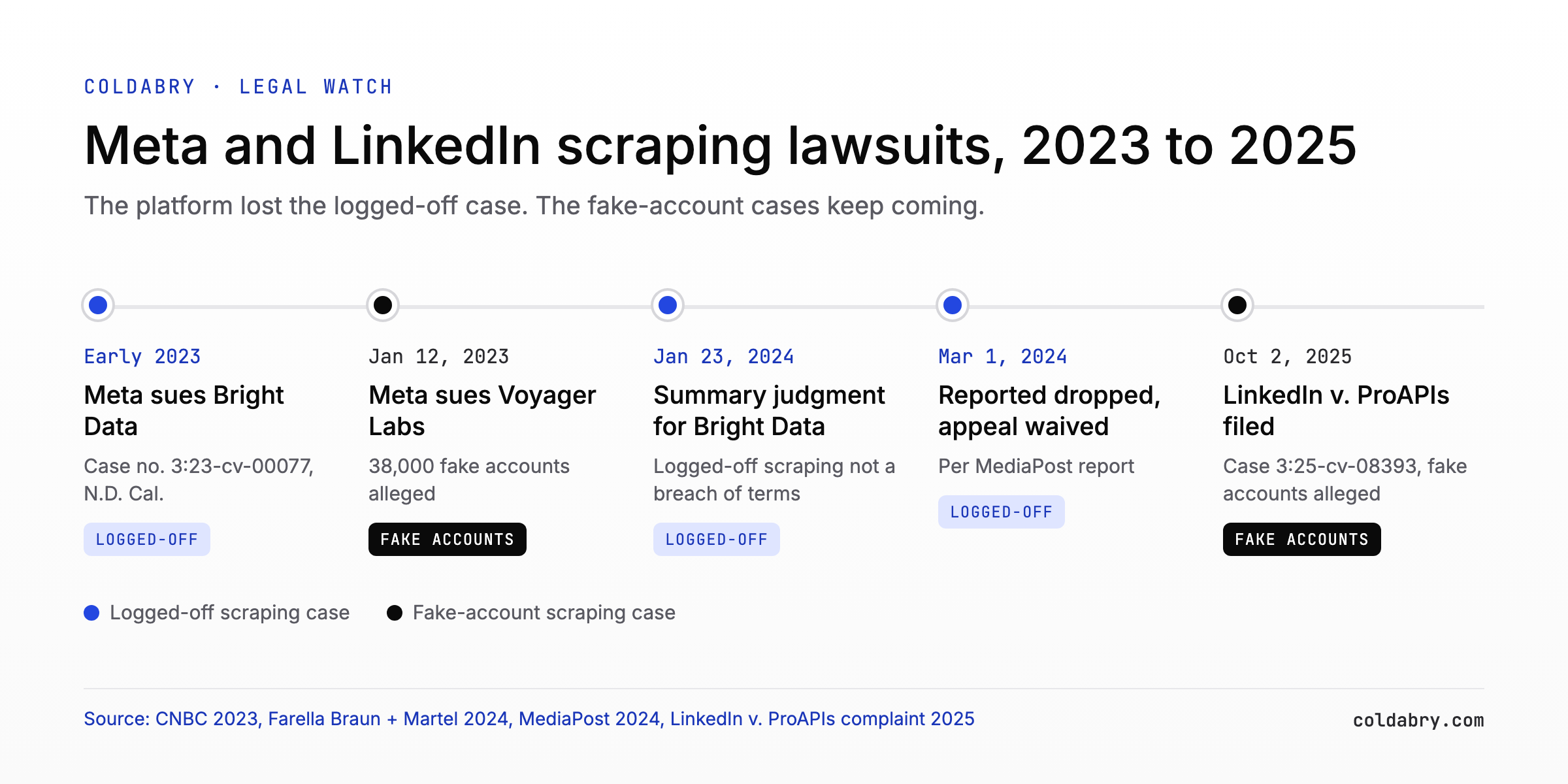
On January 23, 2024, Judge Edward Chen of the Northern District of California issued a summary judgment ruling in Meta Platforms Inc. v. Bright Data Ltd., Case No. 3:23-cv-00077-EMC, according to Farella Braun + Martel's analysis of the ruling. Meta's terms prohibit users from accessing or collecting data "using automated means." The court read those terms as governing "your use" of Meta's services, and found that Bright Data did not "use" Facebook and Instagram when it scraped public data while logged off.
The reasoning matters more than the result. The court said the terms exist to stop account holders from abusing the access an account gives them. An entity that scrapes public data without logging in "stands in the same shoes as a visitor to whom the Terms cannot apply," in the court's words quoted by Farella Braun + Martel. The ruling also rejected Meta's "survival clause" argument, and only Meta's claim for tortious interference with contract remained.
Bright Data itself had accounts with Meta from April 2021 until December 2022, and Judge Chen still found no breach, because its scraping was logged-out, as MediaPost reported on March 1, 2024. In the same report, MediaPost said Meta quietly dropped the lawsuit and waived its right to appeal. Meta had contended that Bright Data offered an Instagram data set of 615 million records for $860,000.
Our calculation: $860,000 / 615,000,000 records = about $0.0014 per record, or roughly $1.40 per 1,000 records, using the figures Meta alleged in court papers as reported by MediaPost.
Limits: it is one district-court decision, which an attorney quoted by MediaPost called "at odds with most other decisions regarding scraping," and it applies Meta's terms as they were written at the time.
LinkedIn v. ProAPIs: the fake-account scraping lawsuit
The ProAPIs complaint is the logged-in mirror image of Bright Data. LinkedIn alleges that the defendants run a continuously created network of fake accounts, numbering in the millions, which they use to log in and scrape member, company and school data, per the complaint filed in the Northern District of California (Case 3:25-cv-08393-LJC). The defendants named are ProAPIs Inc., Netswift (SMC-Private) Ltd and the company's co-founder.
According to the complaint, LinkedIn's defenses detect and restrict the fake accounts "within hours of their creation," yet each can scrape "hundreds of profiles, if not more" in that window, and the defendants register "hundreds if not thousands of new accounts per day." The data at issue is described as available only "behind LinkedIn's password wall." That phrase is exactly what separates this case from Bright Data.
The commercial side is spelled out too. The complaint says customers pay up to $15,000 per month, and that the iScraper product marketed real-time extraction at up to 150 requests per second, with pricing of $15,000 per month for 5,000,000 API calls. The Record reported that ProAPIs did not respond to a request for comment, and noted that creating fake accounts is against LinkedIn's terms of service.
Our calculation: $15,000 / 5,000,000 calls = $0.003 per call, or $3 per 1,000 calls, from the pricing quoted in the ProAPIs complaint. Meta alleged about $0.0014 per record for Bright Data's logged-off data set. Calls and records are not the same unit, so treat this as an order-of-magnitude comparison, not a like-for-like price.
LinkedIn did not stop at breach of contract. It filed eight counts and demanded a jury trial, seeking injunctive relief and damages. The case did not go to trial: as of October 21, 2026, the docket shows a judgment on consent signed by Judge P. Casey Pitts on September 16, 2026, and the case is closed. We did not review the terms of that judgment.
| # | Count filed by LinkedIn | What it means in plain English |
|---|---|---|
| 1 | Breach of contract | The fake accounts agreed to the User Agreement (cited as Nov. 20, 2024, § 8.2) and broke its scraping and fake-account rules. |
| 2 | Fraud and deceit (Cal. Civ. Code §§ 1572, 1710) | Signing up with fake identities is alleged to be a lie LinkedIn relied on. |
| 3 | Computer Fraud and Abuse Act, 18 U.S.C. § 1030 | Federal anti-hacking law: accessing a computer without authorization. |
| 4 | Cal. Penal Code § 502 | California's state version of unauthorized computer access. |
| 5 | Unfair competition (Cal. Bus. & Prof. Code § 17200) | A catch-all for unlawful or unfair business practices. |
| 6 | Lanham Act, 15 U.S.C. § 1125(c) | Trademark law: alleged dilution of LinkedIn's marks by disparagement (tarnishing them). |
| 7 | Misappropriation | Taking something of value LinkedIn invested in building. |
| 8 | Trespass to chattels | Interfering with LinkedIn's servers as property. |
Is scraping Facebook, Instagram or LinkedIn legal? The logged-in vs logged-off line
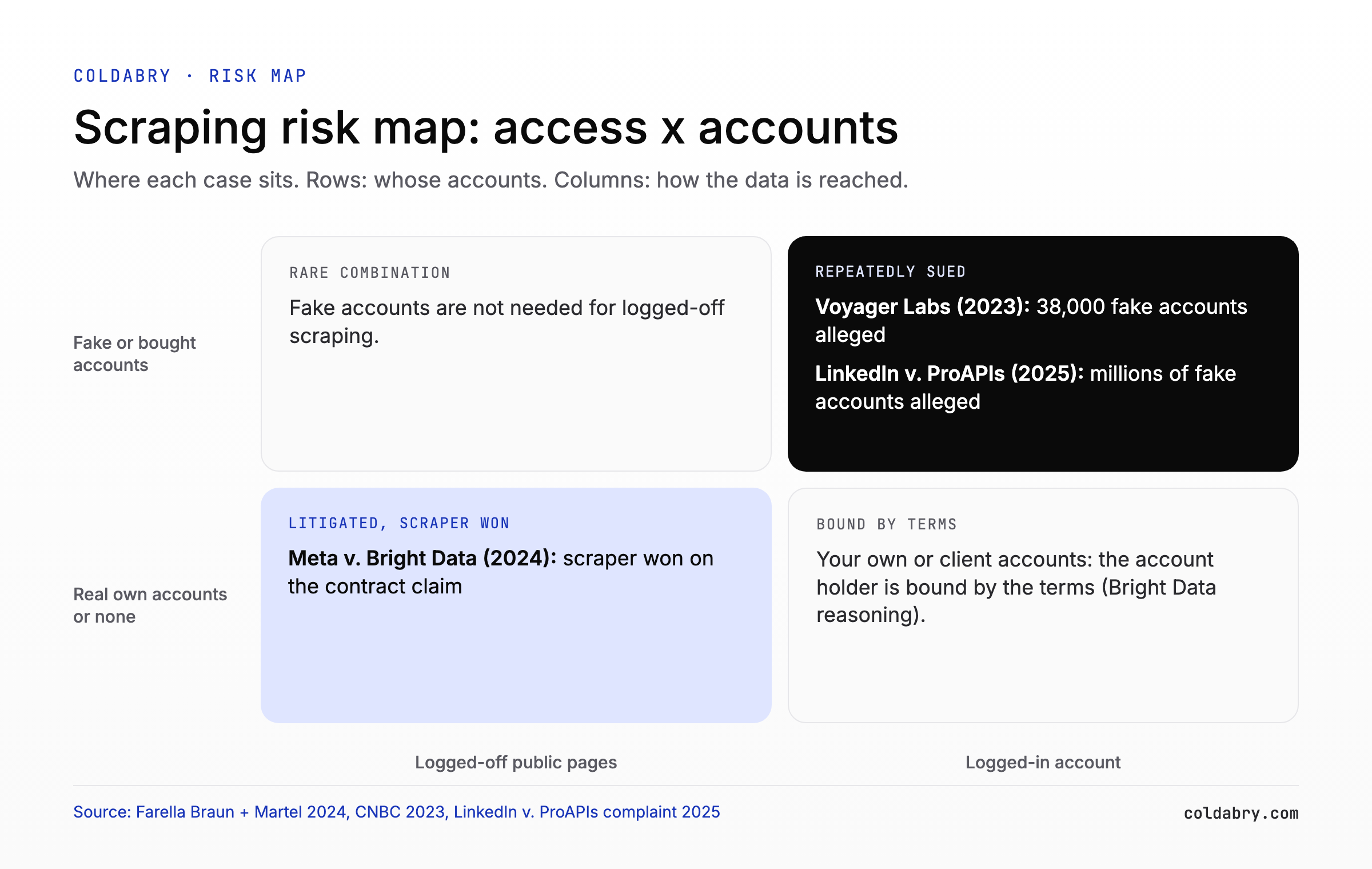
Two questions sort almost every scraping setup: is collection logged in, and whose accounts do it? The cases fall into distinct cells.
- Logged off, no account: Bright Data. Litigated by Meta, and the scraper won on the contract claim at summary judgment (Farella Braun + Martel).
- Logged in, fake or bought accounts: Voyager Labs (38,000 fake Facebook accounts alleged, per CNBC) and ProAPIs (millions of fake accounts alleged). This is the zone platforms repeatedly sue over.
- Logged in, real own accounts: your team's own profiles, or your clients' cookies fed into a tool. No case in our set sits here, but the Bright Data court's own reasoning points at it: the terms exist to stop account holders from abusing the access an account gives them.
- Logged off, but via disguised devices or networks: a grey area: none of the cases reviewed here tests it, and claims such as the CFAA or § 502 have been raised where platforms say access defenses were circumvented (as in ProAPIs).
We are not assigning probabilities to these cells, because no source supports a number. What the record supports is the direction: every fake-account case here drew fraud and computer-access claims, and the one logged-off case was dropped after the platform lost.
Fake accounts are the common thread: Voyager Labs and the rest
Meta alleged that Voyager Labs created over 38,000 fake Facebook accounts, which helped it scrape publicly posted information from more than 600,000 users, including posts, likes, photos and friend lists, according to CNBC. Meta said it disabled over 60,000 Voyager-related accounts and pages and asked the court for the company's "ill-gotten profits."
Note that the Voyager data was described as publicly posted. What made it a case was the fake accounts used to reach it. MediaPost reported in March 2024 that Meta was still pursuing Voyager Labs; we could not verify a later outcome.
Pattern: In both fake-account cases reviewed here (Voyager Labs, ProAPIs), the fake accounts are central to the platform's allegations. Public data reached through fake identities is treated as a fraud and access problem, not a "public page" problem.
Older cases point the same way, with the caveat that they are more than three years old. In December 2021, Meta was reported to have sued Hong Kong based Social Data Trading Ltd, reportedly including a Cal. Penal Code § 502 claim; we did not review that filing. In 2022, Meta was reported to have sued Octopus Data, the US subsidiary of a Chinese company selling scraping software; we did not review that filing.
| Case | Year filed | Accounts used (alleged) | What the platform alleged |
|---|---|---|---|
| Meta v. Social Data Trading | 2021 | Automated accounts (reported, not reviewed) | Reported: Cal. Penal Code § 502 claim |
| Meta v. Voyager Labs | 2023 | 38,000+ fake Facebook accounts | Scraping 600,000+ users; disgorgement of profits sought |
| Meta v. Bright Data | Early 2023 (case no. 3:23-cv-00077) | None used for scraping (logged-off) | Breach of terms; lost at summary judgment, then reported dropped (MediaPost, Mar 1, 2024) |
| LinkedIn v. ProAPIs | 2025 | Millions of fake accounts | Eight counts incl. fraud, CFAA, § 502, Lanham Act; judgment on consent, Sep 2026 |
Sources: CNBC, Farella Braun + Martel, CourtListener.
What does this mean for an agency that buys scraped data?
In the ProAPIs complaint, the defendants are the vendor companies and their co-founder (ProAPIs Inc., Netswift and Rehmat Alam), and no customer is named. Press coverage of the Bright Data and Voyager Labs suits describes the vendors as defendants. That is not a promise that customers are never sued; it is what these sources show.
Your exposure as a buyer is mostly indirect, and it is real. The ProAPIs complaint seeks injunctive relief, which can shut a service down mid-contract. It also stresses that customers were getting data they "certainly are not allowed to copy and keep in perpetuity," which puts a question mark over data you already stored. And if a tool runs on your own accounts, you are the logged-in account holder the Bright Data court described.
| Exposure | What triggers it | What to do |
|---|---|---|
| Vendor disappears mid-contract | Injunction, account wipe, or the vendor shutting down to settle | Pay monthly, avoid annual prepay, keep an export of what you are entitled to keep |
| Data you cannot defend | A client or platform asks where a list came from | Log the source and collection method per data set; drop sets with no answer |
| Your accounts become the scraper | A tool asks for your login, session cookie or browser extension access | Do not connect agency or client accounts to scraping tools |
| Account bans | Automation detected on your own profiles | Treat bans as a separate risk from lawsuits |
| Client contract breach | Your client's terms forbid data obtained against platform rules | Check client MSAs before delivering scraped lists |
Account bans are a separate risk from lawsuits: LinkedIn's weekly connection limit shows what normal activity looks like, and we covered the ban risk of Instagram cold DM tools.
Vendor due diligence: questions to ask before you buy a scraping or enrichment tool
Ask in writing and keep the answers. A vague reply to any of the first four is itself an answer.
| # | Question to ask the vendor | Red-flag answer |
|---|---|---|
| 1 | Is your data collected logged in or logged off? | "Both" with no breakdown, or "we can't disclose that" |
| 2 | Does the tool use my accounts, my session cookies or a browser extension on my profile? | Yes, or "only for better results" |
| 3 | Do you create or buy accounts on the platforms you collect from? | Yes, or "we use a large account pool" |
| 4 | Which fields come from behind a login (password wall)? | Private profile fields, full contact details or connections lists |
| 5 | What happens to delivered data if a platform demands deletion? | No deletion process, or "that has never happened" |
| 6 | Do you use the platform's name or logo in your marketing and product names? | Yes, prominently (the ProAPIs suit includes a Lanham Act trademark count) |
| 7 | Which legal entity am I contracting with, and in which jurisdiction? | No named entity, or an entity with no address |
| 8 | Does the contract include indemnity for claims arising from collection methods? | No indemnity, or "use at your own risk" terms |
| 9 | Is there an official API that gives the same data? | "The API is too limited" as the only reason to skip it |
| 10 | Do you route traffic through proxies, and which kind? | Rotating mobile or residential pools sold as "undetectable" |
Scoring is simple: one red flag means ask for the written policy behind it, and any red flag on questions 2 or 3 means you are buying from the fake-account zone. For questions 9 and 10, compare answers against what the official Instagram Messaging API allows and our guide to mobile vs residential proxies.
Safer ways to get the same data
Most agency use cases do not need password-wall data. Lead lists, social listening and influencer shortlists can usually be built from sources on the safe side of the line, trading some coverage for a deliverable that does not depend on a vendor a platform is suing, and is far less exposed to an injunction.
| Source type | Access type | Platform terms risk | Freshness |
|---|---|---|---|
| Official platform APIs | Authorized, scoped | Low, within the API's terms | Real time for what the API exposes |
| First-party data (your CRM, site, forms) | Your own | None from platforms | As fresh as your capture |
| Opt-in data from your audience | Consented | None from platforms | Updated when people re-engage |
| Logged-off public pages, own pipeline | Public, no account | The zone where Meta lost in Bright Data; still check site terms and access rules | Whatever you schedule |
| Vendor using fake or pooled accounts | Logged in, not yours | The zone platforms sue over | High, until the injunction |
Another route is an owned pipeline on official APIs and public sources. We covered how to assemble an owned prospect research pipeline, and the same logic applies to custom AI automation built on official APIs: you decide what is collected and can prove where every record came from. For agencies that resell data products, a custom data app you own keeps provenance inside your own system instead of a vendor's black box.
Coldabry builds custom AI apps and automations that clients own, and none of what we build relies on fake accounts.
FAQ
Is it illegal to scrape Facebook or Instagram?
It depends on how you do it. In Meta v. Bright Data, a federal district court in California ruled in January 2024 that scraping public data while logged off did not breach Meta's terms, because the terms govern account holders' use of the service. Meta then dropped the case. Scraping while logged in, or through fake accounts, is different: Meta sued Voyager Labs in 2023 over 38,000 alleged fake accounts. Logged-in scraping can also raise CFAA and California Penal Code § 502 claims. This is one district-court ruling, not settled law everywhere, and it is not legal advice.
What did the court decide in Meta v. Bright Data?
On January 23, 2024, Judge Edward Chen granted summary judgment to Bright Data on Meta's contract claim (Case 3:23-cv-00077-EMC, N.D. Cal.). The court found that Meta's terms apply to users' "use" of Facebook and Instagram, and that Bright Data's logged-off scraping of public data was not such use. A visitor without an account stands outside the terms, the court reasoned. It also rejected Meta's survival-clause argument. Only a tortious interference claim remained. Meta had alleged that Bright Data offered a 615 million record Instagram data set for $860,000.
Why did Meta drop its lawsuit against Bright Data?
MediaPost reported on March 1, 2024 that Meta quietly dropped the suit and waived its right to appeal Judge Chen's summary judgment ruling. By then, only one claim, tortious interference with contract, was left after the court rejected Meta's main breach of contract theory on logged-off scraping.
Can LinkedIn sue you for scraping?
Yes, and it does. On October 2, 2025, LinkedIn sued ProAPIs Inc., Netswift and the company's co-founder in the Northern District of California. The complaint alleges millions of fake accounts used to scrape data behind LinkedIn's password wall, sold to customers for up to $15,000 per month. LinkedIn filed eight counts, including breach of contract, fraud, the federal Computer Fraud and Abuse Act, California Penal Code § 502 and the Lanham Act, and seeks an injunction and damages. The case ended without a trial: the docket shows a judgment on consent signed on September 16, 2026; we did not review its terms.
Can an agency be liable for using a scraping tool?
In the ProAPIs complaint, the defendants are the vendor companies and their co-founder, and no customer is named. Press coverage of the Bright Data and Voyager Labs suits describes the vendors as defendants. That does not mean customers cannot be sued. The more common risks are indirect: an injunction can shut down the vendor mid-contract, platforms can question data you already store, and a tool that runs on your own accounts makes you the logged-in account holder bound by the platform's terms. Speak to a lawyer for your specific setup.
What is logged-off scraping?
Logged-off scraping means collecting data from pages anyone can see without signing in, with no account, session cookie or login involved. It was the key fact in Meta v. Bright Data: the court found that Meta's terms bind account holders, and that a logged-off scraper stands in the same shoes as an ordinary visitor. Platforms have repeatedly sued over logged-in scraping with fake accounts, as in Voyager Labs (2023) and LinkedIn v. ProAPIs (2025).