Instagram End-to-End Encryption Is Gone: What It Means for DMs
Instagram end-to-end encryption ended on May 8, 2026, and it was never on by default. What changed, who lost what, what Meta can now access, and what businesses should do.
A typical case: an agency founder handles client onboarding in Instagram DMs. Contract drafts, invoice PDFs, the occasional login sent "just this once". Then a headline lands in the team chat saying Instagram end-to-end encryption is gone and Meta can now read your DMs. The question is whether two years of client messages are suddenly exposed.
The short answer: Instagram end-to-end encryption (E2EE, meaning only the people in the chat hold the keys to read it) for DMs is "no longer supported as of 8 May 2026", per the Instagram Help Centre notice. But the feature was never enabled by default. It was an opt-in mode you switched on chat by chat, and it was "only available in some areas".
So for most people, and for nearly every business conversation, nothing changed on May 8 about who can technically access their messages: ordinary DMs were never end-to-end encrypted. What did change is that the one way to keep a 1:1 Instagram chat out of Meta's reach is gone, and Meta now points people to WhatsApp instead. Below: what the feature was, a dated timeline, Meta's reason versus the theories, what happened to old chats, and what it means for businesses and outreach teams.
Does Instagram have end-to-end encryption in 2026?
No. Since May 8, 2026, Instagram has no end-to-end encrypted DM option at all. Before that date, the feature existed but sat behind a few taps. According to the Help Centre text quoted by PPC Land, you opened a chat, tapped the person's name, went to "Privacy and safety" and chose "Use end-to-end encryption".
That created a separate thread with an "Encrypted" label. Encrypted and normal chats with the same person showed up as two different conversations. In encrypted threads, "every device in an end-to-end encrypted conversation has a special key that's used to protect the conversation", and no one else, "not even Meta", could see what was sent.
There were exceptions even then. Chat themes and other customizations were not end-to-end encrypted, and anyone in the chat could still choose to share messages with Meta when reporting them. PPC Land sums it up as "opt-in, regionally restricted, and positioned as a supplementary privacy mode". The Reddit comment claiming E2EE was never the default is correct.
| Aspect | Before May 8, 2026 | After May 8, 2026 |
|---|---|---|
| Availability | Opt-in per chat, "only available in some areas" | Not available anywhere |
| Default | Off. Standard DMs were the default | Standard DMs only |
| Who can technically access content | Encrypted chats: only the participants. Standard chats: Meta has access | All DMs are standard chats, so Meta has access |
| Reporting | In encrypted chats, a participant could choose to share messages with Meta | Reporting works on standard chats |
| Chat themes and customizations | Not end-to-end encrypted, even in encrypted chats | Not end-to-end encrypted |
Instagram E2EE timeline: from the 2019 pledge to the May 8, 2026 shutdown
Most coverage repeats one Help Centre notice and skips the context. Here is the full sequence, with each date tied to a source.
In 2016, WhatsApp already had end-to-end encryption as a core, non-optional feature, and Messenger added an optional encrypted mode. In 2019, Mark Zuckerberg announced a plan to shift Meta's messaging apps, Instagram included, toward private, encrypted communication.
Instagram got its piece of that plan in 2023, when Meta began rolling out the opt-in feature. On December 6, 2023, Meta started rolling out default end-to-end encryption on Messenger, noting the global rollout would take "a number of months".
On March 13, 2026, 9to5Google and The Verge reported the Help Centre notice that encrypted DMs would end after May 8. There was no newsroom post. An in-app alert was reported through a Reddit thread, which Meta has not confirmed separately. On May 11, Security Affairs quoted the updated notice: no longer supported as of May 8, 2026.
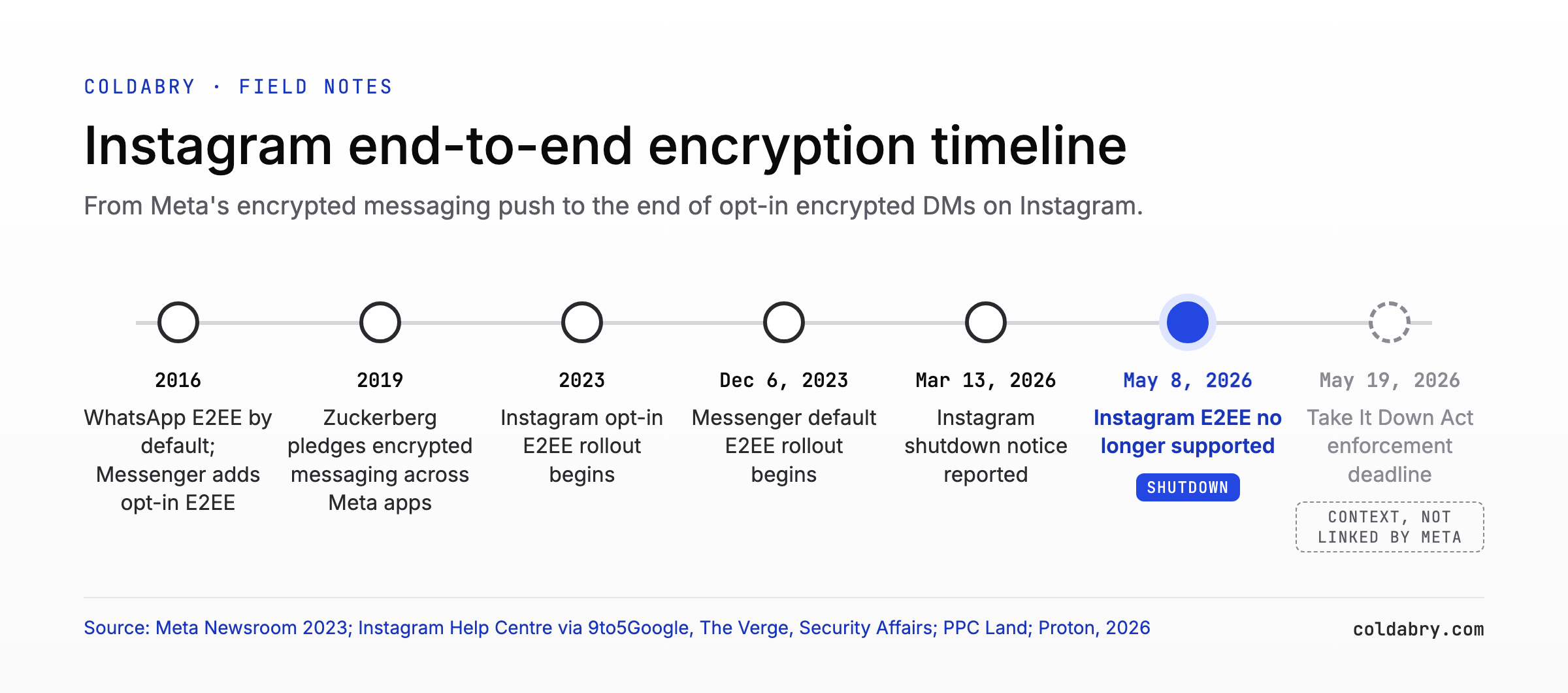
Note: May 19, 2026 sits on this timeline as context only. Meta has not linked the Take It Down Act to the Instagram change; analysts did.
Why is Instagram removing end-to-end encryption?
Meta has given one reason. Spokesperson Dina El-Kassaby Luce told The Verge that "very few people" were using E2EE in their DMs. The full statement quoted by 9to5Google: "Very few people were opting in to end-to-end encrypted messaging in DMs, so we're removing this option from Instagram in the coming months. Anyone who wants to keep messaging with end-to-end encryption can easily do that on WhatsApp."
Meta has published no adoption numbers, and CyberInsider noted the announcement itself gave no detailed public explanation. Everything else you read is a theory. Some theories are reasonable; none is confirmed.
The most cited one is the Take It Down Act. Security Affairs reports that the law requires platforms to build enforcement systems by May 19, 2026, and that "while Meta has not explicitly linked the two developments, analysts note that removing encryption makes it easier for platforms to detect and moderate harmful content at scale". The second is child-safety pressure: in 2024 the Nevada Attorney General filed a motion to ban Meta from offering E2EE to minors.
The third theory is about money: that unencrypted DMs feed ads or AI training. PPC Land infers possible advertising signal use, and Proton, a privacy company that sells encrypted services, raises it as an open question. Meta has said nothing of the kind. Treat it as a question, not a finding.
| Claim | Who says it | Status |
|---|---|---|
| Very few people opted in | Meta spokesperson (The Verge) | Meta-confirmed reason, no numbers given |
| WhatsApp is where E2EE lives now | Meta statement and Help Centre (9to5Google) | Meta-confirmed |
| Linked to the Take It Down Act deadline (May 19, 2026) | Analysts (Security Affairs) | Analyst theory, not linked by Meta |
| Child-safety and regulator pressure (Nevada AG, 2024) | Press context (The Verge) | Context, not stated by Meta as a reason |
| DM content will be used for ads or AI training | PPC Land, Proton | Unconfirmed inference or open question |
Can Meta read your Instagram DMs now?
Technically, Meta can access the content of standard DMs, and since May 8 every Instagram DM is a standard DM. Security Affairs puts it this way: the change "gives Meta the technical ability to access message content that was previously readable only by senders and recipients". That sentence applies to people who had switched encryption on.
If you never turned it on, your exposure did not change. Your DMs were standard chats before May 8 and they still are. The "Meta can now read your DMs" headlines are true for the small group of opt-in users and misleading for everyone else.
What Meta has not said matters as much. It has not announced any new scanning, ad targeting or AI training based on DM content. If you want to know how Meta uses your data, read its privacy policy rather than headlines, and assume any standard DM is accessible to the platform.
Users do care about this. A Proton survey found that the share of people rating E2EE as very or somewhat important ranged from 61% in France to 79% in Germany, with the UK at 72% and the US at 76%. Proton sells encrypted products, so weigh it accordingly.
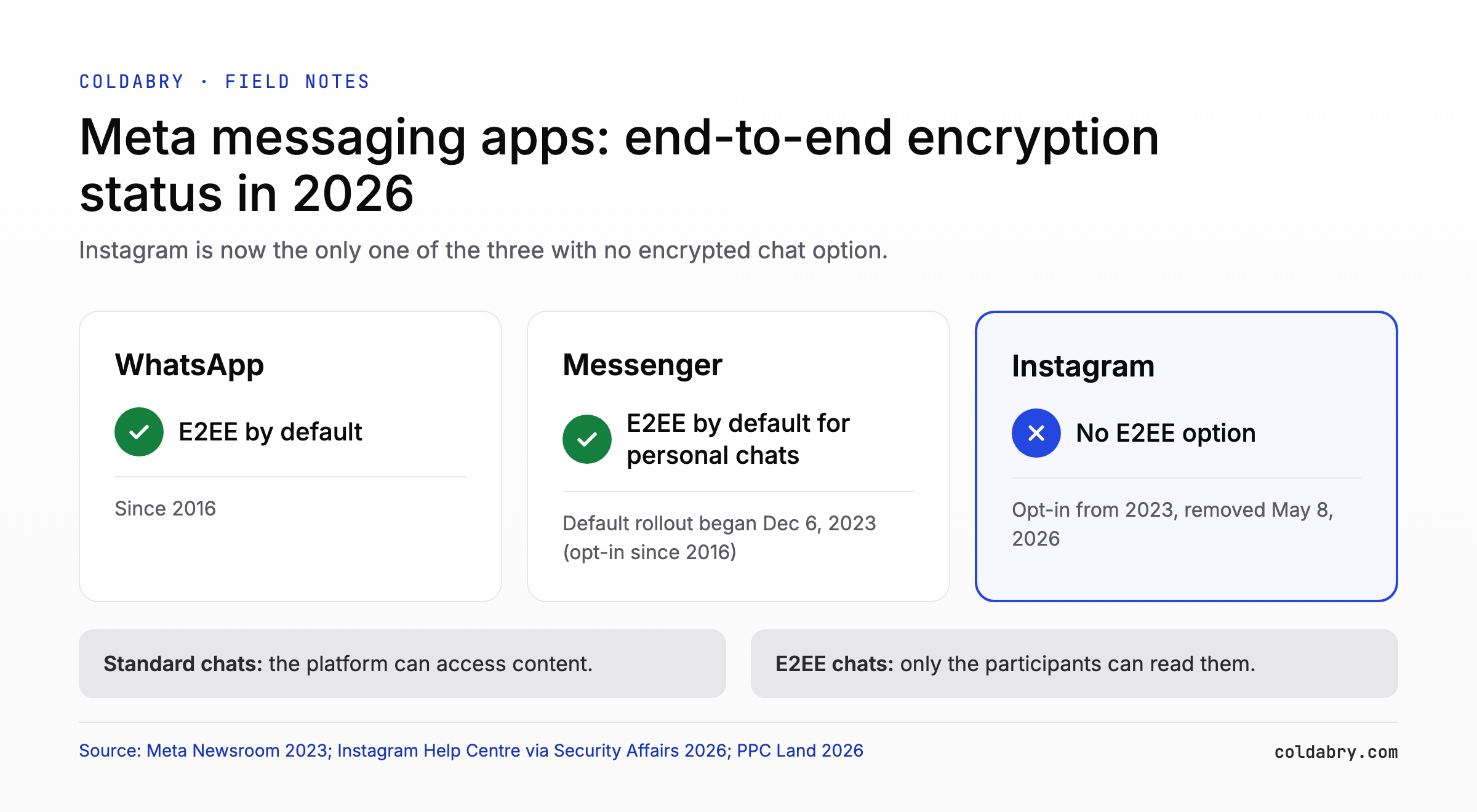
Note: Instagram is now the only one of Meta's three messaging apps with no E2EE option. WhatsApp has been encrypted by default since 2016, and Messenger switched personal chats to default E2EE in a rollout that began in December 2023.
What happened to old encrypted Instagram chats?
Before the cutoff, the Help Centre said: "If you have chats that are affected by this change, you will see instructions on how you can download any media or messages that you may want to keep." It added that people on an older app version "may also need to update the app" before downloading.
What happens to those threads now is not confirmed by Meta, and reports conflict. CyberInsider wrote that after the deadline "the encrypted threads will no longer be accessible". Security Affairs said experts were unsure whether they would become regular chats or become inaccessible. Check your own inbox rather than trusting either report.
Steps to check your account:
- Update Instagram to the latest version from your app store.
- Open Messages and look for threads that carried the "Encrypted" label, usually a second thread with someone you also have a normal chat with.
- Open each one and look for download instructions or a notice about the change.
- If a download is offered, save the media and messages you need.
- Store the export on a local, encrypted drive rather than a cloud folder.
- If a thread is gone or locked, note who it was with and ask that person whether they kept a copy.
Warning: Security Affairs points out that downloaded backups "lose protection if uploaded to cloud services such as Google Drive or iCloud". An export of a formerly encrypted chat is a plain file. Treat it like any sensitive document.
What Instagram end-to-end encryption ending means for businesses and outreach
For business accounts, day-to-day inbox work does not change. Business conversations were almost always standard DMs, because encryption had to be switched on per chat and was limited to some regions. Inbox tools, saved replies and automations that already worked with standard DMs keep working with them.
The bigger shift is in policy. Teams that told themselves "DMs are private" for client work now have no Instagram setting that backs that up. Contracts, IDs, passwords and health details should not travel through Instagram DMs at all. That was true before May 8; now there is no encrypted fallback inside the app.
Now the part we have to label clearly. This is speculation, not a reported fact: with no encrypted threads left, Meta's automated spam and abuse systems could in principle apply to every Instagram DM, which could make cold outreach patterns easier to flag. We have no data showing detection has increased since May 8, and Meta has said nothing about it. Do not plan around this theory, and do not ignore the possibility either.
Cold DM automation was already against Instagram's terms before any of this, and it still is. If you run outreach, read our breakdown of Instagram cold DM tools and their ban risk, keep volumes conservative, and have a recovery plan for what to do if your Instagram account is suspended. For how one outreach setup is structured end to end, see how we built an Instagram outreach engine.
| What your team sends | Keep in Instagram DMs? | Where to move it |
|---|---|---|
| Passwords, logins, 2FA codes | No | A password manager's shared vault or secure share link |
| Contracts, invoices, ID scans | No | Email or an e-signature tool with access controls |
| Sensitive client conversations (health, finances, legal) | No | WhatsApp or Signal, both end-to-end encrypted |
| First contact, lead qualification, booking links | Yes | Instagram DMs, then move the thread once it gets sensitive |
| Creative feedback and public-facing content | Yes | Instagram DMs or your project tool |
Checklist: what to do after Instagram dropped E2EE
Copy this into your team's task tool. It takes an afternoon for a small agency and closes the gaps the change exposed.
| # | Action | Who | When |
|---|---|---|---|
| 1 | Search every team-managed account for threads labelled "Encrypted" and save any offered exports to a local encrypted drive | Account owner | This week |
| 2 | Audit the last 90 days of DMs for passwords, contracts, IDs or health data and delete what should not be there | Each team member, own accounts | This week |
| 3 | Rotate any password or credential that was ever sent in an Instagram DM | Ops lead | Same day as the audit |
| 4 | Write a one-line DM policy, for example: "No credentials, contracts or personal data in Instagram DMs; move it to email or the password manager" | Founder or ops lead | This week |
| 5 | Set up the destinations from the table above: shared vault, e-sign tool, WhatsApp or Signal for sensitive threads | Ops lead | Within 2 weeks |
| 6 | List every third-party tool and person with access to your Instagram inboxes and remove what you no longer use | Account owner | Within 2 weeks |
| 7 | Confirm two-factor authentication is on for every account and that backup codes are stored in the vault | Account owner | Within 2 weeks |
| 8 | Tell clients where sensitive files now go, so they stop sending them over DM | Account managers | Next client touchpoint |
The checklist does not depend on any theory about scanning. It rests on one fact: Instagram no longer offers any encrypted DM option, so the app should not carry anything you would not put in a standard email.
FAQ
Does Instagram have end-to-end encryption?
No. Instagram stopped supporting end-to-end encrypted DMs on May 8, 2026, according to its Help Centre notice. Before that, encryption was an opt-in feature you turned on for each chat under "Privacy and safety", and it was only available in some areas. Meta began rolling it out in 2023. Standard Instagram DMs, which were the default for nearly everyone, were never end-to-end encrypted. If you need encrypted messaging inside Meta's apps today, Meta itself points people to WhatsApp, and Messenger also encrypts personal chats by default.
Why did Instagram remove end-to-end encryption?
Meta's only official reason is low adoption. A Meta spokesperson told The Verge that "very few people" were using encrypted DMs and that anyone who wants end-to-end encryption can use WhatsApp. Meta has not published adoption numbers. Analysts have linked the timing to the Take It Down Act, which required platforms to build enforcement systems by May 19, 2026, and to child-safety pressure such as the Nevada Attorney General's 2024 motion. Meta has not confirmed either link, so treat them as theories.
Can Meta read my Instagram DMs now?
Meta has technical access to the content of standard DMs, and since May 8, 2026 every Instagram DM is a standard DM. If you never switched on encryption, nothing changed for you: your chats were already standard. If you used encrypted chats, those conversations no longer have that protection going forward. Meta has not announced any new use of DM content for ads or AI training, so claims that it will are inferences. The safe assumption: do not send anything in Instagram DMs you would not want the platform to access.
Was end-to-end encryption on by default on Instagram?
No. The Reddit claim is correct. Instagram's end-to-end encryption was never the default. You had to open a chat, tap the person's name, go to "Privacy and safety" and choose "Use end-to-end encryption", which created a separate thread marked "Encrypted". The feature was also limited to some regions. That is why Meta could say "very few people" used it, and why most users saw no difference on May 8, 2026. Messenger and WhatsApp, by contrast, encrypt personal chats by default.
What happened to my old encrypted Instagram chats?
Meta has not confirmed it publicly. Before the cutoff, Instagram said affected users would see instructions to download media and messages, and that older app versions might need an update first. One outlet reported the encrypted threads would no longer be accessible after the deadline; another said experts were unsure whether they would become regular chats or disappear. Update the app and check your inbox for threads labelled "Encrypted". If an export is offered, save it to a local encrypted drive, not a cloud folder.
Are Messenger and WhatsApp still end-to-end encrypted?
Yes. WhatsApp has used end-to-end encryption by default since 2016. Messenger had an optional encrypted mode from 2016 and began rolling out default end-to-end encryption for personal messages and calls on December 6, 2023, a rollout Meta said would take a number of months worldwide. Instagram is now the only one of Meta's three messaging apps without any end-to-end encryption option. For sensitive business conversations, WhatsApp or Signal are the practical choices.
We build custom automations and internal tools that clients own, and we design them on the assumption that Instagram DMs are a standard, unencrypted channel.