A Self-Hosted AI Agent in the Marketing Department: 13 Real Use Cases
Not a $99 CMO-in-a-box. A small VPS, a Telegram bot, and a dozen jobs that quietly remove marketing busywork. The use cases, the stack, and what practitioners actually report.
A post claiming a $99 subscription could replace a $200,000 CMO did about 12 million views on X this spring. Enter a website URL, and a team of agents finds your competitors, drafts your Reddit replies, and writes your SEO articles. The demo looks like magic.
We watched marketers try it. The honest verdict, repeated across teardowns and forums, is consistent: the generic "CMO-in-a-box" is impressive for ninety seconds and useless by Tuesday, because it knows nothing specific about your business. One reviewer who tested the viral tool on two of his own apps put it plainly: it is "very generic and it doesn't fit your specific business needs."
An agent without your tools, your data, and your voice is a chatbot with a marketing skin. An agent wired into all three is an employee for one specific job.
The version that actually earns its keep is less glamorous and far more useful: a small self-hosted agent that lives on a cheap server, that you talk to from Telegram on your phone, that runs a handful of narrow jobs against the tools you already use. We run exactly that pattern internally. This is the playbook.
What "agent" means here
Forget the dashboard. The setup we are describing has four moving parts:
- A runtime on a box you control. A single small Hetzner VPS running the agent in Docker. No per-seat SaaS pricing, no data leaving for a third-party platform you cannot audit.
- One interface: Telegram. You message the bot like a coworker. Voice notes work too. Replies come back in seconds. There is no new app to open and no dashboard to learn.
- Skills. Small, scoped scripts the agent is allowed to call: read the CRM, draft an email, search the web, write to the content backlog. Each skill is a narrow capability with a clear boundary.
- Cron. The same agent runs jobs on a schedule while you sleep. A morning digest at 07:00. A content drop at 08:00. A follow-up nudge at 17:00.
Under the hood it is plain and reproducible: Python skills, Docker Compose, a model like Kimi K2 over OpenRouter for inference, a Cloudflare Tunnel for the read-only web dashboard, and the agent reaching out to Gmail, Google Calendar, your CRM database, and a synced notes vault. Cost is a single small VPS plus pay-per-token model calls measured in fractions of a cent per message.
That architecture is the whole trick. The intelligence is commodity. The value is the wiring.
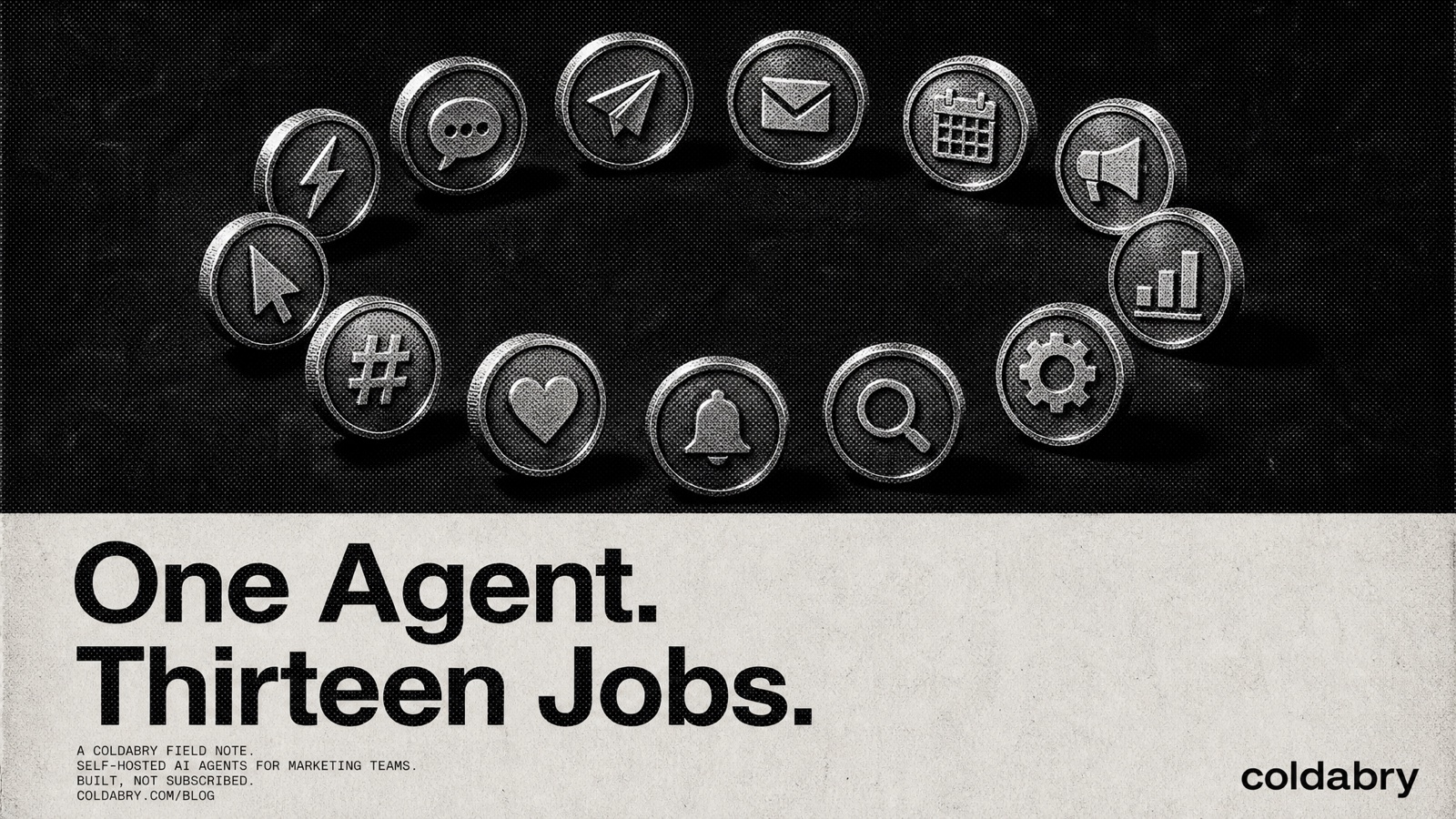
13 real use cases for a marketing team
Grouped by where the time actually goes. Each one is a job a single self-hosted agent can run today, and most map to something practitioners are already doing in the wild.
Content production
1. Morning content-idea drop. A cron job at 08:00 web-searches what is trending in your niche, reads your brand context from a synced notes vault, and pushes three on-brand post ideas to Telegram before your coffee is cold. You reply "expand 2" and it writes the draft.
2. Weekly post batch in your voice. Every Monday the agent drafts a week of LinkedIn or X posts using your past posts and style notes as the voice reference, then drops them as Telegram messages for editing. This is the single most common "scheduled" use we see reported, precisely because it is low-risk: a human still hits publish.
3. Repurpose on command. Paste a long doc, a transcript, or a recorded talk into the chat. Get back five posts, a newsletter blurb, and three cold-open hooks. Marketers on r/content_marketing build standing systems for exactly this, scraping their own and competitors' top-performing content "twice a week" and reshaping it into new formats.
4. Catch the idea before it evaporates. Voice-note an idea while driving. The agent transcribes it and files it straight into your content backlog or knowledge base. The best marketing idea is the one you did not lose between the car and the laptop.
Market and competitor intelligence
5. Daily competitor watch. A cron job checks your rivals' pricing pages, blog, and changelog, and sends a Telegram digest of what changed. One founder described this as already part of his routine: "I run a small SaaS in a category with 7 direct competitors. Tracking their pricing, blog posts, and changelog is part of my morning." The agent does the tracking; he reads the diff.
6. Reddit and community opportunity radar. The agent surfaces threads where your ideal customer is asking the exact question your product answers, then drafts a genuinely helpful, non-spammy reply for a human to approve and post. This is the one good idea inside the viral CMO tools, executed honestly with a person in the loop instead of auto-posting slop.
7. A daily category brief. We already run this pattern in a different domain: a 07:00 job that pulls live data, web-searches the calendar of upcoming events, checks the macro backdrop, and delivers a formatted brief with a clear recommendation. Repoint it at your market and you have a standing intelligence analyst that costs cents a day. Another practitioner built the same shape for a client: an agent that "monitors their key competitor's online activity and sends a report on Slack once a week."
Inbox, calendar, and client ops
8. Inbox triage with drafted replies. "Search unread from clients, draft a reply to the one about the Q3 renewal." The agent uses Gmail search syntax, reads the thread, and writes a draft. Draft-by-default is the safety rule: nothing sends without your review.
9. Follow-up nudges. A 17:00 cron job lists every client you have not messaged in seven or more days, with a suggested follow-up line for each. The deals that die quietly are the ones nobody remembered to chase.
10. Scheduling without the back-and-forth. "Find free time tomorrow afternoon and book a call with the InstaOutreach lead at 10." The agent checks your calendar free/busy and creates the event with an invite.
11. Meeting to action items. Call recordings sync in automatically as notes with extracted action items in your vault, and the agent surfaces them. The follow-ups from a sales or strategy call stop living only in your memory.
Reporting and coordination
12. The one-message morning digest. A single 07:00 Telegram message: today's agenda, unread mail worth knowing about, and your CRM task board (overdue, due today, awaiting approval). Three systems, one glance, no tabs.
13. Delegate and track from your phone. Add, list, move, and comment on tasks on a shared CRM board straight from Telegram, and assign work to people or to other agents. The marketing board stays current without anyone opening the CRM UI.
The pattern across all thirteen: the agent does the grunt work and a human reviews and ships. Nobody on the front lines is running marketing fully end-to-end, and the ones who tried have the burned reputation to prove it.
The tech stack, honestly
No mystery boxes. If you wanted to rebuild this, here is the entire list.
| Layer | What we use | Why |
|---|---|---|
| Runtime | NousResearch Hermes agent, Docker Compose | Self-hosted, conversational, runs unattended cron jobs |
| Model | Kimi K2 via OpenRouter | Fast, multilingual, cheap per token; swap to a reasoning model on command |
| Interface | Telegram bot (allowlisted users) | The whole UI; voice notes included; nothing to install |
| Skills | Plain Python scripts | One narrow capability each, with a hard boundary |
| Data in | Supabase / PostgREST (CRM), Gmail + Calendar APIs | Reads and writes the systems you already run |
| Data out | Brevo (send-only email), Telegram | Drafts and digests land where you already look |
| Context | Synced Obsidian vault, searched with ripgrep | Brand guides, SOPs, client notes, always current |
| Schedule | Native cron, natural-language jobs | "Daily at 8am, summarize follow-ups" becomes a job |
| Ingress | Cloudflare Tunnel + Caddy basic-auth | Private dashboard, no open ports |
| Infra | One small Hetzner VPS | Single-digit-to-low euros a month, fixed |
The fixed cost is one server. The variable cost is model tokens, which for short marketing tasks on a model like Kimi K2 runs to fractions of a cent per message. You add zero new SaaS seats, because the agent plugs into the email, calendar, and CRM you are already paying for.
What practitioners actually say
We went looking for unvarnished experience rather than vendor copy. The signal is remarkably consistent.
On where the money is, from a builder with eighteen months of shipping custom agents for businesses: the value is not in "AI agents" as a buzzword, it is in solving "simple, real" problems. The teams getting paid back are automating one boring, repeated, rule-shaped task, not buying a magic platform.
On the boundary of autonomy, from r/productivity: "AI does the grunt work and you review and move on. Fully end to end only works when the process is very clear and low risk, like daily posts." Human-in-the-loop is not a limitation to engineer away. It is the design.
On the hype itself, from r/b2bmarketing: "AI agents are simply a tool, so in the context of game-changing, yes likely just hype." The marketers who are happy are the ones who set the expectation at "tool," not "replacement."
And on where to start, the most upvoted practical advice for standing up a marketing agent is almost boringly grounded: feed it your offer, your customer notes, your past posts, and your competitor list first. Context beats cleverness. The same teardown of the viral CMO tool reached the identical conclusion: skip the generic preset, "automate the things that work," and build on top of a capable general agent instead.
Greg Isenberg's framing for this shift is "vibe marketing": a single smart marketer with AI agents and workflows doing what a roomful of specialists used to. The leverage is real. The teams realizing it are the ones who wired the agent into their actual business, not the ones who pasted a URL into a dashboard.
What not to automate
The failure modes are as consistent as the wins, and they are worth more than the wins because they are expensive.
- Anything you cannot review at the speed it runs. If an agent posts faster than a human can sanity-check, it will eventually post something that hurts the brand. Auto-posting to social was the single most regretted automation in the threads we read.
- Irreversible actions with no human gate. "Organize my inbox" sounds harmless until emails you needed are filed somewhere you will never find them. Send, delete, and publish stay behind a person.
- A process you have not done by hand enough to know works. You cannot automate your way to a strategy you do not have. Automate the workflow that already produces results, then let the agent run it more often.
- The generic everything-tool. The CMO-in-a-box is seductive because it promises to skip the wiring. The wiring is the entire value. Skip it and you get plausible, on-brand, completely generic output that moves no needle.
Start this weekend
You do not need the full thirteen jobs to get value. You need one.
- Pick the single most repetitive thing your marketing team does that is high-volume, rule-shaped, and eats senior time. The morning digest or the weekly post batch are the usual first wins.
- Give the agent real context. Your offer, your voice samples, your competitor list, your brand notes. Twenty minutes here outperforms any amount of prompt cleverness.
- Wire one tool and one schedule. Connect the inbox or the CRM, set one cron job, keep a human on the approve button.
- Measure the hours it gives back. If the first automation does not save real time within a few weeks, you picked the wrong process, not the wrong technology.
The marketers winning with AI right now are not the ones who bought the loudest tool. They are the ones who put a cheap, narrow, well-wired agent next to a human who still makes the calls. That is a build, not a subscription, and it is well within reach.
If you want one stood up for your team, that is the kind of thing we build.
Sources and further reading
- "Can AI Agents ACTUALLY Replace your Marketing Team? Here's the Honest Truth" — teardown of the viral $99 CMO tool, Build Great Products
- Greg Isenberg on "vibe marketing"
- r/AI_Agents: "I built a competitive intelligence agent"
- r/AI_Agents: "Tried 5 agent platforms for daily competitor monitoring"
- r/content_marketing: "Content repurposing based on competitors' top performing content"
- r/productivity: "How are people actually using AI agents for real work?"
- r/AI_Agents: "AI Agents truth no one talks about"
- r/AI_Agents: "Best AI Agent for setting up a Marketing team"